22 Bahman as COIN

Crossposted at Secure Nation.

So in addition to using their Chinese-made riot trucks and gas attacks on the protesters, the Iranian security forces were able to quell much of the 22 Bahman uprising by simply relying on the weakness of the movement’s organizational structure. Letting the enemy defeat itself; very Art of War. The very lack of hierarchy in the green movement was both a blessing and a curse. From Foreign Policy:

Like many of the green movement activists, Sadeghi’s belief in the protests seems related to their “horizontal organization,” the fact that they were structured without hierarchies. This was supposed to be the great strength of the movement, but it is also an abiding weakness. A horizontal organization can’t clearly delineate different roles to different people according to their strengths; it can’t reward those who participate, or sanction those who hesitate. Facebook enabled many young Iranians to forget these points.

Now obviously the Taliban is not organizing via Facebook, but the principle of decentralization is the same. Avoid having a center of gravity, put together your demonstrations (attacks) at the last possible minute; coordinate, execute, and then melt away into the night. But if the Iranian green movement using the same principles was successfully put down, does this offer us a rubric for approaching insurgencies?
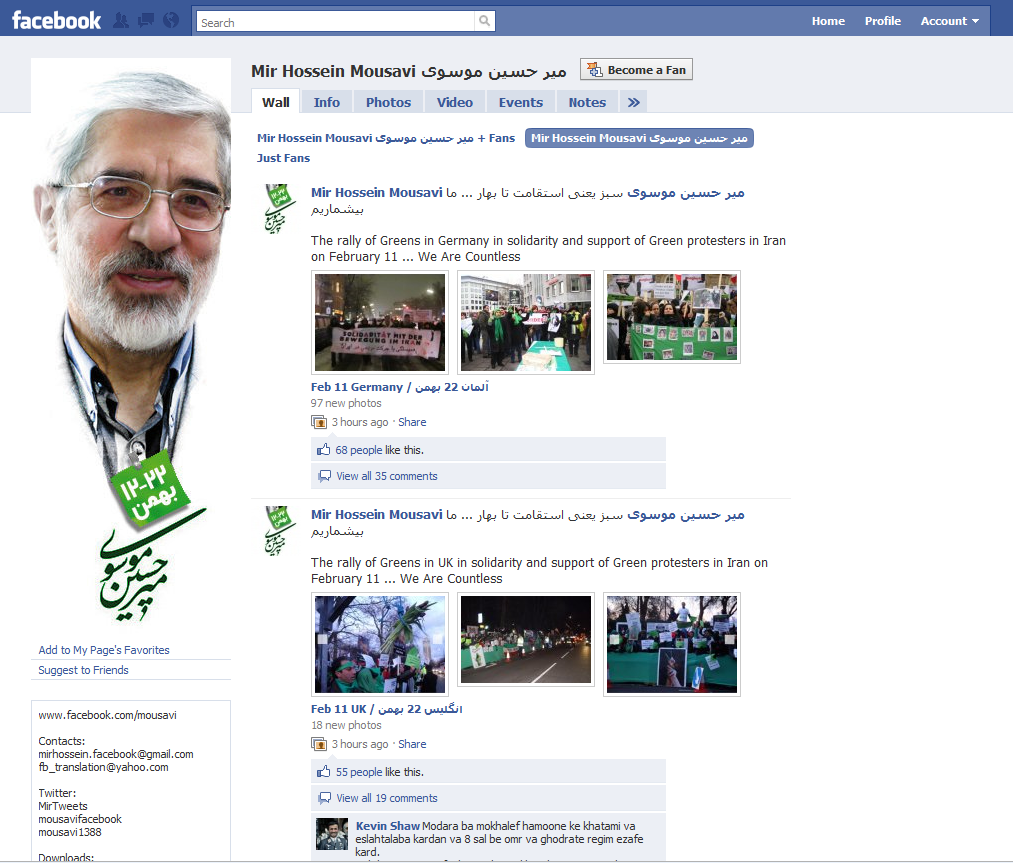
Mir Hossein Mousavi's Facebook page.

The short answer is probably not. The Taliban is not planning its operations through Facebook or tweets. But the reason the Revolutionary Guard so effectively shut down the protests was by blocking access to means of communications; that is to say the internet. No Gmail, no Facebook, no twitter meant that there was no coordination between demonstrators, nor was there a way to quickly spread the word of crackdowns in a particular area. The networks used by the Taliban for communication are more dispersed, making a system-wide shutdown more difficult. Walkie-talkies and satellite phones are the order of the day, and while we can intercept calls, we cannot easily end them. Even if we did, human couriers would merely proliferate further.

Also worth keeping in mind is the psychological element. The pushback given by the Iranian regime was demoralizing and a clear setback for the movement, slowing momentum and further progress. Presumably more than one green movement adherent changed his colors, or at least plans to lay low thanks to the IRG. But when ISAF and the United States attempt to stop the movement (the Taliban), it disperses them without costing the Taliban anything. Most of the Iranian protesters were relatively concentrated – do we need to herd Taliban fighters into a single killing zone? And is the Battle for Marjah a step in that direction?

Accompanied by a Wry Signoff

Does anyone still watch news? I find myself more and more turning towards online text. With the possible exception of The Onion, video news is a total waste of time. There are so many ways to obscure your lack of a point with video, the vast majority of which usually ends up as meaningless. On Newswipe, Charlie Brooker explains “how to report the news,” beginning with that lackluster establishing shot (via Disinformation).

With Open Arms

Admiral Michael Mullen, Chairman of the Joint Chiefs of Staff.

I’ve meant to talk about it sooner, but it wasn’t until I saw some particularly egregious arguments that I was spurred to action. Don’t Ask, Don’t Tell absolutely needs to be repealed. First announced at the State of the Union address, Defense Secretary Bob Gates and JCS Chairman Admiral Mike Mullen continued to call for it at a press conference later that week. Admiral Mullen’s comments – declaring the current policy as detrimental to the military’s integrity – are particularly noteworthy:

No matter how I look at this issue, I cannot escape being troubled by the fact that we have in place a policy which forces young men and women to lie about who they are in order to defend their fellow citizens. For me, it comes down to integrity — theirs as individuals and ours as an institution. I also believe that the great young men and women of our military can and would accommodate such a change. I never underestimate their ability to adapt.

We would also do well to remember that this is not an issue for the military leadership to decide [emphasis mine].

Continue reading

Recommended Reading (2010-02-11)

Back on Track?: Jobs lost per month between December 2007 and January 2010 (via GOOD).

In any world menu, Canada must be considered the vichyssoise of nations — it’s cold, half-French, and difficult to stir.

Stuart Keate

As Iran prepares for today’s festivities…

– Moscow seems surprised that the world gets a bit nervous when Russians start talking about reenacting Red Dawn.

– And if you weren’t yet feeling nostalgic for the Cold War… that’s okay, because we may be on the verge of a new one with China. And it’s the Chinese who say so.

– Nate Silver crunches the numbers and possible scenarios for a 2012 Palin bid in the Republican primary. There are many more avenues open than I care to see.

– A nifty little overview is available at Howstuffworks on snipers. More detailed than I thought it would be.

The Liberal from Lufkin

Charlie Wilson died today. From my limited knowledge (basically a book and a film), I’ve developed a deep admiration for the man. To some extent his death is part of the passing of an era, for better or for worse. But this country will surely miss him. Bob Gates writes a fitting farewell. We’re still picking up the pieces, as Charlie always wanted.

I had the unforgettable experience of knowing Congressman Wilson when I was at CIA and he was working tirelessly on behalf of the Afghan resistance fighting the Soviets.  As the world now knows, his efforts and exploits helped repel an invader, liberate a people, and bring the Cold War to a close.  After the Soviets left, Charlie kept fighting for the Afghan people and warned against abandoning that traumatized country to its fate — a warning we should have heeded then, and should remember today.

America has lost an extraordinary patriot whose life showed, once more, that one brave and determined person can alter the course of history.

Amen, Mr. Secretary. Good-Time Charlie, we hardly knew you.

Down That Road Again

If you thought the LSE (and Britain in general) was bad at curbing extremism and hatred (and I do, see here, here, and here), then Oxford University will knock your socks off. From The JC:

Israel’s Deputy Foreign Minister was met by a protester screaming “slaughter the Jews” as he spoke at the Oxford Union.

Antisemitic and anti-Israel abuse was shouted throughout Danny Ayalon’s speech on Monday evening, with students causing numerous disruptions to the event.

During the hour-long session one student ran towards Mr Ayalon shouting the Arabic phrase “Itbah Al-Yahud” [Slaughter the Jews].

As many as 10 others, carrying Palestinian flags, made attempts to attack Mr Ayalon but were intercepted and removed by security.

Unlike when Ayalon spoke at LSE, the administration in this situation sprang to his defense as a speaker and contributor of ideas. No faculty petitions up north (to my knowledge). In their statement (PDF), the Oxford Union said:

Whilst the vast majority of the audience behaved in an orderly and responsible fashion, some members continually interrupted the speech, and one individual in particular appears to have made a directly anti-Semitic remark. These individuals exceeded the principles of free speech that the Society upholds…

…This morning, the Union’s President launched an investigation aimed at identifying the
Members who disrupted the event. The Union will be taking disciplinary action against these
Members, in accordance with the Society’s rules…

…The Oxford Union believes in the rights of free speech and protecting our invited speakers’ ability to express themselves in an orderly and disciplined environment…

…Last night was unprecedented. A disorderly minority disrupted and prevented the speaker from holding the floor where he had been invited to speak.

It’s nice to see an apology, or even an admission that something at the event had not gone as planned. Certainly no such statement was issued at LSE. Because what’s the point of debating when you can just wave your flags, shout some cheers, and win the argument? You don’t even need to make a point.

It’s a perfect storm of the western recoil, its love for countries-in-waiting (see: the Free Tibet movement), and willingness to attend a rally. I really do feel for Ayalon and any other Israeli officials who seek to engage in a back-and-forth with the community in Britain. It won’t do a thing: the minds of this country are made up.

Iran and the SCO

The Shanghai Cooperation Organization (SCO) may soon expand to include Pakistan, and more importantly Iran. Iran is already an observer nation, but full-fledged membership would definitely have a big impact on the region, as well as any future role for the SCO. Larison disagrees:

Granting Iran membership would be seen in the West as a provocative move, but a good question is why anyone should be provoked by it. The SCO is not a full-fledged military alliance or defensive pact, and it has existed primarly as a mechanism to consolidate Russian and Chinese political and economic influence in Central Asia. At the moment, it is a limited security and economic structure.

This is all true – the SCO isn’t even on par with the CIS or other limited regional IGOs. But seeing as one of the main purposes of the organization is to provide China and Russia a multilateral forum for pressuring much of Central Asia, this only increases their ability to do so. I think the way to look at this isn’t so much as Iran gaining influence and legitimacy, but rather another big country on the periphery of Central Asia able to provide additional leverage for Russia and China. A shrinking of Central Asian security.

But the most interesting wrinkle might be that for Iran it can’t be about oil, unless they know something about their reserves we don’t. Larison’s observation that it’s Russia pushing for Iranian membership with the Chinese more reluctant points to some interesting energy politics. Could Russia be looking at Iran as their Kazakhstan?

The Bombing of Auschwitz

A consolidated B-24 Liberator of the 15th A.F. releases its bombs on the railyards at Muhldorf, Germany on 19 March 1945.

Via Blog Them Out of the Stone Age:

What if the Allies had bombed Auschwitz? That’s the counterfactual Mark Grimsley poses in his brief, but intriguing piece for World War II magazine (article at BTOSA). As he admits, “most ‘what if’ scenarios begin with a plausible rewrite of a historical event. The bombing of Auschwitz does not have this characteristic.” A strike on the death camps was not seriously discussed at high levels, much less considered a viable option.

It was certainly possible to launch such an attack:

The Auschwitz complex was well within range of the U.S. Fifteenth Air Force, based at Foggia, Italy … By the summer of 1944, escapees from Birkenau had supplied the Allies with detailed, accurate information about the facility. The crematoria and gas chambers could be readily identified in aerial photographs.

Owing to political considerations and the diversion of “considerable air support” that targeting the camps would require, a raid was never launched. Debate has raged for thirty years whether or not it was a moral imperative to attack the camps, but simply put, it was absolutely within Allied strategic air capabilities.

Continue reading

Recommended Reading (2010-02-09)

Rest in peace, John Murtha.

– Being educated can now be scientifically equated with holding more liberal views. Seriously, that absolutely depends on where you went to school. Condemnation from a student group like SDS can have the opposite effect (via GOOD).

– The Danger Room raises the capabilities VoIP services have for embedding confidential data. Skype: espionage abettor?

Hitchens v. Vidal, round three. Vidal’s “small anthology of half-argued and half-written shock pieces [which] either insinuated or asserted that the administration had known in advance of the attacks” was just an attempt to be “playful,” writes a defender.

– International high politics: NSFW. Pepsi brings your ancestors back from the dead!

The End of COIN?

Maj. General Rick Nash tries his hand at camel riding during a visit to the Sa’adoun tribe confederation land.

Last month, the zenpundit (Mark Safranski) came up with a startling idea: “The Post-COIN Era is Here.” The idea, while revelatory, is definitely worth consideration. The modern timescale for adopting and conceiving new doctrine has shrunk from the decades it used to take to only a few short years – both a blessing and a curse. On the plus side is the ability to shift rapidly from a failed strategy to one which stands a chance of succeeding, saving time and lives that would otherwise be wasted. At the same time, an untested new idea runs the risk of failing, in perhaps even more spectacular fashion.

It was fairly clear, then, that something would have to give way after the abyss into which Iraq plunged the first few years after invasion. Safranski lays down three main reasons for the initial adoption of COIN:

1) The  ”Big Army, fire the artillery, fly B-52’s and Search & Destroy=counterinsurgency” approach proved to be tactically and strategically bankrupt in Iraq. It failed in Mesopotamia as it failed in the Mekong Delta under Westmoreland – except worse and faster. Period.

2) The loudest other alternative to COIN at the time, the antiwar demand, mostly from Leftwing extremists, of immediately bugging-out of Iraq, damn the consequences, was not politically palatable even for moderately liberal Democrats, to say nothing of Republicans.

3) The 2006 election results were a political earthquake that forced the Bush administration to change policy in Iraq for its’ own sheer political survival. COIN was accepted only because it represented a life preserver for the Bush administration.

Continue reading