Down That Road Again

If you thought the LSE (and Britain in general) was bad at curbing extremism and hatred (and I do, see here, here, and here), then Oxford University will knock your socks off. From The JC:

Israel’s Deputy Foreign Minister was met by a protester screaming “slaughter the Jews” as he spoke at the Oxford Union.

Antisemitic and anti-Israel abuse was shouted throughout Danny Ayalon’s speech on Monday evening, with students causing numerous disruptions to the event.

During the hour-long session one student ran towards Mr Ayalon shouting the Arabic phrase “Itbah Al-Yahud” [Slaughter the Jews].

As many as 10 others, carrying Palestinian flags, made attempts to attack Mr Ayalon but were intercepted and removed by security.

Unlike when Ayalon spoke at LSE, the administration in this situation sprang to his defense as a speaker and contributor of ideas. No faculty petitions up north (to my knowledge). In their statement (PDF), the Oxford Union said:

Whilst the vast majority of the audience behaved in an orderly and responsible fashion, some members continually interrupted the speech, and one individual in particular appears to have made a directly anti-Semitic remark. These individuals exceeded the principles of free speech that the Society upholds…

…This morning, the Union’s President launched an investigation aimed at identifying the
Members who disrupted the event. The Union will be taking disciplinary action against these
Members, in accordance with the Society’s rules…

…The Oxford Union believes in the rights of free speech and protecting our invited speakers’ ability to express themselves in an orderly and disciplined environment…

…Last night was unprecedented. A disorderly minority disrupted and prevented the speaker from holding the floor where he had been invited to speak.

It’s nice to see an apology, or even an admission that something at the event had not gone as planned. Certainly no such statement was issued at LSE. Because what’s the point of debating when you can just wave your flags, shout some cheers, and win the argument? You don’t even need to make a point.

It’s a perfect storm of the western recoil, its love for countries-in-waiting (see: the Free Tibet movement), and willingness to attend a rally. I really do feel for Ayalon and any other Israeli officials who seek to engage in a back-and-forth with the community in Britain. It won’t do a thing: the minds of this country are made up.

Iran and the SCO

The Shanghai Cooperation Organization (SCO) may soon expand to include Pakistan, and more importantly Iran. Iran is already an observer nation, but full-fledged membership would definitely have a big impact on the region, as well as any future role for the SCO. Larison disagrees:

Granting Iran membership would be seen in the West as a provocative move, but a good question is why anyone should be provoked by it. The SCO is not a full-fledged military alliance or defensive pact, and it has existed primarly as a mechanism to consolidate Russian and Chinese political and economic influence in Central Asia. At the moment, it is a limited security and economic structure.

This is all true – the SCO isn’t even on par with the CIS or other limited regional IGOs. But seeing as one of the main purposes of the organization is to provide China and Russia a multilateral forum for pressuring much of Central Asia, this only increases their ability to do so. I think the way to look at this isn’t so much as Iran gaining influence and legitimacy, but rather another big country on the periphery of Central Asia able to provide additional leverage for Russia and China. A shrinking of Central Asian security.

But the most interesting wrinkle might be that for Iran it can’t be about oil, unless they know something about their reserves we don’t. Larison’s observation that it’s Russia pushing for Iranian membership with the Chinese more reluctant points to some interesting energy politics. Could Russia be looking at Iran as their Kazakhstan?

The Bombing of Auschwitz

A consolidated B-24 Liberator of the 15th A.F. releases its bombs on the railyards at Muhldorf, Germany on 19 March 1945.

Via Blog Them Out of the Stone Age:

What if the Allies had bombed Auschwitz? That’s the counterfactual Mark Grimsley poses in his brief, but intriguing piece for World War II magazine (article at BTOSA). As he admits, “most ‘what if’ scenarios begin with a plausible rewrite of a historical event. The bombing of Auschwitz does not have this characteristic.” A strike on the death camps was not seriously discussed at high levels, much less considered a viable option.

It was certainly possible to launch such an attack:

The Auschwitz complex was well within range of the U.S. Fifteenth Air Force, based at Foggia, Italy … By the summer of 1944, escapees from Birkenau had supplied the Allies with detailed, accurate information about the facility. The crematoria and gas chambers could be readily identified in aerial photographs.

Owing to political considerations and the diversion of “considerable air support” that targeting the camps would require, a raid was never launched. Debate has raged for thirty years whether or not it was a moral imperative to attack the camps, but simply put, it was absolutely within Allied strategic air capabilities.

Continue reading

Recommended Reading (2010-02-09)

Rest in peace, John Murtha.

– Being educated can now be scientifically equated with holding more liberal views. Seriously, that absolutely depends on where you went to school. Condemnation from a student group like SDS can have the opposite effect (via GOOD).

– The Danger Room raises the capabilities VoIP services have for embedding confidential data. Skype: espionage abettor?

Hitchens v. Vidal, round three. Vidal’s “small anthology of half-argued and half-written shock pieces [which] either insinuated or asserted that the administration had known in advance of the attacks” was just an attempt to be “playful,” writes a defender.

– International high politics: NSFW. Pepsi brings your ancestors back from the dead!

The End of COIN?

Maj. General Rick Nash tries his hand at camel riding during a visit to the Sa’adoun tribe confederation land.

Last month, the zenpundit (Mark Safranski) came up with a startling idea: “The Post-COIN Era is Here.” The idea, while revelatory, is definitely worth consideration. The modern timescale for adopting and conceiving new doctrine has shrunk from the decades it used to take to only a few short years – both a blessing and a curse. On the plus side is the ability to shift rapidly from a failed strategy to one which stands a chance of succeeding, saving time and lives that would otherwise be wasted. At the same time, an untested new idea runs the risk of failing, in perhaps even more spectacular fashion.

It was fairly clear, then, that something would have to give way after the abyss into which Iraq plunged the first few years after invasion. Safranski lays down three main reasons for the initial adoption of COIN:

1) The  ”Big Army, fire the artillery, fly B-52’s and Search & Destroy=counterinsurgency” approach proved to be tactically and strategically bankrupt in Iraq. It failed in Mesopotamia as it failed in the Mekong Delta under Westmoreland – except worse and faster. Period.

2) The loudest other alternative to COIN at the time, the antiwar demand, mostly from Leftwing extremists, of immediately bugging-out of Iraq, damn the consequences, was not politically palatable even for moderately liberal Democrats, to say nothing of Republicans.

3) The 2006 election results were a political earthquake that forced the Bush administration to change policy in Iraq for its’ own sheer political survival. COIN was accepted only because it represented a life preserver for the Bush administration.

Continue reading

Recommended Reading (2010-02-08)

WHO DAT NEW ORLEANS!

– We didn’t think we’d go out like this. Krugman: “Instead of re-enacting the decline and fall of Rome, we’re re-enacting the dissolution of 18th-century Poland.”

– Politics and football: as American as global power projection. America Bowl breaks down the relationships: 44 presidents, 44 Superbowls (via Andrew Sullivan).

– Since winning an election, Hamas has been unable to govern responsibly. Or really govern at all. Michael Herzog in Foreign Affairs:

Constantly torn between its ideology as an Islamist jihadi movement and its responsibilities as a governing authority in the Gaza Strip, Hamas has proven unwilling to transform itself. The result has been an ongoing ideological and political crisis for Hamas and, more generally, the Palestinian Authority.

– The Air Force is canceling new systems left and right across the board and turning to old models with life extensions, such as the C-17, C-5, and the HH-60 for CSAR operations. War is Boring lays out why the CSAR-X cancellation probably isn’t a good thing.

For Love of Country, Part V

Part 5 of a 5-part series.

On behalf of France, La Coloniale and the Armée d’Afrique performed admirably in both combat and occupation duties during World War I.

The French Africans who served in Europe came from all across the empire—Tirailleurs from Senegal, spahis from Tunisia and Algeria, and goums from Morocco, 175,000 in all. Other local regiments of Tirailleurs from equatorial French Africa were in turn deployed to the French colonial possessions in North Africa, and many others (about 160,000 in total) joined the Armée Métropolitaine in France on an ad hoc basis.

Moroccan goums, 1914.

In combat, the colonial troops proved themselves beyond a shadow of a doubt. Many succumbed to the illnesses brought on by the radical change of climate, and for the most part, the harsh European winters meant that the African units would winter in the south of France. To some, this was reason enough to doubt the effectiveness of Africans in combat, but it was always ignored that these ‘deficiencies’ had nothing to do with the fighting skill of men from the tropics.

Continue reading

Recommended Reading (2010-02-07) – SUNDAY Edition

Chinese digital camouflage variants, part of a great collection of global camo uniforms at Strike - Hold!

I have so often seen how people come by the name of genius; in the same way, that is, as certain insects come by the name of millipede — not because they have that number of feet, but because most people won’t count up to fourteen.

Georg Christoph Lichtenberg

– I’ve railed a number of times against the seemingly-necessary dumbing down of politics and mass communication. But it turns out that it might be stupidity on a subconscious level rather than a conscious one. Easy = true?

– However, Jacob Weisberg at Slate agrees with my original hypothesis: people are stupid.

– Food for thought: our entire universe might be a giant hologram.

Continue reading

An Island Apart

Muslims protest Geert Wilders' appearance before Parliament, October 2009.

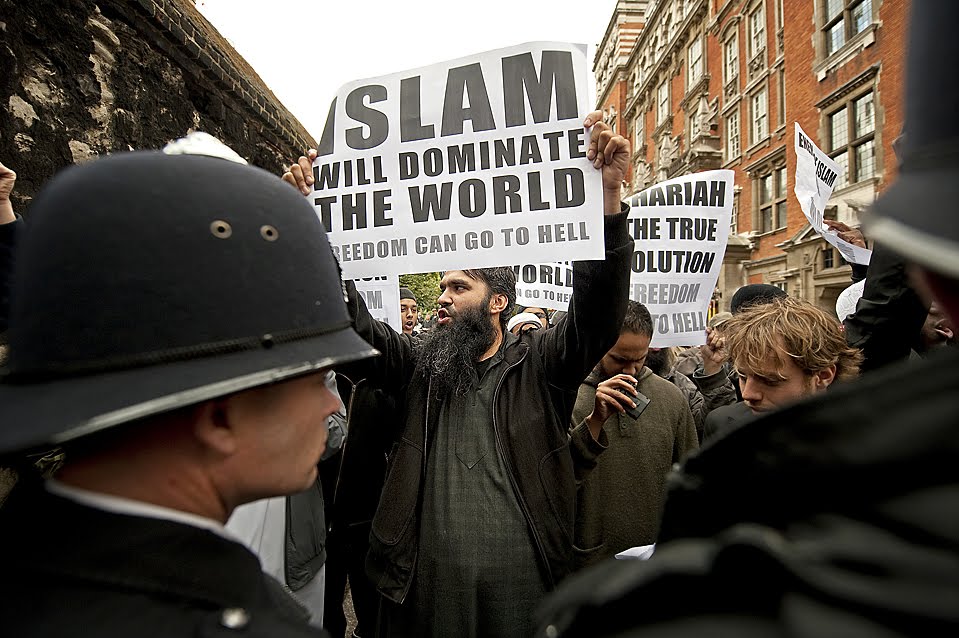
Something’s gotta give. No, seriously. Finally backlash seems to be mounting against the British government’s tolerance for extremist organizations (provided, of course, that they are Muslim). The trend is especially present in universities, however, where the constant mantra of “free speech” has somehow blocked out all voices, such as the BNP and others, with the sole exception of any Islamic or Muslim society.

The Christmas Pants Bomber has prompted a new bout of soul-searching as the west attempts to decipher the source of radicalization. Nigerian Nobel Laureate Wole Soyinka perhaps made the loudest and boldest claim, laying blame on Britain (“a cesspit“) – and not Nigeria – for the pants bomber’s radicalization.

Continue reading

For Love of Country, Part IV

Part 4 of a 5-part series.

World War I was more global in scope than is often realized.

World War I belligerents; Allies are green, Central Powers orange, and non-aligned are gray.

The colonial forces of both Britain and France were tried and tested in theaters throughout the globe, perhaps most surprisingly in India itself. Thanks to the Anglo-Japanese Pact of 1902 there was no direct threat across the frontier – as the Japanese would pose in World War II – but the fighting in the  Middle Eastern theater often spilled over in the Punjab, and nationalist revolts there and in Bengal threatened to destabilize the Raj. In Mesopotamia, there were three mutinies by Muslim soldiers unwilling to fight their fellow believers, but for the most part native troops remained unwaveringly loyal. Even the horrific casualties in the various African campaigns did not dissuade colonial troops from fighting alongside their occupiers and preserving their own subjugation.

Continue reading