But They Knew Where the Keys Were

Even if they misplaced the tanks themselves. From the Telegraph:

‘There are tanks all over the forest, abandoned,’ an unnamed reporter on the video says. ‘If you need one, come and get it.’

Locals in a nearby village said the tanks had been sitting there for almost four months covered in snow. The armoured vehicles were identified as a mixture of T-80 and T-72 battle tanks, the workhorses of the Russian army.

Who has time to worry about where they left an entire armored regiment’s worth of tanks? What with the nation-state collapsing anyways and all manner of intrigue on every conceivable frontier… Or are the Russians early adopters of the “tanks do not equal power projection” school?

Transatlanticism

Daniel Korski’s new article in Foreign Policy, “Partners in Decline,” calls for a renewed US-European relationship, as a way of staving off marginalization at least for a while. It’s kind of hard to discern his point – clearly at this point, Europe needs the US far more than the US needs Europe. True, NATO is a force of legitimacy right now, but if the demographic trends Korski points to as signs of decline continue, won’t it begin to lose that legitimacy as it becomes less and less representative of any significant proportion of global population?

Korski also misinterprets history. He asks us to

Imagine if the United States had in the past chosen its allies exclusively on whether they were willing to fight alongside the 82nd Airborne. That would have meant abandoning an alliance with Britain in 1966 after then-Prime Minister Harold Wilson refused to send British troops to the Vietnam War.

Is there some sort of treaty or piece of paper we would have torn up? Aside from the (predominantly cultural) Special Relationship – which certainly was damaged for most of the 70s until the Reagan-Thatcher revival – Britain’s refusal to commit troops to Vietnam was no more than a disagreement between longtime global partners. There was no real ‘alliance’ to end as a response but even that informal alliance was seriously damaged.

I wouldn’t go so far as to advocate an American withdrawal from NATO (as Andrew Bacevich does), but at the same time it is perhaps on an even steeper path to irrelevancy than Europe and the United States themselves. Korski’s argument is in itself contradictory, as his prescription for waning influence just reemphasizes the extent of Western decline. And like all other nation-states, it is an inevitable collapse.

Reliving the Past

As Herbert Butterfield warns us and as I’ve mentioned here before, past performance is no guarantee of future results.  I was then pleased to read Patrick Porter’s latest column, “The Shadow of the Fathers.” He writes about invocations of the Founding Fathers as justification for all manner of… anything, really. To him, American policymakers have “the tricky job of acknowledging the powerful ideas and heritage that shaped American statecraft, while also resisting it.”

Perhaps my favorite line in the piece, though, belonged to Nicholas Spykman:

Not conformity with the past but workability in the present is the criterion of a sound policy.

Words for today.

Abdication

The grim future of a world without net neutrality

The government won’t push for it. The existing near-monopolies have no incentive to change. So who steps up? Google, of course. Google’s plan to offer internet services at the blisteringly-fast speeds of up to 1 GB/s could finally revolutionize the American broadband network. As a bottleneck for innovation, the archaic state of internet infrastructure obviously needs improvement. South Korea leads the world in internet speeds, with a 100 Mbps fiber optic line scheduled to come online nationwide this year. The United States didn’t make the top ten – it was 18th in the world with an average speed of 3.9 Mbps.

But no one will act (even though Google’s been prodding telecom companies), and the government won’t push anyone to act.

The risks of lagging behind are comparable to net neutrality in terms of stifling new developments, which is why it may seem weird to call for more regulation. But the regulation that would help only need set a baseline for acceptable quality and service.

This kind of wide push for faster internet service works on a number of levels:

  1. It allows for new growth, research, and innovation.
  2. It keeps the U.S. on equal footing with the rest of the world.
  3. It allows us to avoid ridiculously hyperbolic nightmare scenarios like the “bandwidth caps” Mark Cuban envisions (and I won’t even begin to take apart his prediction of our computerless-future).
  4. New infrastructure work, especially as part of a comprehensive federal plan, will a) allow/mandate simultaneous rural development, always a must in the expanse of the United States, and something any corporation is loathe to take on of its own volition (the per capita subscription rate really can’t justify it, but thanks to equal representation in the Senate is a necessity nonetheless), and b) create jobs. Let’s also not forget those 93 million Americans without broadband access at all, whom Cuban’s market-based solutions have clearly left behind.

As Google is proving though, the federal government has little interest in sweeping technology improvements across the country. A Reaganesque privatization this is not. The government has merely ceded responsibility to the private sector yet again.

One Man’s Malaise is Another’s Motivation

We’ll see if I can’t get up and running more regularly, but this is such an accurate quote to describe the lack of anything being undertaken in Congress that I needed to risk another meltdown:

Members of Congress—including seven Republicans who had proposed the idea—were even too chicken to vote for a bipartisan commission. This is the political equivalent of being too timid to take a nap.

I’ve jury-rigged the laptop to work in spurts while I wait for my backup to get sent, so I’ll have a semi-regular selection of new material for you. But hell, this one post alone has made my week more productive than the United States Congress.

Marjah

Lance Cpls. Keith B. Lawson and Spence G. Press, scout snipers attached to Charlie Company, 1st Battalion, 3rd Marine Regiment, work together to identify targets as Taliban fighters approached from Marjeh toward their position at the “Five Points” intersection Feb. 9, 2010.

Last night, the American, British, and Afghan assault on Marjah began. 6,000 soldiers were in the initial wave, and another 15,000 have been committed to rooting out Taliban-aligned elements operating in the area. Early reports have five Taliban fighters and one British soldier killed.

Resistance has been “light.”

In the run-up to the attack, there was no shortage of criticism over the advance warning given, the stated objectives, and even the target of Marjah itself. It was certainly well-founded. Registan argued that the strategic value of Marjah was limited at best and that the amount of opium production in the area was overstated, while Wired characterized the Coalition heads-up as asking residents to “please, please, pretty please don’t leave the warzone.” But everyone may be wrong about the purpose (or at least the timescale) of fighting in Marjah altogether. From Free Range International:

When the Marines crossed the line of departure today, the battle for Marjah had already been won.

Like a master magician General Nicholson mesmerized the press with flashy hand movements to draw attention away from what was important.  The press then focused on the less important aspects of the coming fight.  Just like a magic show the action occurred right in front of the press in plain view yet remained out of sight.

In an unparalleled combination of regular and special forces units, the real conflict over Marjah was conducted mostly behind the scenes. It’s too early to say for sure, but the FRI analysis sure does raise some interesting points. If the goal was to convince the Taliban (and not the civilian inhabitants of Marjah) to leave, doesn’t that just allow them to escape and regroup? (i.e., what’s the point?) Obviously avoiding civilian casualties is of huge concern, but there still seems to be a disconnect over goals and methods.

Conversely, even if everything is going as planned and the Taliban bugs out, “somebody has to do the hold and build – it is not fair or smart to put that burden on the 2nd MEB.” Absolutely. I can’t help but wonder how thoroughly the post-battle plan was thought out.

Either way, at this point nothing to do but play the waiting game. Now let’s see how this plays out.


22 Bahman as COIN

Crossposted at Secure Nation.

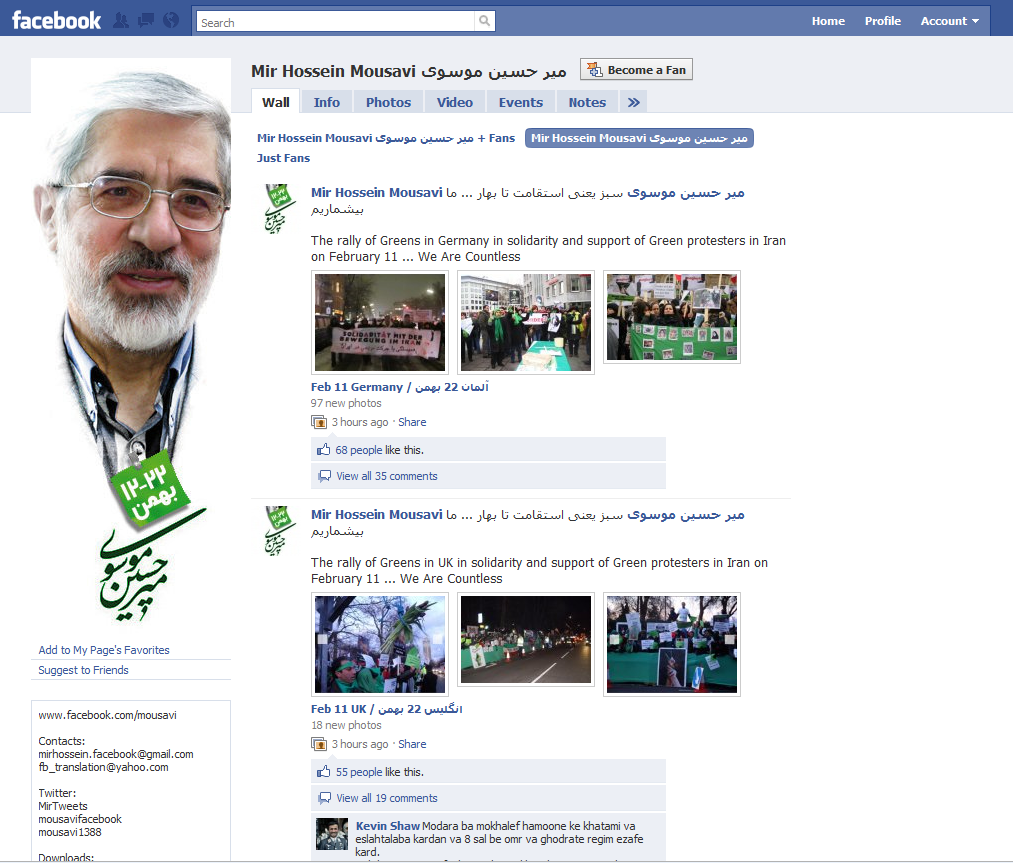
So in addition to using their Chinese-made riot trucks and gas attacks on the protesters, the Iranian security forces were able to quell much of the 22 Bahman uprising by simply relying on the weakness of the movement’s organizational structure. Letting the enemy defeat itself; very Art of War. The very lack of hierarchy in the green movement was both a blessing and a curse. From Foreign Policy:

Like many of the green movement activists, Sadeghi’s belief in the protests seems related to their “horizontal organization,” the fact that they were structured without hierarchies. This was supposed to be the great strength of the movement, but it is also an abiding weakness. A horizontal organization can’t clearly delineate different roles to different people according to their strengths; it can’t reward those who participate, or sanction those who hesitate. Facebook enabled many young Iranians to forget these points.

Now obviously the Taliban is not organizing via Facebook, but the principle of decentralization is the same. Avoid having a center of gravity, put together your demonstrations (attacks) at the last possible minute; coordinate, execute, and then melt away into the night. But if the Iranian green movement using the same principles was successfully put down, does this offer us a rubric for approaching insurgencies?

Mir Hossein Mousavi's Facebook page.

The short answer is probably not. The Taliban is not planning its operations through Facebook or tweets. But the reason the Revolutionary Guard so effectively shut down the protests was by blocking access to means of communications; that is to say the internet. No Gmail, no Facebook, no twitter meant that there was no coordination between demonstrators, nor was there a way to quickly spread the word of crackdowns in a particular area. The networks used by the Taliban for communication are more dispersed, making a system-wide shutdown more difficult. Walkie-talkies and satellite phones are the order of the day, and while we can intercept calls, we cannot easily end them. Even if we did, human couriers would merely proliferate further.

Also worth keeping in mind is the psychological element. The pushback given by the Iranian regime was demoralizing and a clear setback for the movement, slowing momentum and further progress. Presumably more than one green movement adherent changed his colors, or at least plans to lay low thanks to the IRG. But when ISAF and the United States attempt to stop the movement (the Taliban), it disperses them without costing the Taliban anything. Most of the Iranian protesters were relatively concentrated – do we need to herd Taliban fighters into a single killing zone? And is the Battle for Marjah a step in that direction?

With Open Arms

Admiral Michael Mullen, Chairman of the Joint Chiefs of Staff.

I’ve meant to talk about it sooner, but it wasn’t until I saw some particularly egregious arguments that I was spurred to action. Don’t Ask, Don’t Tell absolutely needs to be repealed. First announced at the State of the Union address, Defense Secretary Bob Gates and JCS Chairman Admiral Mike Mullen continued to call for it at a press conference later that week. Admiral Mullen’s comments – declaring the current policy as detrimental to the military’s integrity – are particularly noteworthy:

No matter how I look at this issue, I cannot escape being troubled by the fact that we have in place a policy which forces young men and women to lie about who they are in order to defend their fellow citizens. For me, it comes down to integrity — theirs as individuals and ours as an institution. I also believe that the great young men and women of our military can and would accommodate such a change. I never underestimate their ability to adapt.

We would also do well to remember that this is not an issue for the military leadership to decide [emphasis mine].

Continue reading

The Liberal from Lufkin

Charlie Wilson died today. From my limited knowledge (basically a book and a film), I’ve developed a deep admiration for the man. To some extent his death is part of the passing of an era, for better or for worse. But this country will surely miss him. Bob Gates writes a fitting farewell. We’re still picking up the pieces, as Charlie always wanted.

I had the unforgettable experience of knowing Congressman Wilson when I was at CIA and he was working tirelessly on behalf of the Afghan resistance fighting the Soviets.  As the world now knows, his efforts and exploits helped repel an invader, liberate a people, and bring the Cold War to a close.  After the Soviets left, Charlie kept fighting for the Afghan people and warned against abandoning that traumatized country to its fate — a warning we should have heeded then, and should remember today.

America has lost an extraordinary patriot whose life showed, once more, that one brave and determined person can alter the course of history.

Amen, Mr. Secretary. Good-Time Charlie, we hardly knew you.

Down That Road Again

If you thought the LSE (and Britain in general) was bad at curbing extremism and hatred (and I do, see here, here, and here), then Oxford University will knock your socks off. From The JC:

Israel’s Deputy Foreign Minister was met by a protester screaming “slaughter the Jews” as he spoke at the Oxford Union.

Antisemitic and anti-Israel abuse was shouted throughout Danny Ayalon’s speech on Monday evening, with students causing numerous disruptions to the event.

During the hour-long session one student ran towards Mr Ayalon shouting the Arabic phrase “Itbah Al-Yahud” [Slaughter the Jews].

As many as 10 others, carrying Palestinian flags, made attempts to attack Mr Ayalon but were intercepted and removed by security.

Unlike when Ayalon spoke at LSE, the administration in this situation sprang to his defense as a speaker and contributor of ideas. No faculty petitions up north (to my knowledge). In their statement (PDF), the Oxford Union said:

Whilst the vast majority of the audience behaved in an orderly and responsible fashion, some members continually interrupted the speech, and one individual in particular appears to have made a directly anti-Semitic remark. These individuals exceeded the principles of free speech that the Society upholds…

…This morning, the Union’s President launched an investigation aimed at identifying the
Members who disrupted the event. The Union will be taking disciplinary action against these
Members, in accordance with the Society’s rules…

…The Oxford Union believes in the rights of free speech and protecting our invited speakers’ ability to express themselves in an orderly and disciplined environment…

…Last night was unprecedented. A disorderly minority disrupted and prevented the speaker from holding the floor where he had been invited to speak.

It’s nice to see an apology, or even an admission that something at the event had not gone as planned. Certainly no such statement was issued at LSE. Because what’s the point of debating when you can just wave your flags, shout some cheers, and win the argument? You don’t even need to make a point.

It’s a perfect storm of the western recoil, its love for countries-in-waiting (see: the Free Tibet movement), and willingness to attend a rally. I really do feel for Ayalon and any other Israeli officials who seek to engage in a back-and-forth with the community in Britain. It won’t do a thing: the minds of this country are made up.