The Ring of Truthiness

From a Freakonomics post at the New York Times:

If I were a clever, real economist, I might neatly package the conclusion along the lines of the demand for opiates being relatively inelastic, but the brand (?) sensitivity is low, and once the incidental costs of heroin (inconvenience, lower quality, abscesses, disease, visibility) became lower than the absolute cost of oxycontin, the market suddenly tilted. (That’s probably mostly gibberish, but it sounds economish.)

Economish! Great coinage there. ‘Supply-side economish.’ ‘The Austrian school of economish’.

Plus, it’s a great word to use, representing the evaporation of any credibility the whole discipline may have once had. Anyone see where the Dow is these days? Exactly, who cares!

Human Sacrifice, Cats and Dogs Living Together

Mass hysteria!

“Truedog” has found the one word necessary to describe modern America: ‘hysterical‘. Everything’s blown out of proportion; no one has an ounce of common sense; we’ve all lost our collective shit. He also offers a most intriguing explanation:

Here’s my theory:  I think everyone in America shares an unconscious, often hidden, and largely unarticulated conclusion that we fucked up, the glory days are over, the country is in deep shit, and there’s no way out.  We know in our bones that we’re falling apart and the rest of the world is moving ahead.  Forget about being #1, we’ll be lucky to level off at #17.  I think that panic is shared across the political board.  Although ideology plays a strong role in who is blamed, the hysteria comes from a common root.  This isn’t just about now or the unemployment rate.  It’s deeper and more primal.  It taps into our inner terror of losing our grip and never getting it back.  Hysteria is just the vibration in our national fuselage as the American empire noses over and loses altitude. People sense they have lost something and are frantic over it.

So let’s just chill the fuck out until we regain our senses, or at least come to grips with our emerging place in the world. In the meantime, we would do well to acknowledge that we’re overreacting, and to at least back up our paranoia with meaningful actions instead of half-assing it. Bruce Schneier suggests that we close the Washington Monument instead of installing airport-like security. “We can reopen the monument when every foiled or failed terrorist plot causes us to praise our security, instead of redoubling it.”

Deep breaths.

You Want Science? I Got Yer Science Right Here!

At least some people are looking ahead, looking deep, and looking out to space. First, we get NASA:

NASA-funded astrobiology research has changed the fundamental knowledge about what comprises all known life on Earth.

Researchers conducting tests in the harsh environment of Mono Lake in California have discovered the first known microorganism on Earth able to thrive and reproduce using the toxic chemical arsenic. The microorganism substitutes arsenic for phosphorus in its cell components.

And then courtesy Yale astronomer Pieter van Dokkum:

A new study suggests that a specific kind of galaxy might hold 10 times more red dwarf stars than estimated. That would triple projections for the number of stars in the observable universe, with implications for explanations of how stars and galaxies form and evolve.

Life doesn’t require all six of the building blocks we thought. The very term ‘life’ takes on new meaning. And there might be three times as many star systems in the universe than we thought – and many times that of possible  life-supporting planets, with our now vastly expanded definition of life.

Science is pretty cool when we actually do it.

Two Steps Back

Do you get the feeling that we’re slowing down? I mean that in the entropic sense, that humanity may have gone as far as it can and is now contracting. Look at how far we’ve come since the year 1910 – two world wars and all the carnage and technological progress they produced, rocketry and space exploration (we put a man on the moon), the rise of computing, Moore’s Law, all the conveniences of modern life. And yet, where are the big breakthroughs?

John Horgan recently wrote in Scientific American about “scientific regress,” fields of science that are not just slowing down as a result of diminishing returns, but that are actually retreating from their own discoveries. Infectious disease is back, including some that were on the brink of eradication. The Concorde, fastest commercial jet in history, was entirely scrapped, and there are no plans to replace it. Even science itself has come under fire – evolution has shifted from common knowledge to a disputable “theory.”

Research and technologies without ‘practical’ application never get off the ground. Hence the hole in the ground that could have been America’s own Large Hadron Collider. Who knows what CERN’s will discover? Alexander Fleming was just studying some bacteria. He ‘invented’ penicillin. Or consider the Vela satellites used to detect nuclear explosions on Earth, which ended up discovering the existence of Gamma-ray bursts. Even the most mundane of new technologies can have serendipitous results, and that’s why continued innovation and discovery is so important. But we’ve stopped.

Even in terms of military procurement – and let’s not forget that ARPA and DARPA brought us the internet and the global positioning system – we’re taking steps backwards in the name of fiscal sanity. Not that balanced budgets are an ignoble pursuit, but we’re voluntarily ending production of the most advanced fighter in the world (the F-22) in favor of its slightly less capable cousin (the F-35). Production of the F-35 itself will be notably slashed. With Britain retiring the Harrier and the F-35B variant in jeopardy, the novel technology of VTOL aircraft may itself not be long for this world.

Meanwhile, the Russian-designed contemporary of the F-35, the Sukhoi Su-35, is making waves, with China about to become a major purchaser of the technology. It takes ages for a new system to come online – the Airbus A400M military transport just now making maiden flights has been in the works since 1982! And even the new weapons systems intended to create capabilities where there are none – the Marine Corps’s Expeditionary Fighting Vehicle comes to mind – are being canceled.

We don’ produce anything any more. The picture of our economy, especially vis-a-vis China, is that of a junkyard. We have a resource economy now, where we ship raw materials out for “more skilled” hands to mold into a finished product. These products are things that just fuel our consumerism, a consumerism wherein we look forward to things breaking just so we can feel the rush of buying something new.

We put so little energy into real long-term thought. Everything we do as a society is all about the quick buck, the near-term gain, what we can see and hold and spend now. Politics continue to be an internal, mind-numbing struggle with no winners and no vision beyond the next election. And of course today’s politicians won’t be living with the consequences of their decisions (there’s still time to atone, though). As the Great Society gets rolled back, the New Deal is next. And what then, the gains of the Progressive Era?

It’s not like I don’t understand why – when you don’t even have a paycheck to look forward to in the next week, every day becomes its own micro-scale struggle just to get to the next one. But it’s not impossible to take care of today’s problems and plan for the future. I’ve previously called for stronger leadership, or a real public works plan, or maybe some British-style openness and transparency (and when the Brits are leading the way in those fields, you just know something’s gone horribly wrong somewhere). These things are not impossible. And they’re not too expensive. I don’t care how bad the deficit looks; no one cares (no, really, outside of a vocal few, it’s not the most pressing concern). It’s certainly a problem, but we have the chance to solve other problems while still looking to the future.

Things are expensive. But in the long long term, doing nothing and stagnating will be even more costly. We need to keep building, inventing, dreaming, knocking over test tubes accidentally, leaving petri dishes next to each other, and to stop arguing over today. Tomorrow is more important.

Think big. Think bold. But most importantly, think ahead.

A Brief History of Future War

Another article at Fortnight today, this one the most relevant to regular readers of this blog. Simply titled “Future War,” it’s a fairly comprehensive overview of Things I’m Interested In militarily. Opening excerpt:

Much as we in the United States may have forgotten our two land wars in Asia, we’re still in them.

But if all goes according to plan, we’ll be completely out of both Iraq and Afghanistan by 2015. Except for the “advisory and assistance brigades.” And special forces. And drones. And all the other minutiae and caveats that will have essentially set the stage for a near-permanent American presence in Central Asia for the foreseeable future.

But some day, an end will come both in name and in deed—even if that end turns out to be anticlimactic. It’s said all too often that “today’s generals are preparing to fight yesterday’s wars.” By the same token, the ascendancy of counterinsurgency doctrine in the United States military could be here to stay.

Charting the future course of war requires wisdom—and prescience. Who will do the fighting? How will our fighting be done? Why will we fight? And why will they fight? The pithy answers, in order, are: Very few people, remotely, preservation and economics.

Go read it!

Death from Above

At a recent conference in Beit Hatotchan on urban warfare, Major General Sami Turgeman of the Israeli 36th Armored Division announced findings from Operation Cast Lead in 2008.-9 One of them struck me as rather surprising, considering other counterinsurgency/military operations – that “the Air Force is more accurate in urban warfare.”

Now granted, that is in comparison with Israeli armor, but nevertheless it rings a bit hollow. Even with air strikes in at historical highs in October, it was deemed necessary to deploy tanks to southwest Afghanistan. Tankers were naturally thrilled, and one wrote of the new firepower available to bring to bear:

Currently, most American military vehicles are equipped with remote optics systems,  which are useful for urban fire fights at short ranges but do not offer the depth necessary to fight effectively in southwestern Afghanistan. However, tanks offer optics systems that dwarf the traditional capabilities of an infantry carrier…and, oh yeah, these days each tank can acquire targets clearly in excess of four times as far.

So perhaps it’s not a zero-sum case of tanks or planes, but rather using both in areas of relative superiority. Still, returning to the IAF, Gen. Turgeman “explained that the solution for urban warfare is stronger cooperation between air and ground forces.”

There are an unbelievable number of problems facing aviation as used in urban warfare, be it counterinsurgency or conventional operations. Israel has begun to slightly shift the focus of even their conventional ops to a more population-centric (read: media-friendly) approach, but more air power is absolutely not the way to go about it. Even discriminate aerial bombing and air strikes pose a great risk of collateral damage, and most definitely does not look good on camera.

This is, of course, what I wrote my dissertation about, albeit in the case of Aden (I’ve been holding off on reprinting the whole article here while I try to get it published). But here’s a relevant passage:

While the RAF enjoyed great success up-country in the Aden Protectorate, both independent and in support of ground operations by both the FRA and the British Army, that success was useless when compared with the insurgency’s shift to urban centers, and when the political situation of Aden is taken into account. Both in terms of the use of airpower and the overall relevance of it, politics are hugely important. The potential fallout from misapplied air strikes and civilian casualties was and remains immense, as Britain learned to its detriment. Furthermore, even if airpower is used responsibly and with minimal collateral damage – such as during the Harib raid – interpretation is everything, and when Yemen claimed 25 civilian casualties resulting from the raid, Britain could neither prove nor disprove the figure, despite the near-certainty of its untruth. Obviously, the use of airpower both before and during the insurgency had to rely on precise targeting and weapons systems to avoid further alienating the local population and inflaming world opinion, but regardless of the truth, it was all too often that Britain found its reputation in tatters due to an air attack of any kind.

So while the Israeli Air Force may indeed have improved its relative accuracy, it ultimately doesn’t matter. Air power, however skillfully employed, does not win hearts and minds.

On Value

Recent headlines like this:

And this:

And this:

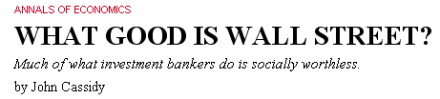
Are enough to make you ask: why are we still pretending that these people produce anything of value whatsoever? That their hyper-inflated ‘MegaJob‘ salaries are anything close to realistic compensation? When will we publicly acknowledge that the vast majority of the American finance sector is completely full of shit and damages the reputation and capabilities of this country?

Manipulation of numbers produces nothing. It contributes nothing. If you want to do that, download R and make a graph. But don’t make $500,000 a year to do nothing.

Supposedly the recession is ‘over’ and we’re beginning to recover. But if ‘recovery’ means restoring the finance sector to its previous pedestal atop the grand pantheon of economic bullshit, then that kind of recovery leaves us worse off than we were before. Nothing has changed. It could take ten years to restore unemployment levels to what they were before the recession, and all the while new immigration will be rewriting the face of the country. Much as Elizabeth Warren tries (bless her heart) to change the culture of Wall Street, she is fighting a losing battle. Who would voluntarily surrender an obscene paycheck ‘for the good of the nation’?

We have never been particularly good as a country at rewarding the right kind of work – at paying firemen and manufacturers and miners and the other types of employees that produce something tangible. But the current state of inequality is mind-boggling. And for those like Matt Ridley, who would seek to lull us into a sense of complacency by comparing human life not to that of our parents, not to that of the last three decades, but to the entirety of human history, that’s not where we get out benchmarks for today. We misplaced our priorities a long time ago; are we ever going to find them?

“There is nothing to be gained by trying to get away”

Between the weather and a complete lack of good news in the world, I’ve been in not so much a foul mood lately as a dark mood; I’ve found myself exploring all manner of eschatology and other ridiculousness related to the apocalypse (great resource: Exit Mundi). And rereading my own article hasn’t helped anything. I know this is old news to most, but I was reminded of the BBC’s nuclear war transcript the other day and thought it deserved some reprinting.

If Britain had been attacked with nuclear weapons during the Cold War (I believe the years 1974-79 were when this particular transcript would have been used), then BBC presenters would have read the following chilling passages to the nation:

This is the Wartime Broadcasting Service. This country has been attacked with nuclear weapons. Communications have been severely disrupted, and the number of casualties and the extent of the damage are not yet known. We shall bring you further information as soon as possible. Meanwhile, stay tuned to this wavelength, stay calm and stay in your own homes.

Remember there is nothing to be gained by trying to get away. By leaving your homes you could be exposing yourselves to greater danger….

Make your food stocks last: ration your supply, because it may have to last for 14 days or more. If you have fresh food in the house, use this first to avoid wasting it: food in tins will keep…

Do not, in any circumstances, go outside the house. Radioactive fall-out can kill. You cannot see it or feel it, but it is there. If you go outside, you will bring danger to your family and you may die. Stay in your fall-out room until you are told it is safe to come out or you hear the “all clear” on the sirens.

The actual BBC link above has a clip of Harry Shearer reading the transcript while doing a pretty serviceable impression of Cronkite. But I’d love to hear it from an actual Briton. Is there anything more despair-inducing than “nothing to be gained by trying to get away”?

Fin

I have a new piece out at Fortnight today. This one, in keeping with the dire overtones of the last, is all about our fascination with the apocalypse and mass destruction. Featuring awesome artwork by Matt McCann! Brief sample:

We’re pretty fucked, and we know it.

Two weeks ago, I wrote about the grim economic and political situation in which our generation has found itself. If the present is indeed a culmination of the trends of the last two decades, then it would seem to be no mere coincidence that our era has witnessed a phenomenal rise across all forms of media in the formerly obscure subgenres of nihilism, post-apocalypticism and dystopian fiction. And even less surprising is how avidly our generation has consumed the stuff.

We were born into upheaval and collapse. We were raised during the height of the Cold War, and were toddlers when the Soviet Union disintegrated and Germany reunited. For those of us raised in the United States, then came the boom years of the Clinton era. Even to our less-than-fully-conscious minds, things seemed to be going pretty well. At least one, if not both our parents (or all four) had a job. We were safe from scary things like that Gorbyshave man, and this fantastic new thing called AOL was making our lives really interesting.

But as they say, “the night is darkest before dawn”—and, perhaps by the same token, the day is brightest at sunset. The unbelievable trauma that the destruction of the World Trade Center and the E-Ring of the Pentagon wrought on my nation was unparalleled in living memory. For our generation, it defined the beginning of our maturity, including attention to politics and global affairs…

Read the rest at Fortnight.

Play Up! Play Up! And Play the Game!

“The Battle of Waterloo was won on the playing-fields of Eton.”

– Arthur Wellesley

There’s a breathless hush in the close to-night
Ten to make and the match to win
A bumping pitch and a blinding light,
An hour to play, and the last man in.
And it’s not for the sake of a ribboned coat.
Or the selfish hope of a season’s fame,
But his captain’s hand on his shoulder smote
“Play up! Play up! And play the game!”

The sand of the desert is sodden red-
Red with the wreck of the square that broke
The gatling’s jammed and the colonel dead,
And the regiment blind with dust and smoke.
The river of death has brimmed its banks,
And England’s far and Honor a name,
But the voice of a schoolboy rallies the ranks-
“Play up! Play up! And play the game!”

This is the word that year by year,
While in her place the school is set,
Every one of her sons must hear,
And none that hears it dare forget.
This they all with joyful mind
And bear through life Eke a torch in flame,
falling fling to the host behind-
“Play up! Play up! And play the game!”

– Sir Henry Newbolt