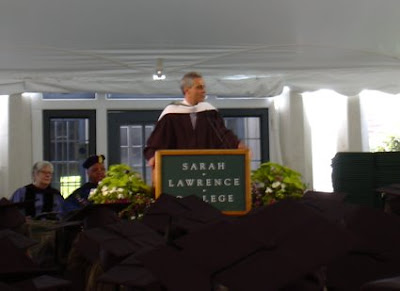
 Kevin Carey writes in Democracy Now about the ‘quality’ of colleges in the United States. Comparing higher education to the Catholic church, he describes the modern university as in institution terrified of actually trying to evaluate how well they’re teaching. Answerable to no one, accountable to none, non-profit colleges try to maximize reputation rather than profits, including gaming the U.S. News & World Report rankings. I can speak from experience here: my own undergraduate college was unceremoniously dropped from the list in 2005. This came solely because we stopped looking at S.A.T. scores, which were a quantifiable measure of – I don’t know, something – an ability to take tests, and we were duly punished. Yet, the college flourishes, admission has only grown more selective, and I don’t for a minute think less of Sarah Lawrence for her absence from the USNWR tables.
After moving from the unique style of an SLC education to that of the British university, the biggest difference is in fact the alumni donation/endowment-based system of private American colleges. It seems like a bad idea from the start – too close to a business/consumer model, but not actually responsible in the same way. The British schools can count on receiving their funding from the Exchequer each year; they have the benefit of stability. But it’s in fact the endowment system that allows students to change their educational experience while it’s happening. Schools that rely on alumni donations (especially true for those with smaller endowments) must address the needs of current students, whether they be shortages in the curriculum or draconian alcohol policies. Otherwise they risk losing a lifelong source of income, in a state of even further dependence than a business.
Carey misses this almost entirely: “If bad teaching created negative publicity or materially affected the ability of college presidents to recruit students and raise money from alumni, presidents would have much stronger incentives to tackle reform head-on.” So then, is the problem that the alumni of prestigious schools are all idiots, unable to realize they were fleeced? Not sure how to remedy this.
 It could be pointed out that the future alumni donation model merely ensures that the wealthiest students have the loudest voices, but I’d have to disagree. A college doesn’t know who’s going to be wealthy or not down the road. It could produce a world-renowned director/producer or a White House Chief of Staff who majored in dance. It’s the ultimate equalizer, and the inverse relationship between the size of a college and its dependence on alumni donations means that the most supportive, responsive colleges will be the tiny liberal arts ones. The big universities are too big to learn. Lectures tell you, seminars engage you (even if some smart people think otherwise).
Carey’s prescription is for new modeling and quantitative assessments of teaching quality and other intangibles. The problem with this (as with all sociological attempts at structuring human behavior) is that it’s too individualistic and subjective a measurement to boil down to a formula. The NSSE and the CLA, even if accurate, merely tell you how a given college is. What’s truly needed is an instrument to change how that college will be. Students should affect their own destiny.
What it comes down to is a need for decentralizing higher education. Harvard as the Ma Bell of universities?




 Automatic Ballpoint