Operation Tannenbaum, Part IV

It is now November 9 1940. The bitterness of the Battle for Switzerland is something that will live with all Swiss and those German soldiers who participated. Out of the 800,000 Swiss under arms on September 24, 120,000 did not reach the redoubt. Only 15,486 of these soldiers were taken prisoner. In fact, there are more French and Polish prisoners in the German laagers then there are Swiss!

The Zytglogge in Bern, Switzerland.

Wilhelm Ritter von Leeb, commander of Heeresgruppe C.

Guisan and his staff are secure in the Redoubt, with the Germans unable to penetrate the massive defense works. However, the Germans are rather unwilling to commit so many forces to the strategically irrelevant alpine region. In the areas at higher altitude, the first snow has fallen, tabling any large offensives until the spring of 1941.

No less than 20 divisions are in occupied Switzerland, and tensions between occupier and occupied are running extremely high. Just as in Czechoslovakia, all popular gatherings have been banned. Weapons and wireless sets owned by private citizens have been ordered to be turned into authorities, including hunting rifles.[1] Heeresgruppe C has not been redeployed to the eastern front for a Russian offensive, and Wilhelm von Leeb has established his headquarters in occupied Bern for the winter.

Continue reading

Leaving on a Jet Plane

Buda Castle, Budapest, Hungary.

Today I’m en route to Hungary to kick off a grand central/eastern European trip, accompanied by an especially lovely lady. If you’re curious, the itinerary is Budapest-Vienna-Salzburg-Munich-Berlin-Warsaw.

I’ll be over there for two weeks, and while I’d like to pretend I’ll make occasional posts with pretty pictures I’ve taken, it would only take a couple of days for you all to see through the charade.

There’s a slight chance I’ll post every once in a while, but don’t hold your breath. Later today I’ll have Part IV of “Operation Tannenbaum” up, which will be the last for some time (and hopefully provide some needed closure). I’ll be back in April for sure.

And again, thanks so much for reading. If you haven’t already, this would be an excellent time to explore the links page and discover some interesting new blogs.

Operation Tannenbaum, Part III

While the odds were against any sort of meaningful Swiss victory in the event of invasion, such a German offensive was equally unlikely in the early years of the war. By 1943, the possibility of a successful German invasion had dwindled to virtually nothing, as the Swiss Army had expanded and modernized to a point that would make Tannenbaum a suicidal mission. This begs the question: why, then, would Hitler ever have chosen to invade Switzerland? Let us proceed with our counterfactual under the following premises.

It is now September 15. The unrestricted bombing campaign authorized by Churchill four months ago has been relatively unsuccessful. Fewer than 25 percent of the bombs dropped are landing within five miles of their intended targets, and only 30 percent have landed in any built-up areas.[1] However, this has had an unintended benefit. Having disguised the few industrial plants manufacturing jewel bearings, the Germans were fairly certain of their security. However, in a truly ironic case, this ended up being more costly, as the plants have been disproportionately hit by the British bombs. Jewel bearings are a main component of bombsights, and without them, Hitler is reluctant to press his luck in the Battle of Britain, much less Operation Sealion.

Continue reading

Operation Tannenbaum, Part II

Hitler, flush with victory over France, now demanded to see plans for the invasion of Switzerland. His rage knew no bounds, as the head of OKH Franz Halder recalled: “I was constantly hearing of outbursts of Hitler’s fury against Switzerland, which, given his mentality, might have led at any minute to military activities for the army.”[1] Within hours of the French capitulation, Captain Otto Wilhelm von Menges in OKH submitted a draft plan for the invasion.

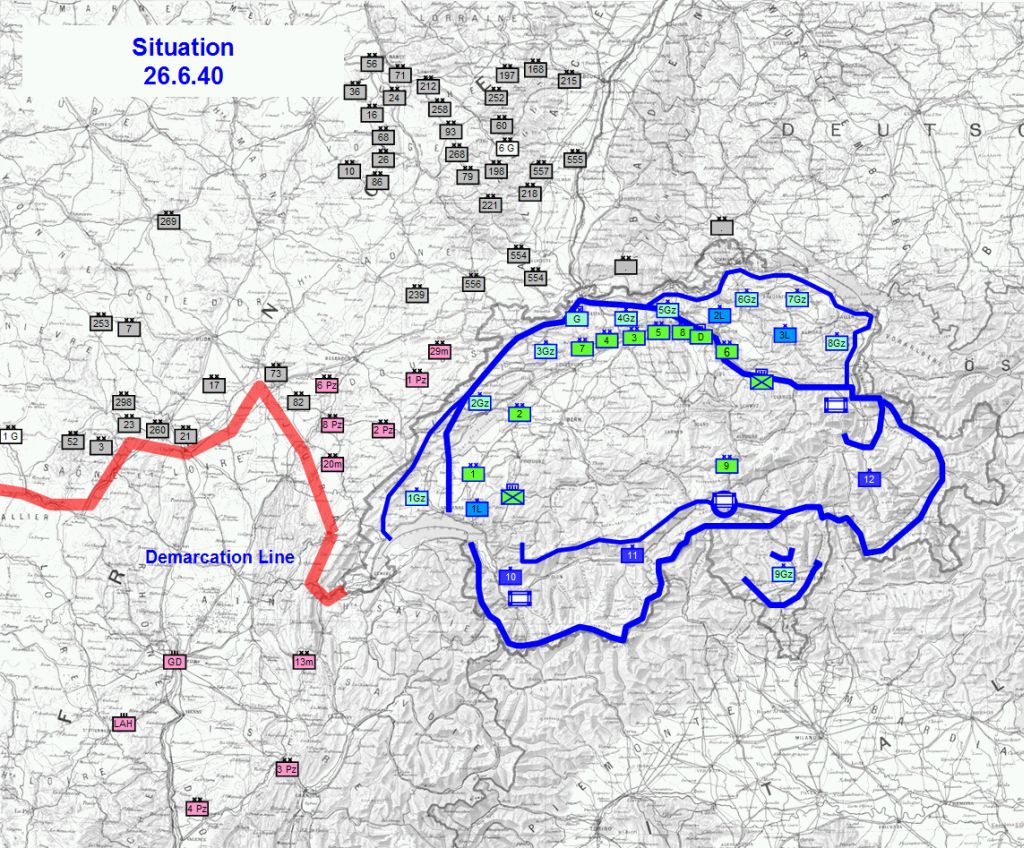
Menges' Fall Schweiz, first draft (June 26 1940).

Generaloberst Wilhelm Ritter von Leeb’s Heeresgruppe ‘C’ (HGr. C), led by Generalleutnant Wilhelm List and the 12th Army would conduct the attack. Leeb himself personally reconnoitered the terrain, studying the most promising invasion routes and paths of least resistance.[2] Menges’ plan called for a pincer movement from German troops in France and Germany focused on taking Bern quickly, with Italian divisions invading from the south. Speed was critical: the plan’s primary objective was to seize the industry in the Solothurn area and capture the railroads, bridges, and transportation infrastructure across the Alps intact.[3]

Continue reading

Operation Tannenbaum: Hitler’s Invasion of Switzerland

The military picture on the Franco-Swiss border, June 26, 1940.

France was defeated. So too were Poland, Norway, Denmark, Holland, and Belgium. Austria and Czechoslovakia had been incorporated into the Greater German Reich. Great Britain stood alone in her ‘splendid isolation,’ and the fascist regime of Francisco Franco held sway over the Iberian Peninsula. In June of 1940, all that remained, surrounded by enemies, was the Swiss Confederation.

Hitler called it a “pimple on the face of Europe.”[1] In the heady days of victory for the Third Reich, a move against the alpine republic seemed a great possibility – almost inevitable, even. Even before the Fall of France was made official, plans were being drawn up for ‘Operation Tannenbaum,’ the German invasion of Switzerland. Yet Hitler’s attention was soon drawn towards Britain, and eventually the plan fell by the wayside as he began focusing attention on his Bolshevik neighbor to the East.

But…what if? What if Hitler had decided that the conquest of that mountainous pimple was indeed worth the effort and manpower? What if Tannenbaum had been more than just idle words and an OKW plan? If Hitler had embarked on the ultimate folly, the results would have been disastrous for the Swiss – and the Nazis.

Continue reading

“The Dropout Economy”

Great article in TIME by Reihan Salam. It’s short, but provides a pretty good indicator of the future to come, particularly for my generation:

But what if the millions of so-called dropouts are onto something? As conventional high schools and colleges prepare the next generation for jobs that won’t exist, we’re on the cusp of a dropout revolution, one that will spark an era of experimentation in new ways to learn and new ways to live.

It’s important to keep in mind that behavior that seems irrational from a middle-class perspective is perfectly rational in the face of straitened circumstances. People who feel obsolete in today’s information economy will be joined by millions more in the emerging post-information economy, in which routine professional work and even some high-end services will be more cheaply performed overseas or by machines. This doesn’t mean that work will vanish. It does mean, however, that it will take a new and unfamiliar form.

Look at the projections of fiscal doom emanating from the federal government, and consider the possibility that things could prove both worse and better. Worse because the jobless recovery we all expect could be severe enough to starve the New Deal social programs on which we base our life plans. Better because the millennial generation could prove to be more resilient and creative than its predecessors, abandoning old, familiar and broken institutions in favor of new, strange and flourishing ones.

Only thing missing is the increasing incidence of a five-year plan (or even more) to graduate. Spreading out the experience isn’t necessarily a bad idea.

And at least this means we’ll be good at something. The alternative, of course, being to cryogenically freeze ourselves until the economy improves.

More analysis from Shlok Vaidya here and John Robb here.

The Hummingbird has Landed

The A160T Hummingbird Unmanned Helicopter/Rotorcraft.

Boeing’s A160T “Hummingbird” robot rotorcraft has been cleared for liftoff.

A series of tests conducted at the Army’s Dugway Proving Ground in Utah achieved all of the necessary goals laid out for it. The Hummingbird can successfully

deliver at least 2,500 pounds of cargo from one simulated forward-operating base to another 75 nautical miles away in well under the required six hours. The simulated mission carried 1,250-pound sling loads over two 150-nautical-mile round trips, with the A160T operating autonomously on a preprogrammed mission.

A max payload of 2,500 pounds? 20,000 foot ceiling? This thing is badass.

The real question how long before garage tinkerers make rotary-wing variants of their DIY drones. At the rate they’re advancing for fixed-wing, it won’t be long at all. Just think of all the things you could do with a helicopter as opposed to a plane…

A Taste of Libya

Michael Moynihan has a scathing report on his recent journey to Libya. Highlights are below, but definitely read the whole thing. It’s like P.J. O’Rourke at his best.

When the BBC reported that “at Tripoli’s ultra-modern airport…you could be almost anywhere in the world,” I expected at bare minimum a Starbucks, a fake Irish pub, and…a bank of vending machines dispensing iPods … Well, perhaps we came through Libya’s spillover airport, its Midway or Stansted, because this is “anywhere in the world” only in some mad, dystopian-novel sense. Available for purchase are Egyptian gum, cheap watches celebrating 40 years of the Libyan revolution, and glossy magazines with Hugo Chavez on the cover.

Libya ought to at least resemble a wealthy country, with its vast oil reserves and all those desperate politicians willing to do almost anything in exchange for access to them. Yet Tripoli is covered from end to end in garbage.

Remove the oil economy, and it isn’t entirely clear what Libyans do for money. The only shops I spot are selling either vegetables or cigarettes, sometimes both. There are markets trading in all manner of junk: old sewing machines, toilets, fake perfume (Hugo Boos seems particularly popular). The most frequently promoted product…is, inexplicably, corn oil.

The pious Muslims of Libya are not unlike vegetarians, surrounding themselves with pointless facsimiles of the forbidden, from beef bacon to bottles of booze with all the booze removed.

Soon after arriving, along with three other journalists and one academic, we are…to meet the first group of terrorists recently released from Tripoli’s notorious Abu Salim prison. All are former members of the Al Qaeda farm team known as the Libyan Islamic Fighting Group (LIFG) … With every conversation, they sound more and more like the Women’s Auxiliary Balloon Corps of Al Qaeda.

Mexican Standoff

Gunmen killed an American consulate worker and her husband in Ciudad Juárez. Their baby was found in the back seat.

News comes that the cartels in Ciudad Juarez have finally started targeting U.S. nationals, murdering three last night. One was a pregnant consulate worker and her husband, the other was the husband of another consulate employee. I’m suprised only that it took so long (and that only now is the violence in Mexico “provoking an angry reaction from the White House”).

If we don’t end the War on Drugs, the impetus and justification for organized crime and narcotics trafficking will only increase, as will the profitability of murder. As the Times reminds us, “more than 2,000 people were killed there last year, giving it one of the highest murder rates in the world.” American students are arriving in Acupulco now for spring break. And for the cartels, the risk-reward benefit right now is too large to ignore.

But violence itself isn’t the only thing to fear here. The cartels and gangs (this particular shooting was blamed on Los Aztecas, who only get more impudent) have effective control over much of northern Mexico. The crippling government weakness is now affecting the very legitimacy of the Mexican state. The catastrophic death toll has:

prompted the government to shift course after three years of its military-led crackdown on drug cartels and acknowledge that it has to involve citizens in the fight and deal with the social breakdown fueling the violence. [emphasis mine]

For now, those efforts will be government-coordinated. But in the future, who’s to say that the citizenry won’t take matters into their own hands, like in the favelas of Rio de Janeiro? Chirol thinks that the future of the border patrol will be a similiar, civilian, militia-style solution, at least on this side of the border. The key, though, is probably fixing that whole ‘social breakdown’ thing. Restore faith, restore legitimacy.

At least the problem is finally back on the radar again.