A Brief History of Future War

Another article at Fortnight today, this one the most relevant to regular readers of this blog. Simply titled “Future War,” it’s a fairly comprehensive overview of Things I’m Interested In militarily. Opening excerpt:

Much as we in the United States may have forgotten our two land wars in Asia, we’re still in them.

But if all goes according to plan, we’ll be completely out of both Iraq and Afghanistan by 2015. Except for the “advisory and assistance brigades.” And special forces. And drones. And all the other minutiae and caveats that will have essentially set the stage for a near-permanent American presence in Central Asia for the foreseeable future.

But some day, an end will come both in name and in deed—even if that end turns out to be anticlimactic. It’s said all too often that “today’s generals are preparing to fight yesterday’s wars.” By the same token, the ascendancy of counterinsurgency doctrine in the United States military could be here to stay.

Charting the future course of war requires wisdom—and prescience. Who will do the fighting? How will our fighting be done? Why will we fight? And why will they fight? The pithy answers, in order, are: Very few people, remotely, preservation and economics.

Go read it!

Death from Above

At a recent conference in Beit Hatotchan on urban warfare, Major General Sami Turgeman of the Israeli 36th Armored Division announced findings from Operation Cast Lead in 2008.-9 One of them struck me as rather surprising, considering other counterinsurgency/military operations – that “the Air Force is more accurate in urban warfare.”

Now granted, that is in comparison with Israeli armor, but nevertheless it rings a bit hollow. Even with air strikes in at historical highs in October, it was deemed necessary to deploy tanks to southwest Afghanistan. Tankers were naturally thrilled, and one wrote of the new firepower available to bring to bear:

Currently, most American military vehicles are equipped with remote optics systems,  which are useful for urban fire fights at short ranges but do not offer the depth necessary to fight effectively in southwestern Afghanistan. However, tanks offer optics systems that dwarf the traditional capabilities of an infantry carrier…and, oh yeah, these days each tank can acquire targets clearly in excess of four times as far.

So perhaps it’s not a zero-sum case of tanks or planes, but rather using both in areas of relative superiority. Still, returning to the IAF, Gen. Turgeman “explained that the solution for urban warfare is stronger cooperation between air and ground forces.”

There are an unbelievable number of problems facing aviation as used in urban warfare, be it counterinsurgency or conventional operations. Israel has begun to slightly shift the focus of even their conventional ops to a more population-centric (read: media-friendly) approach, but more air power is absolutely not the way to go about it. Even discriminate aerial bombing and air strikes pose a great risk of collateral damage, and most definitely does not look good on camera.

This is, of course, what I wrote my dissertation about, albeit in the case of Aden (I’ve been holding off on reprinting the whole article here while I try to get it published). But here’s a relevant passage:

While the RAF enjoyed great success up-country in the Aden Protectorate, both independent and in support of ground operations by both the FRA and the British Army, that success was useless when compared with the insurgency’s shift to urban centers, and when the political situation of Aden is taken into account. Both in terms of the use of airpower and the overall relevance of it, politics are hugely important. The potential fallout from misapplied air strikes and civilian casualties was and remains immense, as Britain learned to its detriment. Furthermore, even if airpower is used responsibly and with minimal collateral damage – such as during the Harib raid – interpretation is everything, and when Yemen claimed 25 civilian casualties resulting from the raid, Britain could neither prove nor disprove the figure, despite the near-certainty of its untruth. Obviously, the use of airpower both before and during the insurgency had to rely on precise targeting and weapons systems to avoid further alienating the local population and inflaming world opinion, but regardless of the truth, it was all too often that Britain found its reputation in tatters due to an air attack of any kind.

So while the Israeli Air Force may indeed have improved its relative accuracy, it ultimately doesn’t matter. Air power, however skillfully employed, does not win hearts and minds.

Recommended Reading (2010-11-28)

Destroyed houses on Yeonpyeong island in the disputed waters of the Yellow Sea after North Korea fired artillery shells at the island, seen on November 23, 2010.

– Analyzing data sets: the future of journalism. So says none other than the inventor of the internet (no, not that one).

– New York City is the most-modeled environment in video gaming. But could games also serve as architectural prophecy?

– Then again, perhaps Tim Berners-Lee and the gaming industry will form a new journalism together. The ‘news game‘ is rapidly becoming an interactive tool for educating (or indoctrinating, depending on your point of view) the public. It’s certainly more fun than Cable in the Classroom (via Futurismic).

– Kyle Mizokami sees the new ‘21st century equation‘: “Growing world population + Increasing affluence in developing countries + Dwindling resources + Territorial disputes + Greed = Trouble.”

– Rich people don’t need America anymore. And finally public intellectuals are picking up on their self-segregation from actual American society. The latest: Tom Ricks.

And from the past two weeks at Automatic Ballpoint:

Thanksgiving happened. I found an interesting organizational chart sans explanation. My most apocalyptic Fortnight article yet came out, which I quoted. I also quoted from the BBC nuclear contingency transcript. The headlines show why we’ll have been sucked dry and suckered into our own moral, societal, and financial bankruptcy.

But with the Palins around, are the end times already here?

On Value

Recent headlines like this:

And this:

And this:

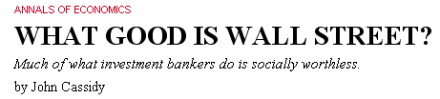
Are enough to make you ask: why are we still pretending that these people produce anything of value whatsoever? That their hyper-inflated ‘MegaJob‘ salaries are anything close to realistic compensation? When will we publicly acknowledge that the vast majority of the American finance sector is completely full of shit and damages the reputation and capabilities of this country?

Manipulation of numbers produces nothing. It contributes nothing. If you want to do that, download R and make a graph. But don’t make $500,000 a year to do nothing.

Supposedly the recession is ‘over’ and we’re beginning to recover. But if ‘recovery’ means restoring the finance sector to its previous pedestal atop the grand pantheon of economic bullshit, then that kind of recovery leaves us worse off than we were before. Nothing has changed. It could take ten years to restore unemployment levels to what they were before the recession, and all the while new immigration will be rewriting the face of the country. Much as Elizabeth Warren tries (bless her heart) to change the culture of Wall Street, she is fighting a losing battle. Who would voluntarily surrender an obscene paycheck ‘for the good of the nation’?

We have never been particularly good as a country at rewarding the right kind of work – at paying firemen and manufacturers and miners and the other types of employees that produce something tangible. But the current state of inequality is mind-boggling. And for those like Matt Ridley, who would seek to lull us into a sense of complacency by comparing human life not to that of our parents, not to that of the last three decades, but to the entirety of human history, that’s not where we get out benchmarks for today. We misplaced our priorities a long time ago; are we ever going to find them?

“There is nothing to be gained by trying to get away”

Between the weather and a complete lack of good news in the world, I’ve been in not so much a foul mood lately as a dark mood; I’ve found myself exploring all manner of eschatology and other ridiculousness related to the apocalypse (great resource: Exit Mundi). And rereading my own article hasn’t helped anything. I know this is old news to most, but I was reminded of the BBC’s nuclear war transcript the other day and thought it deserved some reprinting.

If Britain had been attacked with nuclear weapons during the Cold War (I believe the years 1974-79 were when this particular transcript would have been used), then BBC presenters would have read the following chilling passages to the nation:

This is the Wartime Broadcasting Service. This country has been attacked with nuclear weapons. Communications have been severely disrupted, and the number of casualties and the extent of the damage are not yet known. We shall bring you further information as soon as possible. Meanwhile, stay tuned to this wavelength, stay calm and stay in your own homes.

Remember there is nothing to be gained by trying to get away. By leaving your homes you could be exposing yourselves to greater danger….

Make your food stocks last: ration your supply, because it may have to last for 14 days or more. If you have fresh food in the house, use this first to avoid wasting it: food in tins will keep…

Do not, in any circumstances, go outside the house. Radioactive fall-out can kill. You cannot see it or feel it, but it is there. If you go outside, you will bring danger to your family and you may die. Stay in your fall-out room until you are told it is safe to come out or you hear the “all clear” on the sirens.

The actual BBC link above has a clip of Harry Shearer reading the transcript while doing a pretty serviceable impression of Cronkite. But I’d love to hear it from an actual Briton. Is there anything more despair-inducing than “nothing to be gained by trying to get away”?

Fin

I have a new piece out at Fortnight today. This one, in keeping with the dire overtones of the last, is all about our fascination with the apocalypse and mass destruction. Featuring awesome artwork by Matt McCann! Brief sample:

We’re pretty fucked, and we know it.

Two weeks ago, I wrote about the grim economic and political situation in which our generation has found itself. If the present is indeed a culmination of the trends of the last two decades, then it would seem to be no mere coincidence that our era has witnessed a phenomenal rise across all forms of media in the formerly obscure subgenres of nihilism, post-apocalypticism and dystopian fiction. And even less surprising is how avidly our generation has consumed the stuff.

We were born into upheaval and collapse. We were raised during the height of the Cold War, and were toddlers when the Soviet Union disintegrated and Germany reunited. For those of us raised in the United States, then came the boom years of the Clinton era. Even to our less-than-fully-conscious minds, things seemed to be going pretty well. At least one, if not both our parents (or all four) had a job. We were safe from scary things like that Gorbyshave man, and this fantastic new thing called AOL was making our lives really interesting.

But as they say, “the night is darkest before dawn”—and, perhaps by the same token, the day is brightest at sunset. The unbelievable trauma that the destruction of the World Trade Center and the E-Ring of the Pentagon wrought on my nation was unparalleled in living memory. For our generation, it defined the beginning of our maturity, including attention to politics and global affairs…

Read the rest at Fortnight.

Recommended Reading (2010-11-14)

A member of the New York Institute of Technology R.O.T.C. pauses during the New York City Veterans Day Parade on November 11th, 2010.

This tool is just awesome. Using a combination of immediate troop reductions in Iraq and Afghanistan (to 30,000 by 2013), drawdowns in Asia and Europe, reduced spending on nuclear weapons, returning most taxes to Clinton-era levels, increasing Medicare and retirement ages to 68, and the elimination of farm subsidies, I managed to balance the budget not just by 2030, but by 2013, with a healthy surplus of $200 billion. And we get to keep the Navy and the Air Force (via Lawyers, Guns & Money).

– Starbuck explains the little differences in transitioning from the UH-60 Black Hawk to the LUH-72A Lakota (the Eurocopter).

– Transport for London rolls out a life-size mockup of the new bus replacements. They look gorgeous, much more like the old Routemasters. Hop-on/hop-off. A window for the stairs. And the No. 23 was my bus in London.

– Philip Kennicott examines options for securing the Washington Monument (via Schneier).

– Apparently J.R.R. Tolkien and Salvador Dali were both “anarcho-monarchists.” Perhaps that is the ideal form of government:

Tragically—tragically—we can remove one politician only by replacing him or her with another. And then, of course, our choices are excruciatingly circumscribed, since the whole process is dominated by two large and self-interested political conglomerates that are far better at gaining power than at exercising it wisely…

Yet our system obliges us to elevate to office precisely those persons who have the ego-besotted effrontery to ask us to do so; it is rather like being compelled to cede the steering wheel to the drunkard in the back seat loudly proclaiming that he knows how to get us there in half the time.

– Military history is not dead yet. In fact, it’s getting better.

– Purdue University offers an earth-smashing simulator. It’s not as detailed as I’d like – way lacking in the visual devastation effects department – but reveals interesting results nonetheless (via Discoblog).

And from the past week at Automatic Ballpoint:

Before France entered into its own relation spéciale, Britain and America used to play nice with each other’s atomic weapons. President Obama drops a bombshell of his own on his passage to India.

People are living beneath Las Vegas. The TSA has ruined all air travel. How can one remain optimistic in the face of so much bullshit?

We remember what was fought for. And we’re sorry it turned out to be for this.

Play Up! Play Up! And Play the Game!

“The Battle of Waterloo was won on the playing-fields of Eton.”

– Arthur Wellesley

There’s a breathless hush in the close to-night
Ten to make and the match to win
A bumping pitch and a blinding light,
An hour to play, and the last man in.
And it’s not for the sake of a ribboned coat.
Or the selfish hope of a season’s fame,
But his captain’s hand on his shoulder smote
“Play up! Play up! And play the game!”

The sand of the desert is sodden red-
Red with the wreck of the square that broke
The gatling’s jammed and the colonel dead,
And the regiment blind with dust and smoke.
The river of death has brimmed its banks,
And England’s far and Honor a name,
But the voice of a schoolboy rallies the ranks-
“Play up! Play up! And play the game!”

This is the word that year by year,
While in her place the school is set,
Every one of her sons must hear,
And none that hears it dare forget.
This they all with joyful mind
And bear through life Eke a torch in flame,
falling fling to the host behind-
“Play up! Play up! And play the game!”

– Sir Henry Newbolt

Rational Pessimism

Matt Ridley’s new book about how we’ve got it so good today, The Rational Optimist: How Prosperity Evolves, has met with pretty decent reviews. I only just got around to reading Brendan O’Neill’s review for The American Conservative today (yes, yes, I know it’s dated August 1, but I’ve been busy), and it quashed any desire I might have had to read it.

I mean, I know I’m a pretty ornery cuss, but let’s face it: despite rapid advances in material prosperity, we as a society don’t seem particularly happy with our lot. O’Neill is right in saying that all the threats guaranteed to kill us all – Y2K, Bird Flu, that Man-Bird-Pig disease of a year or two ago – have never materialized, and that despite our constant worrying over the end, if it indeed comes it is almost certain to catch us by surprise.

And yet, there is so much of Ridley’s overall hypothesis that seems to make no sense. At the risk of becoming one of the “angry, graph-obsessed nitpicking” types O’Neill warns against, I think it would make sense to examine Ridley’s actual claims and see why they ring hollow.

In just the past 50 years, the average human “earned nearly three times as much money (corrected for inflation), ate one-third more calories of food, buried one-third as many of her children, and could expect to live one-third longer.”

Right off the bat, I can see one problem here: the average human. While wages and prosperity have risen steadily around the world, in the United States income disparity is at historical levels. Productivity has soared in the past fifty years,  but relative worker pay has dropped precipitously. We’re doing more and getting paid less to do it. So while much of the world may have seen a tangible increase in quality-of-life, we’re in many ways worse off than we were 20, 30 years ago. Continue reading