Size Matters

It’s really difficult to envision just how massive Chinese cities are. From Chinfographics comes this chart of the 60 largest with a population of over 1 million (and including some in Taiwan). Alongside for comparison are other famous world cities – but as you may notice, the population counts there look a bit large. They’re using the metropolitan area population, so New York gets 21.3 million instead of the usual 8.3 million, Boston gets 5.2 million instead of the usual .5-1.3 million, et cetera.

But it is rather mind-blowing just how enormous China is.

Via Slate.

Recommended Reading (2010-06-07)

Lessons learned from the Gaza flotilla raid.

Not so much a Sunday edition, I know. My apologies – I’ve come down with something at the worst possible time, but now my head might be starting to clear. Anyways, your links:

– Mike Burleson reveals the “dirty little secret” of the Falklands War: two “small, modestly capable” V/STOL carriers defeated the entire land-based air force of Argentina.

– General Cartwright gets it on cybersecurity and civil liberties, but Michael Tanji says there are still some major contradictions we need to resolve:

  1. Is access to the Internet a right? If it is not a right (on par with life and liberty, vice, say freedom from having to hear ‘hate speech’) then stop and move on to the next national security topic. We should spend not one iota of time worrying about defending conveniences. If we are going to consider it a right, then move on to #2.
  2. Is cyberspace a domain akin to land, sea and air? Which one? Pick the closest analog and start building your doctrine from there. Make it purple.

– Aliens, the Fermi Paradox, and the likelihood of humanity annihilating itself are all interconnected. But our own demise might be more of a ‘soft’ collapse than a nuclear war…

Jalopnik has a fantastic article on the notoriously finicky U-2 and the chase cars that help it land. Join the Air Force, drive a Camaro down a runway at 140 MPH.

– Surprise, surprise! China occasionally does something deceptive regarding mass media. Film at eleven.

And this past week on Automatic Ballpoint:

We remember Memorial Day. We also remember how crazy nuclear weapons made our plans for society.

Israeli naval commandos raid a Gaza-bound “aid” flotilla, and everyone disagrees on every noun in that sentence. Especially Turkey, who might bring it up with NATO.

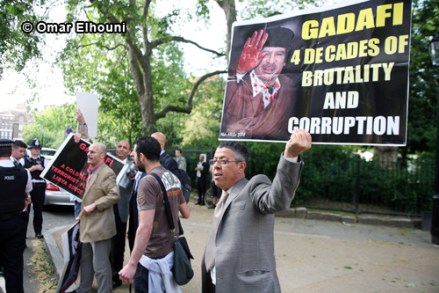
We look at some media including pictures and video of the Libyan anti-Gaddafi protest, maps of deep time, and my own hilariously edited video of a mugging, courtesy CCTV. And speaking of the surveillance state, don’t forget about Stephen Graham tonight at LSE.

Libyan Thugs in the Heart of London, Cont’d Again

This is the last post I’ll write on the subject (probably), but it makes for a good distraction from studying. The exam’s tomorrow. This is how I roll.

Anyways, I got a lovely thank-you email from one of the Libyan protesters at the LSE last week. In addition to my writing, they made sure to credit my good friend the Hybrid Diplomat for his coverage of the event. The email also included links to a number of photo galleries that ‘their’ photographer had taken. Here is the Gaddafi contingent, glowering at the protesters and trading insults:

Saif al-Islam Gaddafi's coterie of bodyguards and thugs at the London School of Economics, May 26, 2010.

Compare that with the size of the protest:

Libyan men protest the Gaddafi regime at the London School of Economics, May 26, 2010.

More pictures are available in galleries here and here, though since receiving the email it looks like someone flagged the sites as “attack sites” (I would assume someone tied to the Gaddafi regime). They’re perfectly harmless. Also available as a special treat is a video of yours truly sitting with Fathallah, the victim of a Libyan beating:

Please distract me in any way possible; it’s only 16 hours until the exam.

I Guess CCTV Is Good for Something

A friend of mine got mugged over the weekend coming back from a bar on Saturday night. Luckily, only his phone was taken and he wasn’t hurt at all.

Naturally, CCTV was useless in helping to prevent the crime or even to identify the assailant after the fact. Two separate cameras caught it, not that that matters. Also, rendering the cameras even more useless, they were owned and operated by the LSE, though they were kind enough to release it to my friend.

From him, it got to me. I took the liberty of editing the footage into a single video, and added a very necessary soundtrack. The whole thing only took me about 30 minutes. At least some good came out of the whole affair…

EDIT: Most of the details regarding the path that footage took to get to me were dead wrong. They have since been corrected.

Stephen Graham to Speak at the LSE

Back in April, I wrote about emerging patterns of urban warfare and the new surveillance state that continues to grow in modern cities. Much of what I wrote was inspired by Geoff Manaugh’s amazing work at BLDGBLOG, but also by Stephen Graham’s new book Cities Under Siege: The New Military Urbanism. If that sounded interesting to you and you’ll in be in London next week, some great news:

Cities Under Siege

LSE Cities Book Launch

Date: Monday 7 June 2010
Time: 6.30-8pm
Venue: Sheikh Zayed Theatre, New Academic Building
Speaker: Stephen Graham
Respondent: Gareth Jones
Chair: Dr Fran Tonkiss

Cities have become the new battleground of our increasingly urban world. From the slums of the global South to the wealthy financial centres of the West, Cities Under Siege traces how political violence now operates through the sites, spaces, infrastructures and symbols of the world’s rapidly expanding metropolitan areas. Drawing on a wealth of original research, Graham shows how Western and Israeli militaries and security forces now perceive all urban terrain as a real or imagined conflict zone inhabited by lurking, shadow enemies, and urban inhabitants as targets that need to be continually tracked, scanned, controlled and targeted. He examines the transformation of Western militaries into high-tech urban counter-insurgency forces, the militarization and surveillance of March international borders, the labelling as “terrorist” of democratic dissent and Politics/Geography protests, and the enacting of legislation suspending “normal” civilian law.

But best of all…

This event is free and open to all with no ticket required. Entry is on a first come, first served basis. For more information, email d.tanner@lse.ac.uk.

I cannot wait. See you all there.

Deep Time and the Roads More Traveled

From Lapham’s Quarterly comes a series of maps exploring ‘deep time’ in a number of different ways. They’re all worth checking out, but particularly fascinating to me is this map of “Beaten Paths.” A good portion of what’s now I-80 in the U.S. echos the former Oregon Trail. The Khyber Pass is of course of historic importance, but appears to be one of the longest-running direct east-west routes in the world. What we think is new is thousands of years old. Plus ça change

Via Isegoria.

Trouble in Paradise

And by paradise, I of course mean NATO. Turkey has called an emergency meeting of the North Atlantic Treaty Organization in order to discuss the recent Israeli attack on the Gaza-bound flotilla. It’s a fairly routine response to such an event, except for what it might actually mean for the alliance and for Israel. As a refresher, Article Five of the treaty:

The Parties agree that an armed attack against one or more of them in Europe or North America shall be considered an attack against them all and consequently they agree that, if such an armed attack occurs, each of them, in exercise of the right of individual or collective self-defence recognised by Article 51 of the Charter of the United Nations, will assist the Party or Parties so attacked by taking forthwith, individually and in concert with the other Parties, such action as it deems necessary, including the use of armed force, to restore and maintain the security of the North Atlantic area.

Now, consider Article Six – and keep in mind that one of the flotilla ships, the MV Mavi Mamara, is Turkish-flagged:

For the purpose of Article 5, an armed attack on one or more of the Parties is deemed to include an armed attack:

[…]

  • on the forces, vessels, or aircraft of any of the Parties, when in or over these territories or any other area in Europe in which occupation forces of any of the Parties were stationed on the date when the Treaty entered into force or the Mediterranean Sea or the North Atlantic area north of the Tropic of Cancer [emphasis mine].

There is a whole world of possibility here, virtually none of it good. Whatever the justification is for Israel’s actions, it’s clear there are going to be consequences, the severity of which have yet to be determined.

Unfortunately, I cannot recall the exact source I saw this in (if you know it, remind me), but if there was an “international aid flotilla” steaming for Turkey with its supplies bound for the Kurds, would Ankara act much differently? It’s a good point – but the current membership of NATO renders such a hypothetical mostly irrelevant.

This could very well mean the beginning of the end for the Atlantic alliance. It will at least pose a serious dilemma in terms of composition. After all, who right now is more aligned with policy and public sentiment in Europe: Turkey, or America?

Different Strokes for Different Folks, or, Whatever Floats Your Boat

Regardless of what the true story is with the Israeli interception of a Gaza-bound flotilla, all sides and interested parties will take away from it what they want to. Much like the al-Durrah incident in 2000, the flotilla intercept will be used a prism through which any side can view the conflict as a whole.

For instance, the earliest reports that were unable to describe anything more detailed than Israelis boarding the flotilla and killing ten implied a massacre for which Jerusalem was directly responsible. But already video has come out with the true nature of the “peace activists” revealed (via Information Dissemination):

Of course, this in no exonerates Israel of responsibility for the raid in the first pace. If nothing else, this was a public relations catastrophe that could easily spark a third intifada. And it’s hard to see how the result couldn’t be predicted on either side. Galrahn calls it a given:

It is hard for Americans to draw any analogies, because we don’t have a relationship like the one between Israel and Palestine.

But if 1000 people from Mexico, whom our government presumed was mostly made up of drug cartel supporters, tried to sail into San Diego with the expectation of running the blockade of the Coast Guard and creating a political demonstration through confrontation – I assure you the odds of people getting killed would be pretty high.

Just like they were in this situation.

Either the flotilla itself was an intentional provocation – or not. It really does push the limits of the imagination to assert that no one had any idea a flotilla like that would possibly provoke Israel. But as Abu Muqawama explains, it’s Israel that should have had an even clearer idea of the possible consequences:

But for the sake of argument, and putting ourselves in the shoes of an Israeli naval commander, let’s assume the most malevolent of motivations for the people participating in the peace flotilla. If I am in charge of doing that for the Israeli Navy, I am going to assume these people are smart and are deliberately trying to provoke a crazy response from my sailors and soldiers that will produce ready-for-television images that both isolate Israel within the international community and further raise the ire of the Arabic-speaking and Islamic worlds. I mean, that is my base assumption for what this group is trying to do. So naturally, the last thing I would want my forces to do would be to overreact, right? [emphasis in original]

One need not assign blame to anyone in order to see this as the colossal fuckup that it is. As usual, absolutely no one wins this game.

Memorial Day

Like Air Force One over Mount Rushmore, it’s hard to find anything more American than Johnny Cash reading the Gettysburg Address.

It’s days like this where I’m embarrassed by my lack of eloquence. I don’t know quite how to express my gratitude and profound respect for those who have served and continue to serve the United States in uniform. It’s a step I don’t know if I’ll take; a commitment that right now I can’t promise to anyone. But that’s what makes you in the military all so much more impressive. It’s thanks to you I have history to study, a country to be proud of, any ideas of my own to write about.

You have made the world, and you continue to shape it.

You have the discipline and the courage to sacrifice for us. To go a step beyond. To show your own kind of restraint. To give us something to admire, to look up to, to inspire us. And I don’t.

All I can do is try and thank you for everything. At the risk of sounding hollow or trite, you never cease to amaze me. And I will never cease to appreciate you for it.

Thank you.

A New Definition of Suburban Sprawl

The atomic bomb was on everyone’s mind quite a bit in the late 1940s. Clearly it was a real city-killer of a weapon, one that worked best when targeted against a dense population system. So what was America to do in the face of such a threat? Simple: spread them out and move all industry underground.

The crux of the issue was to remove everyone from any American city with a population greater than 50,000 people and place them in newly-built communities set out across the country’s landscape (mostly) like a chess board, the towns existing on all of the connecting lines. [As weird as this sounds, the great Norbert Wiener came up with a similarly astounding, untouchable idea using circles.]. The authors proposed to build 20,000,000 new homes, relocate industry (preferably underground), reallocate and redistribute energy supplies and natural resources, and recreate the very fabric of social and economic life in America.

Via io9.