“The Dropout Economy”

Great article in TIME by Reihan Salam. It’s short, but provides a pretty good indicator of the future to come, particularly for my generation:

But what if the millions of so-called dropouts are onto something? As conventional high schools and colleges prepare the next generation for jobs that won’t exist, we’re on the cusp of a dropout revolution, one that will spark an era of experimentation in new ways to learn and new ways to live.

It’s important to keep in mind that behavior that seems irrational from a middle-class perspective is perfectly rational in the face of straitened circumstances. People who feel obsolete in today’s information economy will be joined by millions more in the emerging post-information economy, in which routine professional work and even some high-end services will be more cheaply performed overseas or by machines. This doesn’t mean that work will vanish. It does mean, however, that it will take a new and unfamiliar form.

Look at the projections of fiscal doom emanating from the federal government, and consider the possibility that things could prove both worse and better. Worse because the jobless recovery we all expect could be severe enough to starve the New Deal social programs on which we base our life plans. Better because the millennial generation could prove to be more resilient and creative than its predecessors, abandoning old, familiar and broken institutions in favor of new, strange and flourishing ones.

Only thing missing is the increasing incidence of a five-year plan (or even more) to graduate. Spreading out the experience isn’t necessarily a bad idea.

And at least this means we’ll be good at something. The alternative, of course, being to cryogenically freeze ourselves until the economy improves.

More analysis from Shlok Vaidya here and John Robb here.

The Hummingbird has Landed

The A160T Hummingbird Unmanned Helicopter/Rotorcraft.

Boeing’s A160T “Hummingbird” robot rotorcraft has been cleared for liftoff.

A series of tests conducted at the Army’s Dugway Proving Ground in Utah achieved all of the necessary goals laid out for it. The Hummingbird can successfully

deliver at least 2,500 pounds of cargo from one simulated forward-operating base to another 75 nautical miles away in well under the required six hours. The simulated mission carried 1,250-pound sling loads over two 150-nautical-mile round trips, with the A160T operating autonomously on a preprogrammed mission.

A max payload of 2,500 pounds? 20,000 foot ceiling? This thing is badass.

The real question how long before garage tinkerers make rotary-wing variants of their DIY drones. At the rate they’re advancing for fixed-wing, it won’t be long at all. Just think of all the things you could do with a helicopter as opposed to a plane…

A Taste of Libya

Michael Moynihan has a scathing report on his recent journey to Libya. Highlights are below, but definitely read the whole thing. It’s like P.J. O’Rourke at his best.

When the BBC reported that “at Tripoli’s ultra-modern airport…you could be almost anywhere in the world,” I expected at bare minimum a Starbucks, a fake Irish pub, and…a bank of vending machines dispensing iPods … Well, perhaps we came through Libya’s spillover airport, its Midway or Stansted, because this is “anywhere in the world” only in some mad, dystopian-novel sense. Available for purchase are Egyptian gum, cheap watches celebrating 40 years of the Libyan revolution, and glossy magazines with Hugo Chavez on the cover.

Libya ought to at least resemble a wealthy country, with its vast oil reserves and all those desperate politicians willing to do almost anything in exchange for access to them. Yet Tripoli is covered from end to end in garbage.

Remove the oil economy, and it isn’t entirely clear what Libyans do for money. The only shops I spot are selling either vegetables or cigarettes, sometimes both. There are markets trading in all manner of junk: old sewing machines, toilets, fake perfume (Hugo Boos seems particularly popular). The most frequently promoted product…is, inexplicably, corn oil.

The pious Muslims of Libya are not unlike vegetarians, surrounding themselves with pointless facsimiles of the forbidden, from beef bacon to bottles of booze with all the booze removed.

Soon after arriving, along with three other journalists and one academic, we are…to meet the first group of terrorists recently released from Tripoli’s notorious Abu Salim prison. All are former members of the Al Qaeda farm team known as the Libyan Islamic Fighting Group (LIFG) … With every conversation, they sound more and more like the Women’s Auxiliary Balloon Corps of Al Qaeda.

Mexican Standoff

Gunmen killed an American consulate worker and her husband in Ciudad Juárez. Their baby was found in the back seat.

News comes that the cartels in Ciudad Juarez have finally started targeting U.S. nationals, murdering three last night. One was a pregnant consulate worker and her husband, the other was the husband of another consulate employee. I’m suprised only that it took so long (and that only now is the violence in Mexico “provoking an angry reaction from the White House”).

If we don’t end the War on Drugs, the impetus and justification for organized crime and narcotics trafficking will only increase, as will the profitability of murder. As the Times reminds us, “more than 2,000 people were killed there last year, giving it one of the highest murder rates in the world.” American students are arriving in Acupulco now for spring break. And for the cartels, the risk-reward benefit right now is too large to ignore.

But violence itself isn’t the only thing to fear here. The cartels and gangs (this particular shooting was blamed on Los Aztecas, who only get more impudent) have effective control over much of northern Mexico. The crippling government weakness is now affecting the very legitimacy of the Mexican state. The catastrophic death toll has:

prompted the government to shift course after three years of its military-led crackdown on drug cartels and acknowledge that it has to involve citizens in the fight and deal with the social breakdown fueling the violence. [emphasis mine]

For now, those efforts will be government-coordinated. But in the future, who’s to say that the citizenry won’t take matters into their own hands, like in the favelas of Rio de Janeiro? Chirol thinks that the future of the border patrol will be a similiar, civilian, militia-style solution, at least on this side of the border. The key, though, is probably fixing that whole ‘social breakdown’ thing. Restore faith, restore legitimacy.

At least the problem is finally back on the radar again.

Recommended Reading (2010-03-14) – SUNDAY Edition

Actual Iranian postage stamp, 1983.

Foreign Policy offers a brief introduction to that subtlest of espionage tactics, the ‘honey trap‘. It’s certainly Sterling Archer’s favorite.

– A fantastic series of photographs called Vider Paris shows the French capital devoid of people, and with the bottom two stories shielded with concrete. But the crosswalks remain.

– Will Wiles offers a great review of the new American embassy in London:

It’s worth taking a step back to really admire what we’re looking at: a building designed with explosions in mind. A shape formed by the manipulation of spheres of destruction. It could be the first London building built with attack from the ground in mind since the Second World War.

Isegoria offers an overlook of the very first American assault rifle: the Pedersen device.

– An absolutely fascinating article in GlobalPost on Theo Padnos, who pretended to convert to Islam and infiltrated several mosques and madrassas in Yemen. His inside look will surprise you:

As an educated, left-leaning American, Padnos says he expected that intensive, firsthand exposure to the Salafist faith would temper the message emanating from the West, that these ultra-conservative Muslims were to be feared.

Instead, he says that what he witnessed worried him further.

– Terry Eagleton gets Hitchens, Amis, and the rest of the iconoclast ‘movement’ entirely wrong (it’s “Islamophobia”).

Dragon at Sea: A Brief History of Chinese Navies

The strategic arena of East Asia.

SINCE THE END OF THE COLD WAR, American naval supremacy has been unchallenged throughout the world. Even during that massive, global struggle, the Soviet Navy never came close to rivaling the power projection capabilities of the United States (of course, this was never their intent).

With the dawning of the twenty-first century, however, many commentators are declaring it to be “China’s Century,” during which the People’s Republic will finally assume its rightful place as a counterweight to the United States. Despite the financial crisis currently engulfing the world, the U.S.-China trade deficit reached record levels in 2008, with $266 billion against the United States. If the economic sphere were a battlefield, China would surely be winning.

Yet, the crucial trade arena formed by the South China Sea, East China Sea, Yellow Sea, and Western Pacific Rim has gone largely ignored in China as an area of vital strategic importance. Half of the largest container lines in the world are owned and based in Asia, and one-third of the world’s shipping is owned by Asian nations.[1]

It would make sense, then, for China to possess and deploy a strong navy. Since the Communist victory over the Kuomintang (KMT) in 1949, maritime power has been neglected, but the last decade has seen an ascendant navalist faction in the upper echelons of the Politburo. China has now embarked upon a major program of modernizing the People’s Liberation Army Navy (PLAN), and while American superiority in the region is likely to remain for the near future, the rise of the PLAN will pose significant challenges to the United States Navy in decades to come.

While recent history would indicate otherwise, China has a long and storied naval heritage.

Continue reading

Men of the West

Babatim at Free Range International has a new update from the ground in Afghanistan. One quote struck me; either for the truth it holds or its stunning audacity (probably a little of both):

Less experience[d] cadres will do one of three things; stay in place because they are too freaked out to move, break contact and run because they are too freaked out to stay, or quickly surrender because they are too freaked out to fight.  Afghans do not have a cultural history of standing firm in battle and slugging it out toe to toe with heavy infantry.  Only men of the west fight using that style of warfare which is why western armies have dominated those of other lands since the battle of Plataea in 479 B.C.  I am not saying the Afghan Taliban does not have brave fighters….they do but brave individual fighters do not a cohesive combat unit make.  The shock of rapid violent assault by multiple platoons from multiple angles is something only a well trained, well equipped, well supported western army can handle.  [emphasis mine]

This, of course, is the same thesis of Victor Davis Hanson’s Culture and Carnage (later retitled more directly as Why the West Has Won) – that the west has a superior, innate ability to win the kinds of battles that shape the entire world. There are two sides to this – execution and will – and while the west has proved itself quite adept at winning (even so, not always), its will to fight in the first place seems diminished and continues to shrink.

The metaphors and parallels you could draw are all contradictory and point in very different directions: the U.S. as Rome to Britain’s Greece, the Greek bankruptcy, 300, a rousing speech from Aragorn, John Ford/John Wayne movies… Perhaps that’s just my train of thought leaving the station at full steam.

But what if the west starts abdicating its position, and what if it continues to cringe in the face of particular struggles? Western society is so risk-averse now that the slightest risk of harm – to regular, professional soldiers – now leads to accusations of “authoritarian” leadership. For heading into danger in the military! Thankfully the Dutch example is not pervasive throughout NATO (nor the Netherlands themselves, for that matter).

The Dutch have the 7th highest per capita rate of any nation in Afghanistan, Steve Coll calculated. But 21 dead is now enough to call off an entire deployment of a wealthy, western NATO member. Europe is certainly in decline. America too, albeit at a slower pace. But that’s just when the Netherlands needs to reassert itself as a full and willing member of the west. As does the rest of Europe. All need to be willing to defend themselves and their interests, with force if necessary.

Stand, men of the west!

War in the Pacific

I, like just about everyone, am looking forward to HBO’s new miniseries The Pacific. I mean like, really, really psyched; it’s been much too long in the making. But I’m really liking the Hanks-Spielberg team as of late.

Semperpapa at David Bellavia has taken Hanks to town, though, for the latter’s comments on the ‘true’ meaning of war in the Pacific. I responded at the source, but I also think the arguments deserve a full presentation, so here are his, followed by mine:

I was somewhat disappointed by Tom Hank’s simplistic look at what WWII represented for our Nation, when, during an interview, he stated that the reason America wanted to kill the Japanese was because they were different. They looked different, they believed different.
[…]
I could even understand that Tom, as a good Liberal, would hold America responsible for the Japanese attack on Pearl Harbor, because after all the American fleet was an “imperialistic” obstacle to the “legitimate” expansionist needs of Japan toward South Eat Asia.
[…]
In the interview, Hank points out his latest project wanted to honor the bravery of the American troops

“…but we also wanted to have people say, ‘we didn’t know our troops did that to Japanese people.’”…

I don’t know that Hanks’s opinions, overly simplistic as they are, can be blamed on his liberalism. There weren’t too many alternatives to what we did in either theater. Rather, his misinformation can be attributed to the general American ignorance about the Pacific theater.

Much of whatever vague impressions Americans get of the Pacific are from sources like Dr. Seuss’s wartime propaganda and the various posters attacking “yellow” “Japs.” Which if it’s all you’re getting, definitely paints a one-sided picture.

He’s also not entirely wrong. To a degree much more pronounced than in the ETO, the American war effort dehumanized the Japanese as both a race and a nationality. In Germany, we were fighting Hitler, but in the Pacific we were fighting the Japs. There was a distinct conflation of politics and racism there that was absent from Europe, or at least the western front in Europe. The Pacific shared a viciousness with that life-or-death struggle on the eastern front, where the choices were literally reduced to a binary: victory or death and enslavement.

But I don’t mean to condemn that brutality entirely. In most ways our response was a tit-for-tat regarding Japanese behavior. After enough incidents occurred when surrendering Japanese troops instead carried out the equivalent of a suicide bombing, we stopped taking prisoners. As a tactical solution it was entirely justified. We took no prisoners – but with good reason. See John Dower’s War without Mercy: Race and Power in the Pacific War for a fairly deep analysis of the course of the Pacific theater.

Basically, the dehumanization we carried out in the press and other media is being misattributed by Hanks to a cause of the war, rather than the fairly standard wartime practice and response to in-theater events that it was.

And of course, the Japanese behavior speaks for itself.

A Peaceful Rise at Home?

From World Military Forum:

BEIJING – A stronger Chinese navy will not seek to build military bases overseas, a retired senior officer has said amid media reports that the country harbors such “ambitions”.

Zhang Deshun, who was till recently the deputy chief of staff of the PLA navy, said a naval force with advanced armaments and enhanced capabilities will contribute more to UN-led anti-terrorism, anti-piracy and disaster-relief missions.

A larger navy with a greater reach does not mean it will seek to play the role of “world police”, said the retired rear admiral, who is a deputy to the ongoing session of the National People’s Congress.

I don’t know how to read this. I see several possibilities, not all of which ascribe ulterior motives to the Chinese. But most of them do. The first would be that they’re serious about this, and genuinely believe that if not now, then in the very near future Chinese naval capabilities will be such that they don’t require any overseas support facilities.

If that is true, their public admission of this could serve a twofold purpose: downplay concerns of a Chinese global power play, and at the same time serve notice to the United States and other maritime powers that China is advanced to this degree. After all, the U.S. operates a network of naval facilities around the world – perhaps Beijing is so powerful it doesn’t have to?

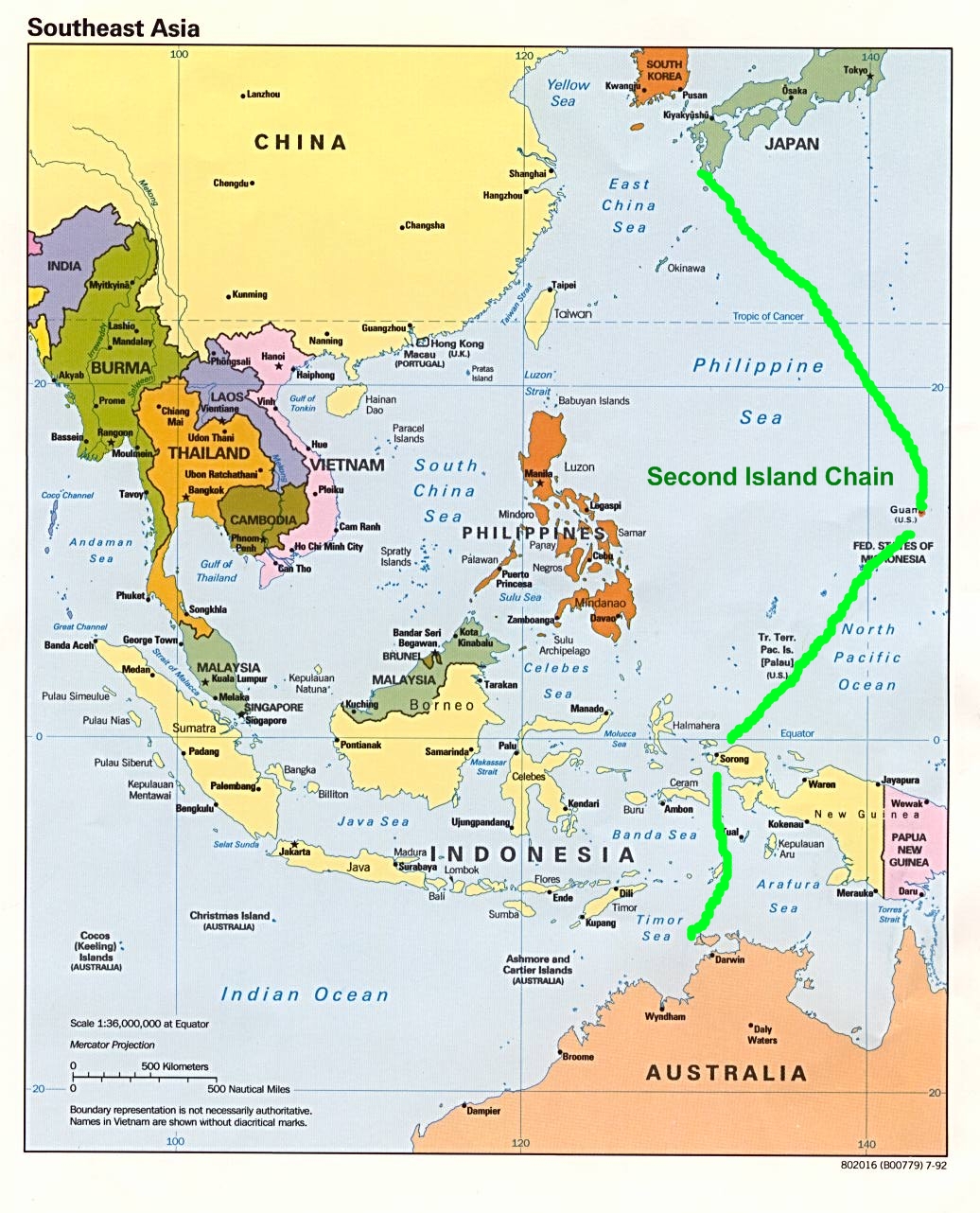
Alternatively, China could be using this to distract from the ‘three island chain’ plan.

The 'second island chain' of Chinese maritime strategy.

By eliminating the ‘third island chain’ – global, blue-water power projection – China’s ambitions of regional hegemony seem much more restrained and reasonable in comparison. But keep in mind that even the ‘second island chain’ in the strategy is demarcated by a line running from southern Japan to Guam through the middle of Indonesia and terminating at Australia. It’s still quite a bit of space.

Am I just being paranoid?