Tsarist Russia, in Color

"A. P. Kalganov poses with his son and granddaughter for a portrait in the industrial town of Zlatoust in the Ural Mountain region of Russia. The son and granddaughter are employed at the Zlatoust Arms Plant--a major supplier of armaments to the Russian military since the early 1800s. Kalganov displays traditional Russian dress and beard styles, while the two younger generations have more Westernized, modern dress and hair styles." 1910.

Sergei Mikhailovich Prokudin-Gorskii was a photographer in Russia born in 1863 and who lived until 1944. He invented his own camera, which in and of itself is impressive, but not only that – it was a color camera. The Library of Congress has used modern computing technology to recreate Produkin-Gorskii’s colorization technique, and the collection is available to view as “The Empire That Was Russia.”

These pictures provide a record of tsarist Russia in color, and the results are stunning. Transportation, ethnic diversity, and people at work are the themes of the exhibition. Make sure to check out the Austro-Hungarian prisoners-of-war in 1915. A land time might now remember.

.

Via Eternal Remont.

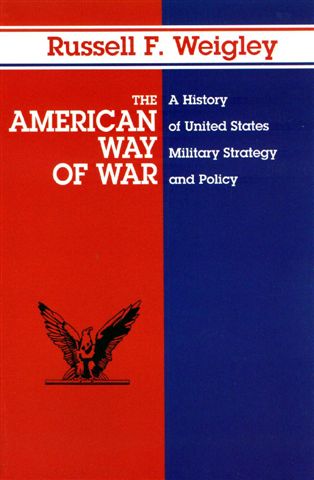
The American Way of War: A Review

After a long while of meaning to, I’ve finished Russell Weigley’s magisterial book The American Way of War. Took longer than it should have, but as a foundational text for understanding not only American strategy, but basic concepts of national strategy itself, this book is unsurpassed. It’s one of the few I can truly call “epic.”

Beginning with George Washington’s “strategy of attrition” during the Revolutionary War, Weigley traces the scope of American strategic thought up to the closing days of the Vietnam War. Structurally, American strategy falls into several phases. Washington eventually gives way to Halleck, who is then replaced by Ulysses Grant. Grant’s approach to war – “a strategy of annihilation” – then serves as the United States’ guiding principle until well into the twentieth century.

Continue reading

But They Knew Where the Keys Were

Even if they misplaced the tanks themselves. From the Telegraph:

‘There are tanks all over the forest, abandoned,’ an unnamed reporter on the video says. ‘If you need one, come and get it.’

Locals in a nearby village said the tanks had been sitting there for almost four months covered in snow. The armoured vehicles were identified as a mixture of T-80 and T-72 battle tanks, the workhorses of the Russian army.

Who has time to worry about where they left an entire armored regiment’s worth of tanks? What with the nation-state collapsing anyways and all manner of intrigue on every conceivable frontier… Or are the Russians early adopters of the “tanks do not equal power projection” school?

Transatlanticism

Daniel Korski’s new article in Foreign Policy, “Partners in Decline,” calls for a renewed US-European relationship, as a way of staving off marginalization at least for a while. It’s kind of hard to discern his point – clearly at this point, Europe needs the US far more than the US needs Europe. True, NATO is a force of legitimacy right now, but if the demographic trends Korski points to as signs of decline continue, won’t it begin to lose that legitimacy as it becomes less and less representative of any significant proportion of global population?

Korski also misinterprets history. He asks us to

Imagine if the United States had in the past chosen its allies exclusively on whether they were willing to fight alongside the 82nd Airborne. That would have meant abandoning an alliance with Britain in 1966 after then-Prime Minister Harold Wilson refused to send British troops to the Vietnam War.

Is there some sort of treaty or piece of paper we would have torn up? Aside from the (predominantly cultural) Special Relationship – which certainly was damaged for most of the 70s until the Reagan-Thatcher revival – Britain’s refusal to commit troops to Vietnam was no more than a disagreement between longtime global partners. There was no real ‘alliance’ to end as a response but even that informal alliance was seriously damaged.

I wouldn’t go so far as to advocate an American withdrawal from NATO (as Andrew Bacevich does), but at the same time it is perhaps on an even steeper path to irrelevancy than Europe and the United States themselves. Korski’s argument is in itself contradictory, as his prescription for waning influence just reemphasizes the extent of Western decline. And like all other nation-states, it is an inevitable collapse.

Recommended Reading (2010-03-02)

U.S. Marines from Bravo Company of the 1st Battalion, 6th Marines look for a Taliban sniper from inside a cotton workshop in Marjah, Helmand province, February 19, 2010.

– The captain of Hr.Ms. Tromp, a Dutch frigate conducting anti-piracy operations in the Gulf of Aden, has a Twitter account. Recent highlight: “approaching a suspiciously behaving Dhow, turned out they were all (!) asleep” (via Information Dissemination).

– The recent Chilean earthquake has permanently affected the length of a day. Sure, only by 1.26 microseconds, but even so.

– American manufacturing is not dead after all. But the statistics everyone quotes do refer to a loss in the manufacturing industry: a loss of manufacturing employment. Hale Stewart breaks down the numbers.

– Everyone knows that cities (particularly the slum-riddles megacities of the developing world) are the future. But that might actually turn out to be a good thing.

– The Army Air Force again? The Air Force is having a bit of an identity crisis – and some are questioning its existence as an independent branch (via Neptunus Lex).

Recommended Reading (2010-02-28) – SUNDAY Edition

New propaganda poster from the Second Artillery Corps, the land-based ballistic missile unit of the People’s Liberation Army (via War is Boring).

– Shades of Scott Brown: remember that impending Tory victory? Turns out it might not happen after all (via Harry’s Place).

– Charlotte Allen takes on the modern dating game, including its neo-Neanderthals. Regression? Lateral movement? A trend that is nothing else if not hilarious.

Slate answers the question we’ve all been asking ourselves: does Afghanistan have phone books?

Naval jihad in the Gulf of Aden. Constant exchanges between Yemen and Somalia. Reclaiming the Bab al Mandat Strait for Islam. And it’s much more effective than we thought:

An AQAP-HSM coalition would not have to actually block the 18-mile wide sea corridor…. Instead, all they have to do is conduct some kind of operation that permeates a far greater psychological threat internationally.

– A bit older, but the New Yorker did a piece on “neuro-enhancing drugs” last year that’s absolutely perfect. Dead-on. I think I recognized myself in at least three of the article’s subjects.

– Now that Multicam’s been officially approved, Oakley has put out a pair of ridiculously fly boots. But I doubt they make them in a 16 (via Strike – Hold!).

– A fascinating overview of how the recession has impacted migration in America. Massachusetts better off than New Hampshire? New York seeing more inflow than Vermont? And the world is upside down.

Reliving the Past

As Herbert Butterfield warns us and as I’ve mentioned here before, past performance is no guarantee of future results.  I was then pleased to read Patrick Porter’s latest column, “The Shadow of the Fathers.” He writes about invocations of the Founding Fathers as justification for all manner of… anything, really. To him, American policymakers have “the tricky job of acknowledging the powerful ideas and heritage that shaped American statecraft, while also resisting it.”

Perhaps my favorite line in the piece, though, belonged to Nicholas Spykman:

Not conformity with the past but workability in the present is the criterion of a sound policy.

Words for today.

Many Happy Returns

At the risk of sending this backup laptop to join my other in the great trash heap in the sky, I think I’m ready to make a comeback (but don’t call it that). The damage to the other one – melting – was a little too significant to make replacing the power assembly alone feasible. Here’s what the outside looked like:

So yeah, the end of an era it is. But now I have a spare up and running (though it has monitor/screen issues of its own), and hopefully can keep doing this for a while. I’ve got lots of ideas ready to go.

Abdication

The grim future of a world without net neutrality

The government won’t push for it. The existing near-monopolies have no incentive to change. So who steps up? Google, of course. Google’s plan to offer internet services at the blisteringly-fast speeds of up to 1 GB/s could finally revolutionize the American broadband network. As a bottleneck for innovation, the archaic state of internet infrastructure obviously needs improvement. South Korea leads the world in internet speeds, with a 100 Mbps fiber optic line scheduled to come online nationwide this year. The United States didn’t make the top ten – it was 18th in the world with an average speed of 3.9 Mbps.

But no one will act (even though Google’s been prodding telecom companies), and the government won’t push anyone to act.

The risks of lagging behind are comparable to net neutrality in terms of stifling new developments, which is why it may seem weird to call for more regulation. But the regulation that would help only need set a baseline for acceptable quality and service.

This kind of wide push for faster internet service works on a number of levels:

  1. It allows for new growth, research, and innovation.
  2. It keeps the U.S. on equal footing with the rest of the world.
  3. It allows us to avoid ridiculously hyperbolic nightmare scenarios like the “bandwidth caps” Mark Cuban envisions (and I won’t even begin to take apart his prediction of our computerless-future).
  4. New infrastructure work, especially as part of a comprehensive federal plan, will a) allow/mandate simultaneous rural development, always a must in the expanse of the United States, and something any corporation is loathe to take on of its own volition (the per capita subscription rate really can’t justify it, but thanks to equal representation in the Senate is a necessity nonetheless), and b) create jobs. Let’s also not forget those 93 million Americans without broadband access at all, whom Cuban’s market-based solutions have clearly left behind.

As Google is proving though, the federal government has little interest in sweeping technology improvements across the country. A Reaganesque privatization this is not. The government has merely ceded responsibility to the private sector yet again.

One Man’s Malaise is Another’s Motivation

We’ll see if I can’t get up and running more regularly, but this is such an accurate quote to describe the lack of anything being undertaken in Congress that I needed to risk another meltdown:

Members of Congress—including seven Republicans who had proposed the idea—were even too chicken to vote for a bipartisan commission. This is the political equivalent of being too timid to take a nap.

I’ve jury-rigged the laptop to work in spurts while I wait for my backup to get sent, so I’ll have a semi-regular selection of new material for you. But hell, this one post alone has made my week more productive than the United States Congress.