Hurry Up… and Wait

Right now I’m dealing with some serious computer difficulties. The key word here is ‘melting’, and you never want to hear that in conjunction with electronic equipment. I don’t know whether I’m in for repairs or replacements, but a heads-up: I might not be posting for a little while, or at the least, very infrequently. It won’t last months, but at least a week or more I should think. Thanks for reading; stay tuned.

Recommended Reading (2010-02-14) – SUNDAY Edition

"The scariest unemployment graph this year."

It would appear that we have reached the limits of what it is possible to achieve with computer technology, although one should be careful with such statements, as they tend to sound pretty silly in five years.

John von Neumann, 1949

– Don Peck sees a grim future for the American economy. Persistent joblessness and relatively high employment will most likely continue to reign for at least the next decade. And the current generation of recent graduates? Yeah, we’re pretty much screwed. Get ready for depression, heavy drinking, and lifetime of mental scarring (via Sullivan).

– Are you an eccentric billionaire? If so, maybe you too can buy a former closed Soviet city in Latvia. And how much might this set you back? Only $3.1 million. Man, has the housing bubble burst (via Disinformation).

– The New York Times has a must-read piece about the battle between Christianity and secularism on the Texas School Board. It’s argued that “we’re a Christian nation,” etcetera etcetera. Religious lunatics are everywhere these days.

– Israel’s legitimacy is under attack everywhere (especially Britain). But even for those who support and defend Israel, and don’t question its right to exist, arguing on its behalf can be troublesome:

Anti-Semites will never be appeased and are not worth engaging on Israel. But to those people who simply care about basic human values, how do you answer “Why does Israel keep expanding its settlements into areas it knows it would have to evacuate in any peace deal?” How can any reasonable person see “Sudan has killed hundreds of thousands of people” or accusations of anti-Semitism against any critic of Israel as anything more than a feeble deflection. It is true that no matter what Israel does, some people will vilify it. Israel should not make movements towards peace to mollify them or anyone. It should do so because it is both the moral thing to do and a strategic necessity for Israel’s long-term survival.

– Change blindness: the more you see it, the more you don’t (via Isegoria).

– David Aaronovitch (new book just released) talks about the appeal of conspiracy theories, even for smart people. And don’t forget the one about IDF theft of organs in Haiti. At least Jenny Tonge got sacked.

– Tonge forgot that blood libel has a long and storied history. That general historical ignorance may soon be on the rise, as Britain’s historians – last of the outward-looking – face an inward, parochial turn.

SMS Goeben, the Berlin-Baghdad Railway, and the Coming of the Great War

SMS Goeben

In November of 1914, the once-mighty “sick man of Europe,” the Ottoman Empire, entered the war to end all wars as a Central Power. Having concluded a secret alliance with Germany against her long-time rival Russia, the conditions for war were met, and on November11 Sultan Mehmed V declared jihad.

As with so many other empires, the jump into war would prove to be the downfall of Turkey as a Mediterranean power, and in fact as an empire at all. The terms of their alliance with Germany pulled the Ottomans into the war, but the real question remains: what led them to sign it? The answers can be found in two places: the Berlin-Baghdad Railway, and the arrival of the SMS Goeben.

Continue reading

Marjah

Lance Cpls. Keith B. Lawson and Spence G. Press, scout snipers attached to Charlie Company, 1st Battalion, 3rd Marine Regiment, work together to identify targets as Taliban fighters approached from Marjeh toward their position at the “Five Points” intersection Feb. 9, 2010.

Last night, the American, British, and Afghan assault on Marjah began. 6,000 soldiers were in the initial wave, and another 15,000 have been committed to rooting out Taliban-aligned elements operating in the area. Early reports have five Taliban fighters and one British soldier killed.

Resistance has been “light.”

In the run-up to the attack, there was no shortage of criticism over the advance warning given, the stated objectives, and even the target of Marjah itself. It was certainly well-founded. Registan argued that the strategic value of Marjah was limited at best and that the amount of opium production in the area was overstated, while Wired characterized the Coalition heads-up as asking residents to “please, please, pretty please don’t leave the warzone.” But everyone may be wrong about the purpose (or at least the timescale) of fighting in Marjah altogether. From Free Range International:

When the Marines crossed the line of departure today, the battle for Marjah had already been won.

Like a master magician General Nicholson mesmerized the press with flashy hand movements to draw attention away from what was important.  The press then focused on the less important aspects of the coming fight.  Just like a magic show the action occurred right in front of the press in plain view yet remained out of sight.

In an unparalleled combination of regular and special forces units, the real conflict over Marjah was conducted mostly behind the scenes. It’s too early to say for sure, but the FRI analysis sure does raise some interesting points. If the goal was to convince the Taliban (and not the civilian inhabitants of Marjah) to leave, doesn’t that just allow them to escape and regroup? (i.e., what’s the point?) Obviously avoiding civilian casualties is of huge concern, but there still seems to be a disconnect over goals and methods.

Conversely, even if everything is going as planned and the Taliban bugs out, “somebody has to do the hold and build – it is not fair or smart to put that burden on the 2nd MEB.” Absolutely. I can’t help but wonder how thoroughly the post-battle plan was thought out.

Either way, at this point nothing to do but play the waiting game. Now let’s see how this plays out.

Recommended Reading (2010-02-13)

Pete Warden breaks up the United States based on data collected solely from Facebook.

Slate has a great roundup of national anthems in anticipation of the Olympics. Good luck identifying “Kimigayo.”

– Nothing quite like learning from the best: many of the high-tech crowd dispersal units used in Tehran were bought from China. Pioneering the art of authoritarian crackdown since 1949.

– Don’t give up hope on Iran just yet. There’s too much at stake, and a democratic outcome would be nothing less than world-shattering. Reuel Marc Gerecht in the New York Times (via Sullivan):

A democratic revolution in Tehran could well prove the most momentous Mideastern event since the fall of the Ottoman Empire.

– The Times takes a welcome stance against Amnesty International’s firing of Gita Saghal. A once-proud institution that has completely sullied its reputation by enabling Islamic extremists and perpetuating the ‘Cageprisoners’ story.

– Galrahn takes a look at upcoming naval ship class retirements, deployments, and possible replacements.

22 Bahman as COIN

Crossposted at Secure Nation.

So in addition to using their Chinese-made riot trucks and gas attacks on the protesters, the Iranian security forces were able to quell much of the 22 Bahman uprising by simply relying on the weakness of the movement’s organizational structure. Letting the enemy defeat itself; very Art of War. The very lack of hierarchy in the green movement was both a blessing and a curse. From Foreign Policy:

Like many of the green movement activists, Sadeghi’s belief in the protests seems related to their “horizontal organization,” the fact that they were structured without hierarchies. This was supposed to be the great strength of the movement, but it is also an abiding weakness. A horizontal organization can’t clearly delineate different roles to different people according to their strengths; it can’t reward those who participate, or sanction those who hesitate. Facebook enabled many young Iranians to forget these points.

Now obviously the Taliban is not organizing via Facebook, but the principle of decentralization is the same. Avoid having a center of gravity, put together your demonstrations (attacks) at the last possible minute; coordinate, execute, and then melt away into the night. But if the Iranian green movement using the same principles was successfully put down, does this offer us a rubric for approaching insurgencies?

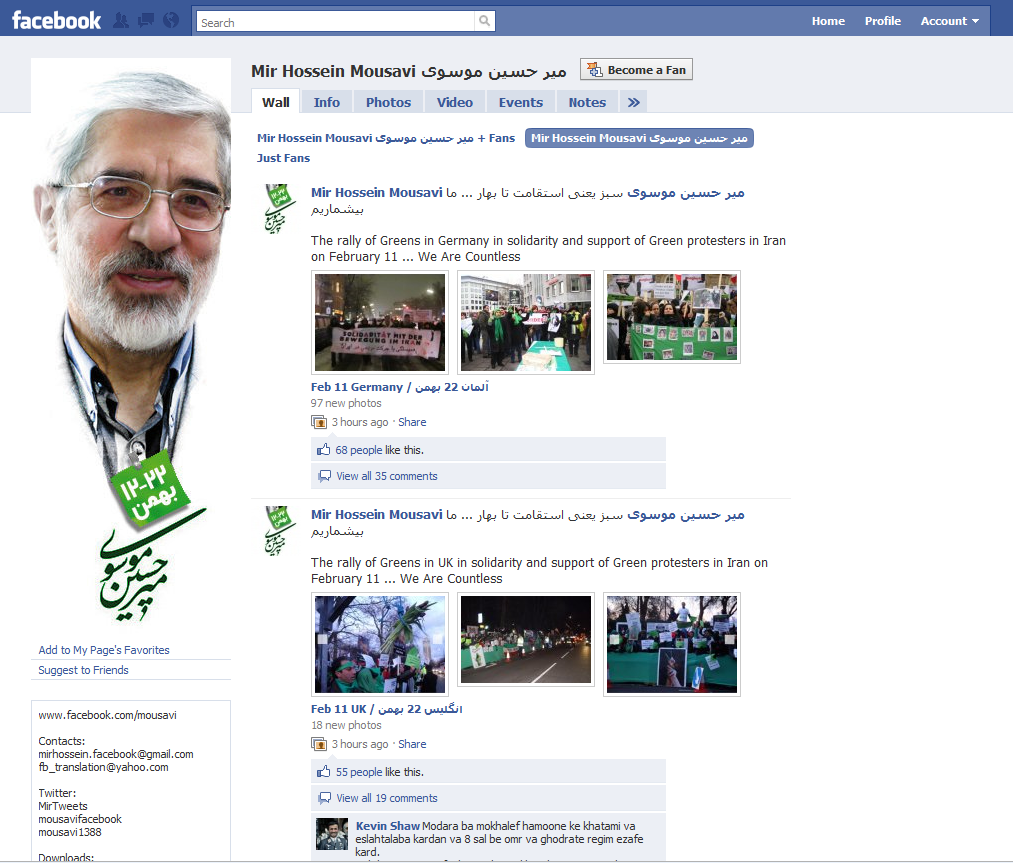
Mir Hossein Mousavi's Facebook page.

The short answer is probably not. The Taliban is not planning its operations through Facebook or tweets. But the reason the Revolutionary Guard so effectively shut down the protests was by blocking access to means of communications; that is to say the internet. No Gmail, no Facebook, no twitter meant that there was no coordination between demonstrators, nor was there a way to quickly spread the word of crackdowns in a particular area. The networks used by the Taliban for communication are more dispersed, making a system-wide shutdown more difficult. Walkie-talkies and satellite phones are the order of the day, and while we can intercept calls, we cannot easily end them. Even if we did, human couriers would merely proliferate further.

Also worth keeping in mind is the psychological element. The pushback given by the Iranian regime was demoralizing and a clear setback for the movement, slowing momentum and further progress. Presumably more than one green movement adherent changed his colors, or at least plans to lay low thanks to the IRG. But when ISAF and the United States attempt to stop the movement (the Taliban), it disperses them without costing the Taliban anything. Most of the Iranian protesters were relatively concentrated – do we need to herd Taliban fighters into a single killing zone? And is the Battle for Marjah a step in that direction?

Accompanied by a Wry Signoff

Does anyone still watch news? I find myself more and more turning towards online text. With the possible exception of The Onion, video news is a total waste of time. There are so many ways to obscure your lack of a point with video, the vast majority of which usually ends up as meaningless. On Newswipe, Charlie Brooker explains “how to report the news,” beginning with that lackluster establishing shot (via Disinformation).

With Open Arms

Admiral Michael Mullen, Chairman of the Joint Chiefs of Staff.

I’ve meant to talk about it sooner, but it wasn’t until I saw some particularly egregious arguments that I was spurred to action. Don’t Ask, Don’t Tell absolutely needs to be repealed. First announced at the State of the Union address, Defense Secretary Bob Gates and JCS Chairman Admiral Mike Mullen continued to call for it at a press conference later that week. Admiral Mullen’s comments – declaring the current policy as detrimental to the military’s integrity – are particularly noteworthy:

No matter how I look at this issue, I cannot escape being troubled by the fact that we have in place a policy which forces young men and women to lie about who they are in order to defend their fellow citizens. For me, it comes down to integrity — theirs as individuals and ours as an institution. I also believe that the great young men and women of our military can and would accommodate such a change. I never underestimate their ability to adapt.

We would also do well to remember that this is not an issue for the military leadership to decide [emphasis mine].

Continue reading

Recommended Reading (2010-02-11)

Back on Track?: Jobs lost per month between December 2007 and January 2010 (via GOOD).

In any world menu, Canada must be considered the vichyssoise of nations — it’s cold, half-French, and difficult to stir.

Stuart Keate

As Iran prepares for today’s festivities…

– Moscow seems surprised that the world gets a bit nervous when Russians start talking about reenacting Red Dawn.

– And if you weren’t yet feeling nostalgic for the Cold War… that’s okay, because we may be on the verge of a new one with China. And it’s the Chinese who say so.

– Nate Silver crunches the numbers and possible scenarios for a 2012 Palin bid in the Republican primary. There are many more avenues open than I care to see.

– A nifty little overview is available at Howstuffworks on snipers. More detailed than I thought it would be.

The Liberal from Lufkin

Charlie Wilson died today. From my limited knowledge (basically a book and a film), I’ve developed a deep admiration for the man. To some extent his death is part of the passing of an era, for better or for worse. But this country will surely miss him. Bob Gates writes a fitting farewell. We’re still picking up the pieces, as Charlie always wanted.

I had the unforgettable experience of knowing Congressman Wilson when I was at CIA and he was working tirelessly on behalf of the Afghan resistance fighting the Soviets.  As the world now knows, his efforts and exploits helped repel an invader, liberate a people, and bring the Cold War to a close.  After the Soviets left, Charlie kept fighting for the Afghan people and warned against abandoning that traumatized country to its fate — a warning we should have heeded then, and should remember today.

America has lost an extraordinary patriot whose life showed, once more, that one brave and determined person can alter the course of history.

Amen, Mr. Secretary. Good-Time Charlie, we hardly knew you.