Freedom™: A Review

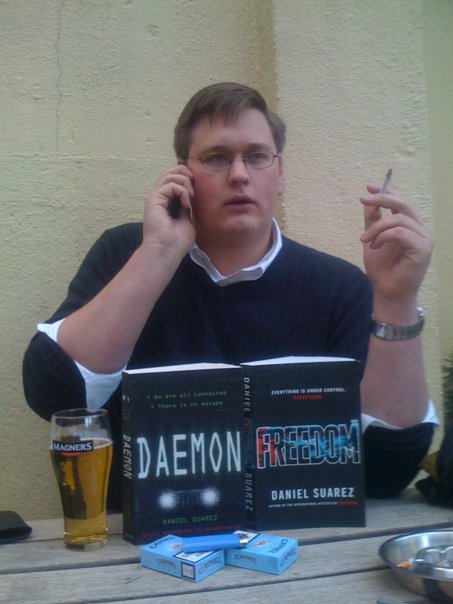
This author, with Suarez' duology at a London pub, May 2010.

After cruising through Daemon in about 2 days, Freedom™ was even quicker: I blew through it in about 24 hours (back in May). That’s no knock against it, though; rather, I just couldn’t put it down at all.

This review will be brief, even though it’s taken me almost three months to get around to finishing it. Basically, if Daemon was the end of the beginning, Freedom™ is the beginning of the end. Or at least of the next step. It lays out the climactic struggle much more succinctly, a titanic clash between people and business, corporate and individual. I found this particular passage most instructive:

You, sir, are walking on a privately owned Main Street—permission to trespass revocable at will. Read the plaque on the ground at the entrance if you don’t believe me. These people aren’t citizens of anything, Sergeant. America is just another brand purchased for its goodwill value. For that excellent fucking logo … No conspiracy necessary. It’s a process that’s been happening for thousands of years. Wealth aggregates and becomes political power. Simple as that. ‘Corporation’ is just the most recent name for it. In the Middle Ages it was the Catholic Church. They had a great logo, too. You might have seen it, and they had more branches than Starbucks. Go back before that, and it was Imperial Rome. It’s a natural process as old as humanity.

Of course, overreach leads to retreat and retrenchment, et cetera, et cetera. Even if the message seems a little obvious (and by no means subtly presented), it’s an important one, and it’s framed in an interesting new way. It’s that presentation that makes this not only legible, but well worth your time, if not just to see what the traditional cries of anticonsumerism and Adbusters-type activism look like in the digital age.

John Robb’s ‘holons‘ take some big strides here too; Suarez has done an excellent job of envisioning the resilient community concept, and doing so in a way that makes them seem not only possible, but inevitable. A blueprint for the future? Not necessarily. But at the least, a realistic portrayal of the kind of decentralized communities that we’ll hopefully be migrating to in the future. Thanks to Daniel Suarez, they’re more than just a concept.

So read Daemon and then read Freedom. Seriously, you won’t be disappointed. And even if you are, ignore the prose and focus on the message – it’s one we sorely need to listen to right now.

Buy Freedom™ at Amazon.com.

Daemon: A Review

After hearing praise from my various luminaries like John Robb, Shlok Vaidya, and zenpundit, there’s no way I could not read Daniel Suarez’s Daemon. The tagline reads “Michael Crichton for the information age,” and in virtually all aspects the book lives up to such a lofty claim.

It’s hard to really explain the book (I found myself attempting to do just that to a drunk South African, and coming up short), but as simply as I can: super-brilliant computer genius who’s responsible for two of the best-selling MMORPGs of all time dies. He’s left embedded in the internet a program – the titular DAEMON, or Disk And Execution MONitor – that can respond and react to news items (such as said genius’ death, or the abortive raid on his house). Using the interconnectedness of the global economy, the daemon insinuates itself into daily life, capitalism comes up against the resilient community, etc, etc.

Anyways, if it sounds pretty far-fetched…it will certainly seem so at times. The prose is nothing particularly elegant or lofty, but that’s not why you read a book like this. The concepts, technologies, and overall contours of the plot are entirely engaging, and this is really a ‘page-turner’ in the tradition of Clancy or Crichton, though with a clear contemporary bent. While the story may come across as somewhat apocalyptic, that’s sort of the point – and at this point within the realm of comprehension.

In case the technology and concepts of Daemon are a little too mindblowing for the reader, Suarez has handily thought to include a quick rundown of recommended further reading, including John Perkins’ Confessions of an Economic Hit Man, P.W. Singer’s Corporate Warriors, and the ubiquitous Jared Diamond’s Collapse. For the more dedicated skeptic, there’s even a compendium of links at the book’s website directing the reader towards further information on the technologies depicted in Daemon. You can even subscribe to “The Daemon Technology RSS Feed,” which is updated infrequently but with an excellent selection of recent technology links.

In addition to being a great read – it’s always nice to take a break from the really dense stuff and read some fiction – Daemon can also help to understand a lot of the terms being thrown around in the 4GW and milblogosphere, especially in a global economic sense. System vulnerability, swarming and nodes, a global elite class, and 3D printer personal manufacturing all hold a prominent place in Daemon‘s world. Its sequel, Freedom™, deals far more heavily with themes of resilient communities and a new system, but that review will wait for another day. In the meantime, read Daemon right now.

Buy Daemon, by Daniel Suarez, at Amazon.

Urban Jungle Warfare

An American solider in Sadr City, Iraq, 2008. Photo: Zoriah.

Geoff Manaugh at the ever-fantastic and always impressive BLDGBLOG has a post up about Stephen Graham’s Cities Under Siege: The New Military Urbanism and urban warfare in general.

The city is obviously going to be the defining social construct of the 21st century, but whether that happens in the benevolent, ‘new urbanist’ way that’s all the rage these days seems increasingly unlikely. From Mike Davis’s Planet of Slums:

The cities of the future, rather than being made out of glass and steel as envisioned by earlier generations of urbanists, are instead largely constructed out of crude brick, straw, recycled plastic, cement blocks, and scrap wood. Instead of cities of light soaring toward heaven, much of the twenty-first-century urban world squats in squalor, surrounded by pollution, excrement, and decay.

One is reminded of John Robb’s take on cities and the coming urban warfare, along with his prescription against urban conglomerations. Cities are immensely important nodes in a country’s system, and taking them down is easier, more profitable, and much more effective than as was practiced in the first half of the twentieth century.The will to besiege a city that continued up through the World Wars at Leningrad, Liege, and Namur is no longer there, but that brute force method is no longer needed. And the material rewards – not to mention the political and social effects of urban devastation – are more promising than ever.

Continue reading

The American Way of War: A Review

After a long while of meaning to, I’ve finished Russell Weigley’s magisterial book The American Way of War. Took longer than it should have, but as a foundational text for understanding not only American strategy, but basic concepts of national strategy itself, this book is unsurpassed. It’s one of the few I can truly call “epic.”

Beginning with George Washington’s “strategy of attrition” during the Revolutionary War, Weigley traces the scope of American strategic thought up to the closing days of the Vietnam War. Structurally, American strategy falls into several phases. Washington eventually gives way to Halleck, who is then replaced by Ulysses Grant. Grant’s approach to war – “a strategy of annihilation” – then serves as the United States’ guiding principle until well into the twentieth century.

Continue reading

Outside the Box

Foreign Policy just ran an article on “The World’s Most Bizarre Terror Threats.” A collection of five ‘wacky’, ‘zany’ (note: those are not actual quotes), potential terrorist threats, they’re pretty roundly dismissed by Kayvan Farzaneh. Unfortunately, a quick ruling-out of these threat vectors is not something to be taken lightly. It was said that 9/11 was “unimaginable” and that the use of commercial airliners to strike American landmarks was an inconceivable event.

Yet, Tom Clancy described such a scenario in the Jack Ryan novel Debt of Honor – which he wrote in 1994. It must have seemed pretty crazy at the time. After the conclusion of a shooting war between Japan and the United States, a disgruntled JAL pilot – whose brothers were killed during the war – crashes his 747 into the Capitol Building during a full joint session of Congress, decapitating the federal government in one fell swoop.

Continue reading

Brave New War: A Review

I had the pleasure of reading John Robb’s Brave New War: The Next Stage of Terrorism and the End of Globalization over the last week. I’ve been familiar with his excellent blog, Global Guerrillas, for some time now, but reading the framework that he’s constructed for his own analyses has added a great deal of depth to my own understanding of his philosophy. Robb has a peculiar style of interpreting news and events, and one that’s very much influenced me. His predictions may not come true, but regardless, he has laid out some fine groundwork even just as a futurist.

Continue reading

Military Orientalism: A Review

Patrick Porter’s Military Orientalism provides an excellent analysis of the recent culturally-focused bent within western military thinking. “It is not a question of whether culture matters,” writes Porter, “but how it matters, and how to conceptualise [sic] it.” This is expressed through several case studies: British perceptions and accounts of the Russo-Japanese War, interwar military thinking and the “lessons” of Ghengis Khan (particularly as expressed by Basil Liddell Hart), the United States and the Taliban in Afghanistan, and finally Israel’s experience in the 2006 Lebanon War.

Continue reading

…And We’re Back.

Sorry for the incredibly long delay. Between flying, driving, holidays, and snow, I haven’t had much time to post or write much.

I have, however, had plenty of time to catch up on some reading. I finally finished Military Orientalism, and while it seems a bit rushed towards the end, it’s an excellent, insightful analysis that is well worth your time. I’ll have a review up shortly.

Rounding off an excellent Christmas, I received a ton of books for both the holiday and my recent birthday (which I’d otherwise prefer not to think about). The plane ride was enough time to finish Michael Crichton’s new posthumous Pirate Latitudes, which was a great, quick read.  Yesterday I was still on a fiction kick, so I finally got around to Arthur C. Clarke’s Rendezvous with Rama. It’s even better than I had imagined, and my only regret is that I’d put it off for so long.

Currently, I’m in the middle of John Robb’s Brave New War (it’s about time, no?) and Michio Kaku’s Physics of the Impossible.

Other books that I now own and am waiting to dive into:

Marcus Aurelius – The Emperor’s Handbook: A New Translation of the Meditations

Allan Dulles – The Craft of Intelligence

Alistair Horne – The Price of Glory: Verdun 1916

Theodore Roosevelt – The Naval War of 1812

Russell Weigley – The American Way of War

Here’s some food for thought (before an absurdly huge links collection tomorrow): Ray Kurzweil declares solar power on the verge of providing 100% of human energy needs. One more benefit of solar? It’s decentralized and “safe from disaster and sabotage.” No more Iraqi pipelines?