Dissert’ Menu

The British begin their withdrawal from Aden, 1967.

So in case anyone wasn’t aware, I’ve been working on my master’s dissertation – for which I finally have a pretty solid topic. The work right now is all archival research, which I have no problem with, but finding sources specific to my area is proving a little bit of a challenge.

That area is the Aden Emergency of 1963-67, in which the British fought a counterinsurgency in the Aden colony and the East and West Protectorate ‘up country’. Specifically, though, I want to focus on the RAF and the use of airpower in COIN strategy.

Starbuck at Wings Over Iraq has been doing some great work on counterinsurgency airpower, and I definitely recommend checking that out and contributing if you can. Many thanks to Shlok Vaidya for pointing me in that direction. In the meantime, my research is mostly being conducted in Liddell Hart Library at King’s College London, but I’ll also be dropping by the RAF archives and others. Any help would be appreciated.

I’ll also from time to time be posting little gems I manage to unearth, so stay tuned for those.

On Decapitation

Warsaw skyline, Saturday, April 3, 2010.

Sunday’s plane crash that wiped out much of the upper echelon of the Polish government was truly tragic, indeed. I hesitated to write this just because of the proximity of the accident, but I don’t think anyone will be too offended (and if you are, my apologies in advance).

The crash was a prime example of a decapitation strike. While those who perished are not exactly comparable to “Barack and Michelle Obama, Joe Biden, Hillary Clinton, Olympia Snowe, Christopher Dodd, Rahm Emanuel, [and] the Joint Chiefs of Staff,” it’s awfully close (and that probably understates the breadth of the victims).

A better example might be Barack and Michelle Obama, Rahm Emanuel, James Jones, Ben Bernanke, Dick Durbin, Steny Hoyer, Admiral Mullen and the other Joint Chiefs, Tim Kaine, Jacob Lew, David Ferriero,  plus an incredible number of dignitaries, cultural icons, and legendary figures. I don’t think the United States has public citizens comparable to the epic Ryszard Kaczorowski or Anna Walentynowicz.

But the moral of the story is that essentially, the casualty list didn’t matter. The government continues to function; the Polish government’s continuity has continued unbroken. Luckily, that order is fairly simple. The Speaker of the lower House, Bronislow Konorowski, is acting president and must call elections, which will be held by the end of June. So far, everything is proceeding as it is supposed to.

This doesn’t mean that it would necessarily be such a smooth process if say, the Tu-154 had crashed due to Russian sabotage or terrorism. But with crazy accusations of Russian culpability being hurled around (thankfully, not by anyone in a position of power) and Poland still continuing to function like a normal country, it seems to point at a rational, calm transition of power even if a future accident was caused by something more sinister.

The continuity in the Polish government makes an article linked to from Abu Muqawama, Jenna Jordan’s “When Heads Roll: Assessing the Effectiveness of Leadership Decapitation” (pdf) even more relevant. Her conclusion?

Decapitation is not ineffective merely against religious, old, or large groups, it is actually counterproductive for many of the terrorist groups currently being targeted. In many cases, targeting a group’s leadership actually lowers its rate of decline. Compared to a baseline rate of decline for certain terrorist groups, the marginal value of decapitation is negative. Moreover, going after the leader may strengthen a group’s resolve, result in retaliatory attacks, increase public sympathy for the organization, or produce more lethal attacks.

I feel like the system most vulnerable to a decapitation strike is the particularly complex one of the United States, but perhaps the fact that it cannot really be planned for (or at least isn’t planned for) in any sort of detailed sense explains our current strategy: ensure the survival of the system.

So it probably wouldn’t work in the United States, either. It won’t work on sub-state actors.It won’t work on non-state actors. It won’t work on state actors. Isn’t it time to call decapitation strategy faulty and scrap it for something more productive?

Operation Tannenbaum, Part IV

It is now November 9 1940. The bitterness of the Battle for Switzerland is something that will live with all Swiss and those German soldiers who participated. Out of the 800,000 Swiss under arms on September 24, 120,000 did not reach the redoubt. Only 15,486 of these soldiers were taken prisoner. In fact, there are more French and Polish prisoners in the German laagers then there are Swiss!

The Zytglogge in Bern, Switzerland.

Wilhelm Ritter von Leeb, commander of Heeresgruppe C.

Guisan and his staff are secure in the Redoubt, with the Germans unable to penetrate the massive defense works. However, the Germans are rather unwilling to commit so many forces to the strategically irrelevant alpine region. In the areas at higher altitude, the first snow has fallen, tabling any large offensives until the spring of 1941.

No less than 20 divisions are in occupied Switzerland, and tensions between occupier and occupied are running extremely high. Just as in Czechoslovakia, all popular gatherings have been banned. Weapons and wireless sets owned by private citizens have been ordered to be turned into authorities, including hunting rifles.[1] Heeresgruppe C has not been redeployed to the eastern front for a Russian offensive, and Wilhelm von Leeb has established his headquarters in occupied Bern for the winter.

Continue reading

Men of the West

Babatim at Free Range International has a new update from the ground in Afghanistan. One quote struck me; either for the truth it holds or its stunning audacity (probably a little of both):

Less experience[d] cadres will do one of three things; stay in place because they are too freaked out to move, break contact and run because they are too freaked out to stay, or quickly surrender because they are too freaked out to fight.  Afghans do not have a cultural history of standing firm in battle and slugging it out toe to toe with heavy infantry.  Only men of the west fight using that style of warfare which is why western armies have dominated those of other lands since the battle of Plataea in 479 B.C.  I am not saying the Afghan Taliban does not have brave fighters….they do but brave individual fighters do not a cohesive combat unit make.  The shock of rapid violent assault by multiple platoons from multiple angles is something only a well trained, well equipped, well supported western army can handle.  [emphasis mine]

This, of course, is the same thesis of Victor Davis Hanson’s Culture and Carnage (later retitled more directly as Why the West Has Won) – that the west has a superior, innate ability to win the kinds of battles that shape the entire world. There are two sides to this – execution and will – and while the west has proved itself quite adept at winning (even so, not always), its will to fight in the first place seems diminished and continues to shrink.

The metaphors and parallels you could draw are all contradictory and point in very different directions: the U.S. as Rome to Britain’s Greece, the Greek bankruptcy, 300, a rousing speech from Aragorn, John Ford/John Wayne movies… Perhaps that’s just my train of thought leaving the station at full steam.

But what if the west starts abdicating its position, and what if it continues to cringe in the face of particular struggles? Western society is so risk-averse now that the slightest risk of harm – to regular, professional soldiers – now leads to accusations of “authoritarian” leadership. For heading into danger in the military! Thankfully the Dutch example is not pervasive throughout NATO (nor the Netherlands themselves, for that matter).

The Dutch have the 7th highest per capita rate of any nation in Afghanistan, Steve Coll calculated. But 21 dead is now enough to call off an entire deployment of a wealthy, western NATO member. Europe is certainly in decline. America too, albeit at a slower pace. But that’s just when the Netherlands needs to reassert itself as a full and willing member of the west. As does the rest of Europe. All need to be willing to defend themselves and their interests, with force if necessary.

Stand, men of the west!

Marjah

Lance Cpls. Keith B. Lawson and Spence G. Press, scout snipers attached to Charlie Company, 1st Battalion, 3rd Marine Regiment, work together to identify targets as Taliban fighters approached from Marjeh toward their position at the “Five Points” intersection Feb. 9, 2010.

Last night, the American, British, and Afghan assault on Marjah began. 6,000 soldiers were in the initial wave, and another 15,000 have been committed to rooting out Taliban-aligned elements operating in the area. Early reports have five Taliban fighters and one British soldier killed.

Resistance has been “light.”

In the run-up to the attack, there was no shortage of criticism over the advance warning given, the stated objectives, and even the target of Marjah itself. It was certainly well-founded. Registan argued that the strategic value of Marjah was limited at best and that the amount of opium production in the area was overstated, while Wired characterized the Coalition heads-up as asking residents to “please, please, pretty please don’t leave the warzone.” But everyone may be wrong about the purpose (or at least the timescale) of fighting in Marjah altogether. From Free Range International:

When the Marines crossed the line of departure today, the battle for Marjah had already been won.

Like a master magician General Nicholson mesmerized the press with flashy hand movements to draw attention away from what was important.  The press then focused on the less important aspects of the coming fight.  Just like a magic show the action occurred right in front of the press in plain view yet remained out of sight.

In an unparalleled combination of regular and special forces units, the real conflict over Marjah was conducted mostly behind the scenes. It’s too early to say for sure, but the FRI analysis sure does raise some interesting points. If the goal was to convince the Taliban (and not the civilian inhabitants of Marjah) to leave, doesn’t that just allow them to escape and regroup? (i.e., what’s the point?) Obviously avoiding civilian casualties is of huge concern, but there still seems to be a disconnect over goals and methods.

Conversely, even if everything is going as planned and the Taliban bugs out, “somebody has to do the hold and build – it is not fair or smart to put that burden on the 2nd MEB.” Absolutely. I can’t help but wonder how thoroughly the post-battle plan was thought out.

Either way, at this point nothing to do but play the waiting game. Now let’s see how this plays out.

22 Bahman as COIN

Crossposted at Secure Nation.

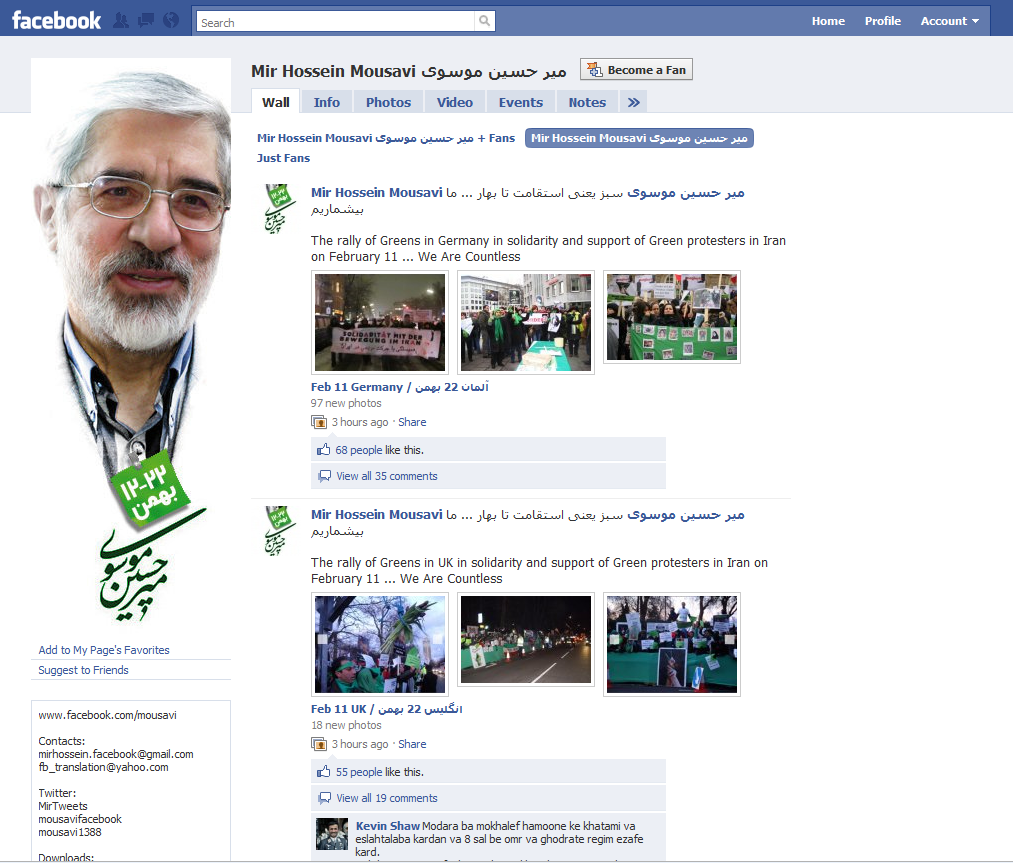
So in addition to using their Chinese-made riot trucks and gas attacks on the protesters, the Iranian security forces were able to quell much of the 22 Bahman uprising by simply relying on the weakness of the movement’s organizational structure. Letting the enemy defeat itself; very Art of War. The very lack of hierarchy in the green movement was both a blessing and a curse. From Foreign Policy:

Like many of the green movement activists, Sadeghi’s belief in the protests seems related to their “horizontal organization,” the fact that they were structured without hierarchies. This was supposed to be the great strength of the movement, but it is also an abiding weakness. A horizontal organization can’t clearly delineate different roles to different people according to their strengths; it can’t reward those who participate, or sanction those who hesitate. Facebook enabled many young Iranians to forget these points.

Now obviously the Taliban is not organizing via Facebook, but the principle of decentralization is the same. Avoid having a center of gravity, put together your demonstrations (attacks) at the last possible minute; coordinate, execute, and then melt away into the night. But if the Iranian green movement using the same principles was successfully put down, does this offer us a rubric for approaching insurgencies?

Mir Hossein Mousavi's Facebook page.

The short answer is probably not. The Taliban is not planning its operations through Facebook or tweets. But the reason the Revolutionary Guard so effectively shut down the protests was by blocking access to means of communications; that is to say the internet. No Gmail, no Facebook, no twitter meant that there was no coordination between demonstrators, nor was there a way to quickly spread the word of crackdowns in a particular area. The networks used by the Taliban for communication are more dispersed, making a system-wide shutdown more difficult. Walkie-talkies and satellite phones are the order of the day, and while we can intercept calls, we cannot easily end them. Even if we did, human couriers would merely proliferate further.

Also worth keeping in mind is the psychological element. The pushback given by the Iranian regime was demoralizing and a clear setback for the movement, slowing momentum and further progress. Presumably more than one green movement adherent changed his colors, or at least plans to lay low thanks to the IRG. But when ISAF and the United States attempt to stop the movement (the Taliban), it disperses them without costing the Taliban anything. Most of the Iranian protesters were relatively concentrated – do we need to herd Taliban fighters into a single killing zone? And is the Battle for Marjah a step in that direction?

The End of COIN?

Maj. General Rick Nash tries his hand at camel riding during a visit to the Sa’adoun tribe confederation land.

Last month, the zenpundit (Mark Safranski) came up with a startling idea: “The Post-COIN Era is Here.” The idea, while revelatory, is definitely worth consideration. The modern timescale for adopting and conceiving new doctrine has shrunk from the decades it used to take to only a few short years – both a blessing and a curse. On the plus side is the ability to shift rapidly from a failed strategy to one which stands a chance of succeeding, saving time and lives that would otherwise be wasted. At the same time, an untested new idea runs the risk of failing, in perhaps even more spectacular fashion.

It was fairly clear, then, that something would have to give way after the abyss into which Iraq plunged the first few years after invasion. Safranski lays down three main reasons for the initial adoption of COIN:

1) The  ”Big Army, fire the artillery, fly B-52’s and Search & Destroy=counterinsurgency” approach proved to be tactically and strategically bankrupt in Iraq. It failed in Mesopotamia as it failed in the Mekong Delta under Westmoreland – except worse and faster. Period.

2) The loudest other alternative to COIN at the time, the antiwar demand, mostly from Leftwing extremists, of immediately bugging-out of Iraq, damn the consequences, was not politically palatable even for moderately liberal Democrats, to say nothing of Republicans.

3) The 2006 election results were a political earthquake that forced the Bush administration to change policy in Iraq for its’ own sheer political survival. COIN was accepted only because it represented a life preserver for the Bush administration.

Continue reading

The 2010 QDR is Here

The  DoD’s Quadrennial Defense Review is out, and its prognosis for America’s military future is quite interesting indeed. Overall funding levels have remained virtually identical; all Gates requested was a 2% increase, about $159.3 billion. Specific increases are called for in the areas of rotary-wing assets, manned and unmanned aircraft, and special forces assets.

For the most part, the strategy remains the same: using a mix of diplomatic, intelligence, and military solutions, keep America safe. Be ready to operate abroad. And be flexible: the military needs the capability to adapt to conventional war, COIN, stabilization, and any other kind of mission that might come up. Below are some key points from the topsheet.

Continue reading

For Love of Country, Part II

Part 2 of a 5-part series.

The Sepoy Mutiny of 1857 can be attributed to many factors, but foremost was the British persistence in attempting to alter the traditional culture of India, particularly the ‘civilizing’ efforts of modernizers and evangelical Christian missionaries.

Sati (Suttee) in practice

The three practices of female infanticide, thagi (a supposed cult of assassin-priest highwaymen), and sati (ritual self-immolation by a widow) were the most heinous in the eyes of British. While these attempts at eradication did not even enjoy the pretense of East India Company legitimacy, it was nevertheless believed by many Indians that every Briton had come to stamp out Hinduism and Islam alike.

Continue reading

The Taliban: Now with 50% More Softness

McChrystal’s population-centric counterinsurgency definitely appears to be working. Now the Taliban has adopted similar methods in order to recreate NATO’s success with the Afghan population.

A 69-point plan has been issued with restrictions and limitations on executions, prisoner-taking, the treatment of civilians, and other rules of engagement that are generally observed by the West. Definitely interesting that a long-term insurgency would start playing by the same rules as their opponent. Patrick Porter sees this as a reinvention along traditional Hamas/Hezbollah/jihadist lines.

How this might play out in the long run of course remains to be seen. Much like Americans, Afghans love a winner, but they’re much more overt about hedging their bets and backing the likely victor. That, in the end, may prove to be the most important factor of all.