Part 1 of 5. Adapted from “For Love of Country? Britain, France, and the Imperial Multiethnic Army, 1815-1919.”
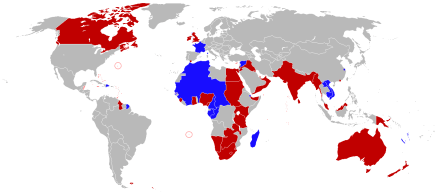
The British and French Empires at their greatest territorial extents (British in red, French in blue).
AT THE HEIGHT OF EMPIRE, nearly thirty percent of the peoples of the world and more than a third of its surface area were controlled by only two nations. The United Kingdom of Great Britain and Northern Ireland ruled a quarter of the earth’s population and a quarter of its landmass. As the saying went, “the sun never sets on the British Empire,” and indeed, for nearly two hundred years it never did.
By far the most expansive and successful empire in history, Britain consolidated and expanded its holdings through wars of conquest and a military might unmatched by any other power on the planet. Britain was not the only globe-spanning empire, though. France controlled much of Africa (to an even greater extent than Britain), as well as holdings in Indochina, the Middle East, and the Caribbean.
French and British Empires alike were kept in power by the violent repression of rebellions, mutinies, and ‘uprisings’. In large part, however, the armies participating in the repression were not composed of all-white formations. The sheer size and scope of the global empires required the imperial powers to recruit heavily from among local populations, and the manpower demands of the two world wars necessitated their deployment to the Western Front.
In many cases, the colonial troops performed even better than their European counterparts. The French Tirailleurs Sénégalaise in particular enjoyed a widespread reputation after the war as both peaceful and respected occupation forces, and as daring and highly successful soldiers. Many other French colonial troops garnered equal praise. The British ANZAC and colonial troops also earned warm words for their bravery (Erwin Rommel was quoted as saying, “If I had to take Hell, I would use the Australians to take it and the New Zealanders to hold it”).
It is no exaggeration to state that both French and British Empires alike were founded on the backs of the native populations. But this went beyond local labor forces and resource extraction.
Continue reading →


 Automatic Ballpoint