The Mask of the Bear: Soviet Deception in Operation Bagration

German columns advance past immobilized Russian tanks, July 1941.

From the moment the first Wehrmacht tank crossed the Soviet border in 1941 until the Battle of Stalingrad in the winter of 1942-43, German victory in World War II seemed inevitable. The fighting on the Eastern Front took place on a scale never seen before or since, a colossal undertaking that consumed three-quarters of all combat forces in Europe, and cost the lives of over twenty-five million Soviet citizens.[1] The war could not have been won without the Soviet front, and even after the Red Army had successfully defended Moscow and Stalingrad, while holding out in besieged Leningrad, victory was far from certain.

The summer offensive of 1943, culminating in the Battle of Kursk—the largest tank battle ever fought by man—finally pushed the Germans onto the defensive. It was not until Operation Bagration, the 1944 summer offensive, that the German ability to conduct offensive operations was curtailed once and for all.

Operation Bagration won the war in the east, and that victory can be attributed to a practice at which the Red Army excelled—deception. The Soviet practice of maskirovka literally translates to ‘camouflage,’ but in the context of military doctrine has a wide variety of definitions covering everything from strategic disinformation to the effective  masking of an individual soldier’s foxhole. The official Soviet definition for maskirovka was:

The means of securing combat operations and the daily activities of forces; a complexity of measures, directed to mislead the enemy regarding the presence and disposition of forces, various military objectives, their condition, combat readiness and operations, and also the plans of the command … Maskirovka contributes to the achievement of surprise for the actions of forces, the preservation of combat readiness, and the increased survivability of objectives.[2]

The Soviets invented the art of maskirovka, and perfected it over the course of World War II. By the summer of 1944, it was second-nature, and the operational planning reflected this. In absolute secrecy, the Soviet High Command (Stavka) managed to position over 2.3 million men and the necessary supplies, all the while deceiving the Wehrmacht as to the actual objectives of the offensive.

It is no stretch to say that Operation Bagration would have unfolded far more poorly without the extensive deception operations, and as it marked an end to any chance of a German victory, the maskirovka so skillfully executed in the summer of 1944 in fact shortened World War II by a substantial amount.

Continue reading

The Manliest Scooter Ever?

This Italian Vespa scooter was built under license in the 1950s by Ateliers de Construction de Motocycles et Automobiles (ACMA), fitted with the US-made M20 75mm recoilless rifle, and employed in some number by the French armed forces (about 800 were deployed in Algeria and Indochina).

The aim was to provide airborne forces (TAP stands for Troupes Aéroportées) with a lightweight, but effective anti-armour weapon. Each gun crew consisted of two men on Vespas – one mounting the gun itself, the other carrying the ammunition and other equipment. To fire, the gun was taken down and deployed on a tripod carried by the team – not, sadly, fired from the Vespa while moving [emphasis mine].

Via Osprey.

But I Repeat Myself

A reminder that history does not repeat itself; it merely rhymes:

Beneath azure blue skies on Sunday, an intrepid band of Englishmen tried to stage a scaled-down rerun of the “little ships,” hundreds of private craft that joined the Royal Navy in the improbable 1940 rescue [at Dunkirk], saving hundreds of thousands of British, French and Canadian soldiers to fight on against Nazi Germany.

This time, the effort centered on a group of men in a flotilla of inflatable speedboats who set out from Dover to ferry some of their stranded compatriots home from the rail and ferry chaos created by the cloud of volcanic ash that has shut down much of Europe’s air traffic.

The Thirty Years’ War and Collective Memory

T. Greer at The Scholar’s Stage tell us World War II provides a convenient metaphorical framework for understanding the world today, but goes on to explain that today’s political situation is more akin to the 30 Years’ War than World War II.

You can summarize the history of the Second World War in two paragraphs. Squeezing the causes, campaigns, and countries of the war into these paragraphs would be a gross simplification, but it is possible. This does not hold true for the Thirty Years War. It is one conflict that simply cannot be related in a paragraph. The number of actors involved, the myriad of motivations and goals of each, and the shifting alliances and intrigues between them all are simply too complex to be stripped down to a single page. Piecing together the events of the Thirty Years War inevitably takes up much more time and effort than single page summaries allow.

Single page summaries or 5-minute interviews allow no room for nuance, deliberation, or even explanation. The goal of televised news seems to be for one side to “win” at the other’s expense, and victory means hammering home as simple an argument as possible. Sure, the Maginot Line is long-gone, we have airborne robots and laser weapons, and even Communism has been defeated, yet somehow the analogies of ‘the last good war’ resonate in our collective memories.

The great majority of policy makers are familiar with the Second World War. If asked to, I am sure that most folks in Washington concerned with foreign affairs and security policy could provide an accurate sketch of the countries and campaigns involved. Indeed, we conceptualize current challenges from the standpoint of World War II; allusions to it are the lifeblood of both popular and academic discourse on foreign affairs. Pearl Harbor, Munich, Stalingrad, Normandy, Yalta, and Hiroshima are gifts that keep on giving – they serve as an able metaphorical foundation for any point a pundit or analyst wishes to make.

Compounding the problem is that old familiar anti-intellectual strain in American public discourse. Just the thought of applying something other than a 20th-century analogy to a contemporary situation seems like high-falutin’ blasphemy, further evidence that the pansy college boys have no place deciding what’s what. But we need to start comparing other human conflicts (thought not so all-over-the-place as Edward Luttwak) to our own, and figuring out what really matters – and what really doesn’t.

Via zenpundit.

Operation Tannenbaum, Part IV

It is now November 9 1940. The bitterness of the Battle for Switzerland is something that will live with all Swiss and those German soldiers who participated. Out of the 800,000 Swiss under arms on September 24, 120,000 did not reach the redoubt. Only 15,486 of these soldiers were taken prisoner. In fact, there are more French and Polish prisoners in the German laagers then there are Swiss!

The Zytglogge in Bern, Switzerland.

Wilhelm Ritter von Leeb, commander of Heeresgruppe C.

Guisan and his staff are secure in the Redoubt, with the Germans unable to penetrate the massive defense works. However, the Germans are rather unwilling to commit so many forces to the strategically irrelevant alpine region. In the areas at higher altitude, the first snow has fallen, tabling any large offensives until the spring of 1941.

No less than 20 divisions are in occupied Switzerland, and tensions between occupier and occupied are running extremely high. Just as in Czechoslovakia, all popular gatherings have been banned. Weapons and wireless sets owned by private citizens have been ordered to be turned into authorities, including hunting rifles.[1] Heeresgruppe C has not been redeployed to the eastern front for a Russian offensive, and Wilhelm von Leeb has established his headquarters in occupied Bern for the winter.

Continue reading

Operation Tannenbaum, Part III

While the odds were against any sort of meaningful Swiss victory in the event of invasion, such a German offensive was equally unlikely in the early years of the war. By 1943, the possibility of a successful German invasion had dwindled to virtually nothing, as the Swiss Army had expanded and modernized to a point that would make Tannenbaum a suicidal mission. This begs the question: why, then, would Hitler ever have chosen to invade Switzerland? Let us proceed with our counterfactual under the following premises.

It is now September 15. The unrestricted bombing campaign authorized by Churchill four months ago has been relatively unsuccessful. Fewer than 25 percent of the bombs dropped are landing within five miles of their intended targets, and only 30 percent have landed in any built-up areas.[1] However, this has had an unintended benefit. Having disguised the few industrial plants manufacturing jewel bearings, the Germans were fairly certain of their security. However, in a truly ironic case, this ended up being more costly, as the plants have been disproportionately hit by the British bombs. Jewel bearings are a main component of bombsights, and without them, Hitler is reluctant to press his luck in the Battle of Britain, much less Operation Sealion.

Continue reading

Operation Tannenbaum, Part II

Hitler, flush with victory over France, now demanded to see plans for the invasion of Switzerland. His rage knew no bounds, as the head of OKH Franz Halder recalled: “I was constantly hearing of outbursts of Hitler’s fury against Switzerland, which, given his mentality, might have led at any minute to military activities for the army.”[1] Within hours of the French capitulation, Captain Otto Wilhelm von Menges in OKH submitted a draft plan for the invasion.

Menges' Fall Schweiz, first draft (June 26 1940).

Generaloberst Wilhelm Ritter von Leeb’s Heeresgruppe ‘C’ (HGr. C), led by Generalleutnant Wilhelm List and the 12th Army would conduct the attack. Leeb himself personally reconnoitered the terrain, studying the most promising invasion routes and paths of least resistance.[2] Menges’ plan called for a pincer movement from German troops in France and Germany focused on taking Bern quickly, with Italian divisions invading from the south. Speed was critical: the plan’s primary objective was to seize the industry in the Solothurn area and capture the railroads, bridges, and transportation infrastructure across the Alps intact.[3]

Continue reading

Operation Tannenbaum: Hitler’s Invasion of Switzerland

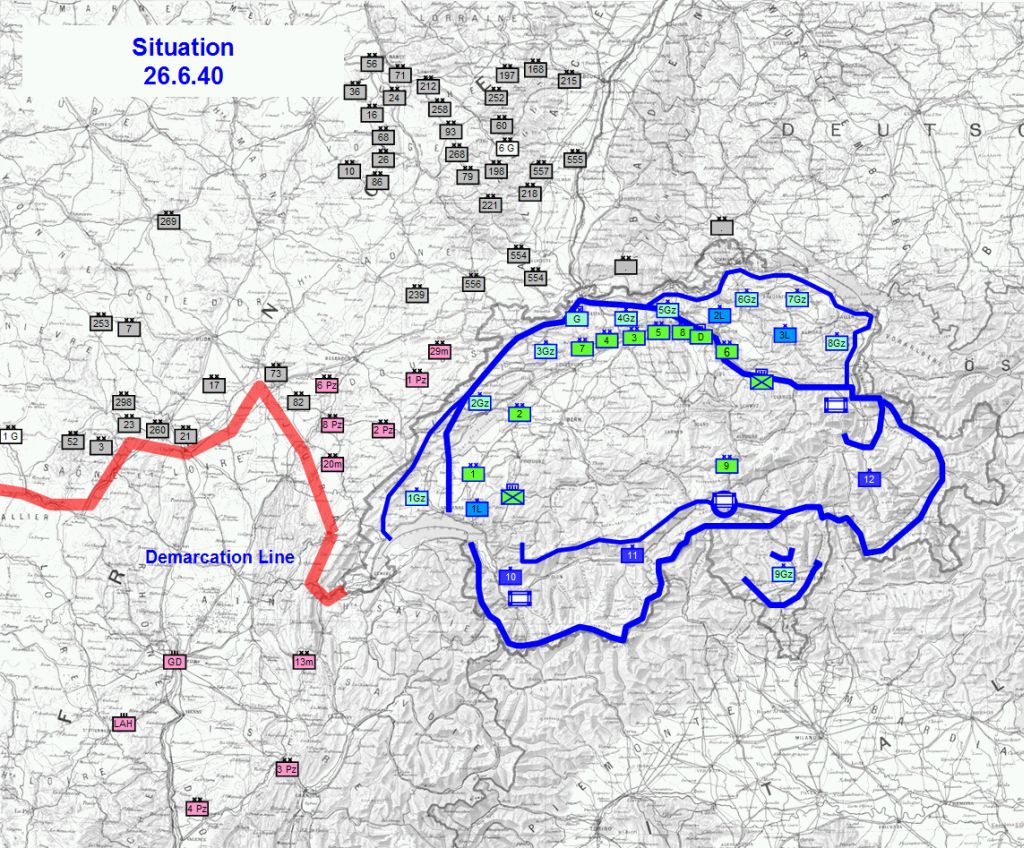
The military picture on the Franco-Swiss border, June 26, 1940.

France was defeated. So too were Poland, Norway, Denmark, Holland, and Belgium. Austria and Czechoslovakia had been incorporated into the Greater German Reich. Great Britain stood alone in her ‘splendid isolation,’ and the fascist regime of Francisco Franco held sway over the Iberian Peninsula. In June of 1940, all that remained, surrounded by enemies, was the Swiss Confederation.

Hitler called it a “pimple on the face of Europe.”[1] In the heady days of victory for the Third Reich, a move against the alpine republic seemed a great possibility – almost inevitable, even. Even before the Fall of France was made official, plans were being drawn up for ‘Operation Tannenbaum,’ the German invasion of Switzerland. Yet Hitler’s attention was soon drawn towards Britain, and eventually the plan fell by the wayside as he began focusing attention on his Bolshevik neighbor to the East.

But…what if? What if Hitler had decided that the conquest of that mountainous pimple was indeed worth the effort and manpower? What if Tannenbaum had been more than just idle words and an OKW plan? If Hitler had embarked on the ultimate folly, the results would have been disastrous for the Swiss – and the Nazis.

Continue reading

Dragon at Sea: A Brief History of Chinese Navies

The strategic arena of East Asia.

SINCE THE END OF THE COLD WAR, American naval supremacy has been unchallenged throughout the world. Even during that massive, global struggle, the Soviet Navy never came close to rivaling the power projection capabilities of the United States (of course, this was never their intent).

With the dawning of the twenty-first century, however, many commentators are declaring it to be “China’s Century,” during which the People’s Republic will finally assume its rightful place as a counterweight to the United States. Despite the financial crisis currently engulfing the world, the U.S.-China trade deficit reached record levels in 2008, with $266 billion against the United States. If the economic sphere were a battlefield, China would surely be winning.

Yet, the crucial trade arena formed by the South China Sea, East China Sea, Yellow Sea, and Western Pacific Rim has gone largely ignored in China as an area of vital strategic importance. Half of the largest container lines in the world are owned and based in Asia, and one-third of the world’s shipping is owned by Asian nations.[1]

It would make sense, then, for China to possess and deploy a strong navy. Since the Communist victory over the Kuomintang (KMT) in 1949, maritime power has been neglected, but the last decade has seen an ascendant navalist faction in the upper echelons of the Politburo. China has now embarked upon a major program of modernizing the People’s Liberation Army Navy (PLAN), and while American superiority in the region is likely to remain for the near future, the rise of the PLAN will pose significant challenges to the United States Navy in decades to come.

While recent history would indicate otherwise, China has a long and storied naval heritage.

Continue reading