War in the Pacific

I, like just about everyone, am looking forward to HBO’s new miniseries The Pacific. I mean like, really, really psyched; it’s been much too long in the making. But I’m really liking the Hanks-Spielberg team as of late.

Semperpapa at David Bellavia has taken Hanks to town, though, for the latter’s comments on the ‘true’ meaning of war in the Pacific. I responded at the source, but I also think the arguments deserve a full presentation, so here are his, followed by mine:

I was somewhat disappointed by Tom Hank’s simplistic look at what WWII represented for our Nation, when, during an interview, he stated that the reason America wanted to kill the Japanese was because they were different. They looked different, they believed different.
[…]
I could even understand that Tom, as a good Liberal, would hold America responsible for the Japanese attack on Pearl Harbor, because after all the American fleet was an “imperialistic” obstacle to the “legitimate” expansionist needs of Japan toward South Eat Asia.
[…]
In the interview, Hank points out his latest project wanted to honor the bravery of the American troops

“…but we also wanted to have people say, ‘we didn’t know our troops did that to Japanese people.’”…

I don’t know that Hanks’s opinions, overly simplistic as they are, can be blamed on his liberalism. There weren’t too many alternatives to what we did in either theater. Rather, his misinformation can be attributed to the general American ignorance about the Pacific theater.

Much of whatever vague impressions Americans get of the Pacific are from sources like Dr. Seuss’s wartime propaganda and the various posters attacking “yellow” “Japs.” Which if it’s all you’re getting, definitely paints a one-sided picture.

He’s also not entirely wrong. To a degree much more pronounced than in the ETO, the American war effort dehumanized the Japanese as both a race and a nationality. In Germany, we were fighting Hitler, but in the Pacific we were fighting the Japs. There was a distinct conflation of politics and racism there that was absent from Europe, or at least the western front in Europe. The Pacific shared a viciousness with that life-or-death struggle on the eastern front, where the choices were literally reduced to a binary: victory or death and enslavement.

But I don’t mean to condemn that brutality entirely. In most ways our response was a tit-for-tat regarding Japanese behavior. After enough incidents occurred when surrendering Japanese troops instead carried out the equivalent of a suicide bombing, we stopped taking prisoners. As a tactical solution it was entirely justified. We took no prisoners – but with good reason. See John Dower’s War without Mercy: Race and Power in the Pacific War for a fairly deep analysis of the course of the Pacific theater.

Basically, the dehumanization we carried out in the press and other media is being misattributed by Hanks to a cause of the war, rather than the fairly standard wartime practice and response to in-theater events that it was.

And of course, the Japanese behavior speaks for itself.

A Brief Study in Hyperbole

Margaret Thatcher and Ronald Reagan at Camp David, 1984.

Yesterday I took part in an in-class debate on which was the more ‘special’ relationship: Churchill and Roosevelt, Macmillan and Kennedy, or Thatcher and Reagan? I was assigned to the Thatcher-Reagan team.

I took it upon myself to write an opening statement, and it follows. Bear in mind I wrote this in approximately 30 minutes (including edits and rewrites). Then you can decide: did I actually say anything at all? Or did I just make it sound like I did? In other words, where’s the beef?

Since revolution tore the two asunder, and the White House burned in 1812, the United States and United Kingdom have enjoyed an extraordinary partnership unrivaled by anyone in the world – a “special” relationship.

The relationship has waxed and waned over the years, but never was it stronger or more dynamic than the Thatcher-Reagan era of the 1980s. Bound together by mutual respect and admiration, cultural affinity, and a shared commitment to western values, the special relationship between the Gipper and the Iron Lady was forged in history and sealed with blood. Through war and in peace, America and Britain held fast at home and abroad with Reagan and Thatcher at the helm.

From the windswept south Atlantic to the skies above Libya, Reagan and Thatcher were partners amidst a sea of troubles. Politically like-minded like to pair before them, they successfully navigated the shoals of the Cold War and brought the Soviet Union to its knees. Together they restored a sense of national pride to their respective countries and returned the special relationship to its lofty pedestal.

Personally, politically, diplomatically, and militarily, Reagan and Thatcher were exceptionally close. Maintaining a solid front publicly, they never hesitated to disagree in private, always constructively and without hint of animosity. Anglo-American relations, NATO, and indeed the west itself were and continue to be rejuvenated by their remarkable friendship; and nothing less than the whole of humanity has been the beneficiary of Thatcher and Reagan’s truly special relationship.

I like the lofty rhetoric I came up with, but methinks the substantive portion leaves something to be desired. And that’s ignoring what I actually think about the merits of the argument.

Tsarist Russia, in Color

"A. P. Kalganov poses with his son and granddaughter for a portrait in the industrial town of Zlatoust in the Ural Mountain region of Russia. The son and granddaughter are employed at the Zlatoust Arms Plant--a major supplier of armaments to the Russian military since the early 1800s. Kalganov displays traditional Russian dress and beard styles, while the two younger generations have more Westernized, modern dress and hair styles." 1910.

Sergei Mikhailovich Prokudin-Gorskii was a photographer in Russia born in 1863 and who lived until 1944. He invented his own camera, which in and of itself is impressive, but not only that – it was a color camera. The Library of Congress has used modern computing technology to recreate Produkin-Gorskii’s colorization technique, and the collection is available to view as “The Empire That Was Russia.”

These pictures provide a record of tsarist Russia in color, and the results are stunning. Transportation, ethnic diversity, and people at work are the themes of the exhibition. Make sure to check out the Austro-Hungarian prisoners-of-war in 1915. A land time might now remember.

.

Via Eternal Remont.

The American Way of War: A Review

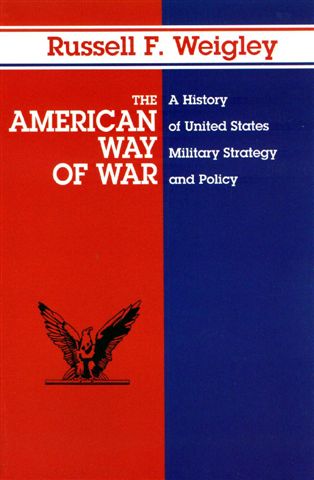
After a long while of meaning to, I’ve finished Russell Weigley’s magisterial book The American Way of War. Took longer than it should have, but as a foundational text for understanding not only American strategy, but basic concepts of national strategy itself, this book is unsurpassed. It’s one of the few I can truly call “epic.”

Beginning with George Washington’s “strategy of attrition” during the Revolutionary War, Weigley traces the scope of American strategic thought up to the closing days of the Vietnam War. Structurally, American strategy falls into several phases. Washington eventually gives way to Halleck, who is then replaced by Ulysses Grant. Grant’s approach to war – “a strategy of annihilation” – then serves as the United States’ guiding principle until well into the twentieth century.

Continue reading

Reliving the Past

As Herbert Butterfield warns us and as I’ve mentioned here before, past performance is no guarantee of future results.  I was then pleased to read Patrick Porter’s latest column, “The Shadow of the Fathers.” He writes about invocations of the Founding Fathers as justification for all manner of… anything, really. To him, American policymakers have “the tricky job of acknowledging the powerful ideas and heritage that shaped American statecraft, while also resisting it.”

Perhaps my favorite line in the piece, though, belonged to Nicholas Spykman:

Not conformity with the past but workability in the present is the criterion of a sound policy.

Words for today.

SMS Goeben, the Berlin-Baghdad Railway, and the Coming of the Great War

SMS Goeben

In November of 1914, the once-mighty “sick man of Europe,” the Ottoman Empire, entered the war to end all wars as a Central Power. Having concluded a secret alliance with Germany against her long-time rival Russia, the conditions for war were met, and on November11 Sultan Mehmed V declared jihad.

As with so many other empires, the jump into war would prove to be the downfall of Turkey as a Mediterranean power, and in fact as an empire at all. The terms of their alliance with Germany pulled the Ottomans into the war, but the real question remains: what led them to sign it? The answers can be found in two places: the Berlin-Baghdad Railway, and the arrival of the SMS Goeben.

Continue reading

The Bombing of Auschwitz

A consolidated B-24 Liberator of the 15th A.F. releases its bombs on the railyards at Muhldorf, Germany on 19 March 1945.

Via Blog Them Out of the Stone Age:

What if the Allies had bombed Auschwitz? That’s the counterfactual Mark Grimsley poses in his brief, but intriguing piece for World War II magazine (article at BTOSA). As he admits, “most ‘what if’ scenarios begin with a plausible rewrite of a historical event. The bombing of Auschwitz does not have this characteristic.” A strike on the death camps was not seriously discussed at high levels, much less considered a viable option.

It was certainly possible to launch such an attack:

The Auschwitz complex was well within range of the U.S. Fifteenth Air Force, based at Foggia, Italy … By the summer of 1944, escapees from Birkenau had supplied the Allies with detailed, accurate information about the facility. The crematoria and gas chambers could be readily identified in aerial photographs.

Owing to political considerations and the diversion of “considerable air support” that targeting the camps would require, a raid was never launched. Debate has raged for thirty years whether or not it was a moral imperative to attack the camps, but simply put, it was absolutely within Allied strategic air capabilities.

Continue reading

For Love of Country, Part V

Part 5 of a 5-part series.

On behalf of France, La Coloniale and the Armée d’Afrique performed admirably in both combat and occupation duties during World War I.

The French Africans who served in Europe came from all across the empire—Tirailleurs from Senegal, spahis from Tunisia and Algeria, and goums from Morocco, 175,000 in all. Other local regiments of Tirailleurs from equatorial French Africa were in turn deployed to the French colonial possessions in North Africa, and many others (about 160,000 in total) joined the Armée Métropolitaine in France on an ad hoc basis.

Moroccan goums, 1914.

In combat, the colonial troops proved themselves beyond a shadow of a doubt. Many succumbed to the illnesses brought on by the radical change of climate, and for the most part, the harsh European winters meant that the African units would winter in the south of France. To some, this was reason enough to doubt the effectiveness of Africans in combat, but it was always ignored that these ‘deficiencies’ had nothing to do with the fighting skill of men from the tropics.

Continue reading

For Love of Country, Part IV

Part 4 of a 5-part series.

World War I was more global in scope than is often realized.

World War I belligerents; Allies are green, Central Powers orange, and non-aligned are gray.

The colonial forces of both Britain and France were tried and tested in theaters throughout the globe, perhaps most surprisingly in India itself. Thanks to the Anglo-Japanese Pact of 1902 there was no direct threat across the frontier – as the Japanese would pose in World War II – but the fighting in the  Middle Eastern theater often spilled over in the Punjab, and nationalist revolts there and in Bengal threatened to destabilize the Raj. In Mesopotamia, there were three mutinies by Muslim soldiers unwilling to fight their fellow believers, but for the most part native troops remained unwaveringly loyal. Even the horrific casualties in the various African campaigns did not dissuade colonial troops from fighting alongside their occupiers and preserving their own subjugation.

Continue reading

For Love of Country, Part III

Part 3 of a 5-part series.

In the aftermath of the Indian Mutiny, whether the Indian Army was exclusively for garrison purposes (at its furthest extent, the invasion of bordering states), or if it could be deployed overseas was a matter of some concern.

The British Expeditionary Force towing artillery across Ethiopia, 1868

Trust in the native infantry regiments reached its nadir in the wake of the Sepoy Rebellion, but when the Emperor Tewodros of Abyssinia began holding British nationals hostage in 1866, they were the nearest available option for the British to deploy. Thanks to the telegraph, a force of 13,000 led by Lieutenant General Robert Napier that included four Native Cavalry regiments and ten Native Infantry regiments (with only a single cavalry squadron and the artillery fully manned by Britons) arrived within two months of receiving Queen Victoria’s orders.

After a brutal three-month, 400-mile trek through mountainous jungle and desert, the expedition reached Tewodros’ stronghold. The brief battle of two hours resulted in 700 Abyssinian deaths and 1,200 more wounded. The British (including native troops) suffered twenty wounded. Not one was killed. The Indian Army had proven itself more than capable of serving outside the provinces from where it was raised.

Continue reading