An Afghan Primer

Hot on the heels of Binyavanga Wainaina’s “How to Write about Africa” comes a new guide, this time from Registan: “How to Write about Afghanistan.”

Always use the word ‘war-torn’ in your title. Subtitles may include the words ‘tribal,’ ‘Taliban,’ ‘corrupt,’ and ‘Sharia.’ Also useful are words such as ‘shuras,’ ‘fighters,’ ‘refugees’ and ‘insurgency.’ Do not distinguish between different ethnic groups with different languages, religions and histories, or regions with different landscapes and livelihoods. If people in Kandahar tell you something, assume people in Kabul feel the same way, and vice versa. Whenever possible, mention Pashtunwali. (Note: you do not need to understand what Pashtunwali is. You get points for mentioning it anyway.)

Never have a picture of a well-adjusted Afghan accompanying your article. (Make an exception for Afghans you want to be president.) A stoned cop, a woman in a burka begging, a scowling man holding a Kalashnikov: use these. If you must include an Afghan who is not miserable or threatening, make sure you get an elderly farmer with very few teeth, or a little girl holding a baby goat.

I’m reminded of why I chose ‘monolithic’ as my word of the month (possibly of the year).
Making and Doing

For anyone currently in London (and by currently, I mean in early May), Cory Doctorow is giving a free talk at Nettlefold Hall in West Norwood on May 8. RSVPs are required, though – send an email to readersandwriters@lambeth.gov.uk.

Along similar Doctorovian lines, I read a post in The Art of Manliness, of all places, bemoaning the “modern immaturity” of men, and encouraging us to “create more, consume less.” Consumerism is, after all, a passive activity that reduces all willpower to an illusory choice – “the weakening of man’s free agency.” It’s an indictment both of consumerism and of any kind of forward thinking:

The problem with consumerism is that it heavily emphasizes choice, to the complete exclusion of the idea of living with that choice. Choose, choose, choose. But what happens after your make that choice?

Definitely worth reading and considering in all contexts – be it manliness, resilience, or otherwise.

Rethinking the U.S.

Chirol, long-time blogger at Coming Anarchy, has struck out on his own and started a new blog, Rethinking the United States.  He plans to cover a lot of ground, mostly serving to answer the question “does the United States serve its purpose?” His welcome post lists the topics to be covered as:

sustainability, autonomy, devolution, decentralization, political identity and loyalty,  political organization, self organization, superempowerment, technology, resilience in general and resilient communities.

Other related and more directly political topics and of great personal interest to the author will be Libertarianism, civil liberties, small government and firearms though they will almost always come back to the topic at hand.

Sounds like a perfect synthesis of stuff that I’m interested in. I cannot wait to see what he comes up with.

An Island Apart

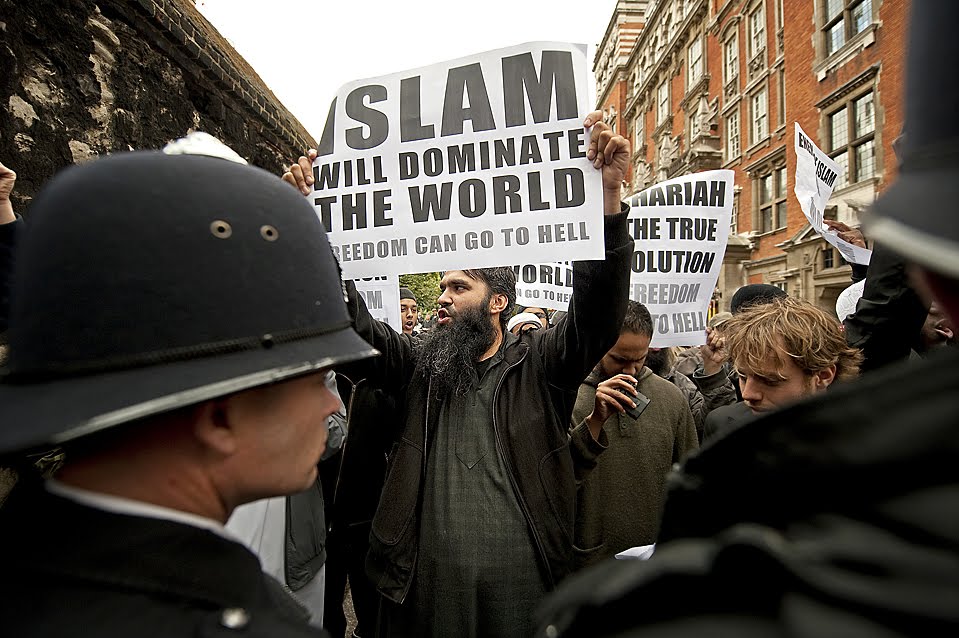
Muslims protest Geert Wilders' appearance before Parliament, October 2009.

Something’s gotta give. No, seriously. Finally backlash seems to be mounting against the British government’s tolerance for extremist organizations (provided, of course, that they are Muslim). The trend is especially present in universities, however, where the constant mantra of “free speech” has somehow blocked out all voices, such as the BNP and others, with the sole exception of any Islamic or Muslim society.

The Christmas Pants Bomber has prompted a new bout of soul-searching as the west attempts to decipher the source of radicalization. Nigerian Nobel Laureate Wole Soyinka perhaps made the loudest and boldest claim, laying blame on Britain (“a cesspit“) – and not Nigeria – for the pants bomber’s radicalization.

Continue reading

For Love of Country, Part IV

Part 4 of a 5-part series.

World War I was more global in scope than is often realized.

World War I belligerents; Allies are green, Central Powers orange, and non-aligned are gray.

The colonial forces of both Britain and France were tried and tested in theaters throughout the globe, perhaps most surprisingly in India itself. Thanks to the Anglo-Japanese Pact of 1902 there was no direct threat across the frontier – as the Japanese would pose in World War II – but the fighting in the  Middle Eastern theater often spilled over in the Punjab, and nationalist revolts there and in Bengal threatened to destabilize the Raj. In Mesopotamia, there were three mutinies by Muslim soldiers unwilling to fight their fellow believers, but for the most part native troops remained unwaveringly loyal. Even the horrific casualties in the various African campaigns did not dissuade colonial troops from fighting alongside their occupiers and preserving their own subjugation.

Continue reading

For Love of Country, Part III

Part 3 of a 5-part series.

In the aftermath of the Indian Mutiny, whether the Indian Army was exclusively for garrison purposes (at its furthest extent, the invasion of bordering states), or if it could be deployed overseas was a matter of some concern.

The British Expeditionary Force towing artillery across Ethiopia, 1868

Trust in the native infantry regiments reached its nadir in the wake of the Sepoy Rebellion, but when the Emperor Tewodros of Abyssinia began holding British nationals hostage in 1866, they were the nearest available option for the British to deploy. Thanks to the telegraph, a force of 13,000 led by Lieutenant General Robert Napier that included four Native Cavalry regiments and ten Native Infantry regiments (with only a single cavalry squadron and the artillery fully manned by Britons) arrived within two months of receiving Queen Victoria’s orders.

After a brutal three-month, 400-mile trek through mountainous jungle and desert, the expedition reached Tewodros’ stronghold. The brief battle of two hours resulted in 700 Abyssinian deaths and 1,200 more wounded. The British (including native troops) suffered twenty wounded. Not one was killed. The Indian Army had proven itself more than capable of serving outside the provinces from where it was raised.

Continue reading

For Love of Country, Part II

Part 2 of a 5-part series.

The Sepoy Mutiny of 1857 can be attributed to many factors, but foremost was the British persistence in attempting to alter the traditional culture of India, particularly the ‘civilizing’ efforts of modernizers and evangelical Christian missionaries.

Sati (Suttee) in practice

The three practices of female infanticide, thagi (a supposed cult of assassin-priest highwaymen), and sati (ritual self-immolation by a widow) were the most heinous in the eyes of British. While these attempts at eradication did not even enjoy the pretense of East India Company legitimacy, it was nevertheless believed by many Indians that every Briton had come to stamp out Hinduism and Islam alike.

Continue reading

For Love of Country, Part I

Part 1 of 5. Adapted from “For Love of Country? Britain, France, and the Imperial Multiethnic Army, 1815-1919.”

The British and French Empires at their greatest territorial extents (British in red, French in blue).

AT THE HEIGHT OF EMPIRE, nearly thirty percent of the peoples of the world and more than a third of its surface area were controlled by only two nations. The United Kingdom of Great Britain and Northern Ireland ruled a quarter of the earth’s population and a quarter of its landmass. As the saying went, “the sun never sets on the British Empire,” and indeed, for nearly two hundred years it never did.

By far the most expansive and successful empire in history, Britain consolidated and expanded its holdings through wars of conquest and a military might unmatched by any other power on the planet. Britain was not the only globe-spanning empire, though. France controlled much of Africa (to an even greater extent than Britain), as well as holdings in Indochina, the Middle East, and the Caribbean.

French and British Empires alike were kept in power by the violent repression of rebellions, mutinies, and ‘uprisings’. In large part, however, the armies participating in the repression were not composed of all-white formations. The sheer size and scope of the global empires required the imperial powers to recruit heavily from among local populations, and the manpower demands of the two world wars necessitated their deployment to the Western Front.

In many cases, the colonial troops performed even better than their European counterparts. The French Tirailleurs Sénégalaise in particular enjoyed a widespread reputation after the war as both peaceful and respected occupation forces, and as daring and highly successful soldiers. Many other French colonial troops garnered equal praise. The British ANZAC and colonial troops also earned warm words for their bravery (Erwin Rommel was quoted as saying, “If I had to take Hell, I would use the Australians to take it and the New Zealanders to hold it”).

It is no exaggeration to state that both French and British Empires alike were founded on the backs of the native populations. But this went beyond local labor forces and resource extraction.

Continue reading

Why They Fight

They hate us because we don’t know why they hate us.” The perceived ignorance of Americans as to the wider world around them was often cited as a compelling reason for the mass murder of several thousand citizens on September 11, 2001. Low scores on math and science, and the inability of two-thirds of Americans between eighteen and twenty-four years old to locate Iraq on a map in 2006 merely perpetuated this claim; that somehow American geographical ignorance is responsible for jihadists and regional strife around the world.

This is of course not the only suggested explanation for conflict in the developing world. Essentially, all the arguments put forth can be summarized as pertaining to ‘greed’, or monetary and personal gain, and ‘grievance’, i.e., ideological and cultural clashes. Abridging the vast array of motives to these two is oversimplifying the matter to begin with; further choosing one of the two as the sole factor would be downright spurious. Complicating matters is the tendency to use the ‘pre-modern’ character of third world conflicts to build an intellectual bridge back to the very beginning of history. Continue reading