A Peaceful Rise at Home?

From World Military Forum:

BEIJING – A stronger Chinese navy will not seek to build military bases overseas, a retired senior officer has said amid media reports that the country harbors such “ambitions”.

Zhang Deshun, who was till recently the deputy chief of staff of the PLA navy, said a naval force with advanced armaments and enhanced capabilities will contribute more to UN-led anti-terrorism, anti-piracy and disaster-relief missions.

A larger navy with a greater reach does not mean it will seek to play the role of “world police”, said the retired rear admiral, who is a deputy to the ongoing session of the National People’s Congress.

I don’t know how to read this. I see several possibilities, not all of which ascribe ulterior motives to the Chinese. But most of them do. The first would be that they’re serious about this, and genuinely believe that if not now, then in the very near future Chinese naval capabilities will be such that they don’t require any overseas support facilities.

If that is true, their public admission of this could serve a twofold purpose: downplay concerns of a Chinese global power play, and at the same time serve notice to the United States and other maritime powers that China is advanced to this degree. After all, the U.S. operates a network of naval facilities around the world – perhaps Beijing is so powerful it doesn’t have to?

Alternatively, China could be using this to distract from the ‘three island chain’ plan.
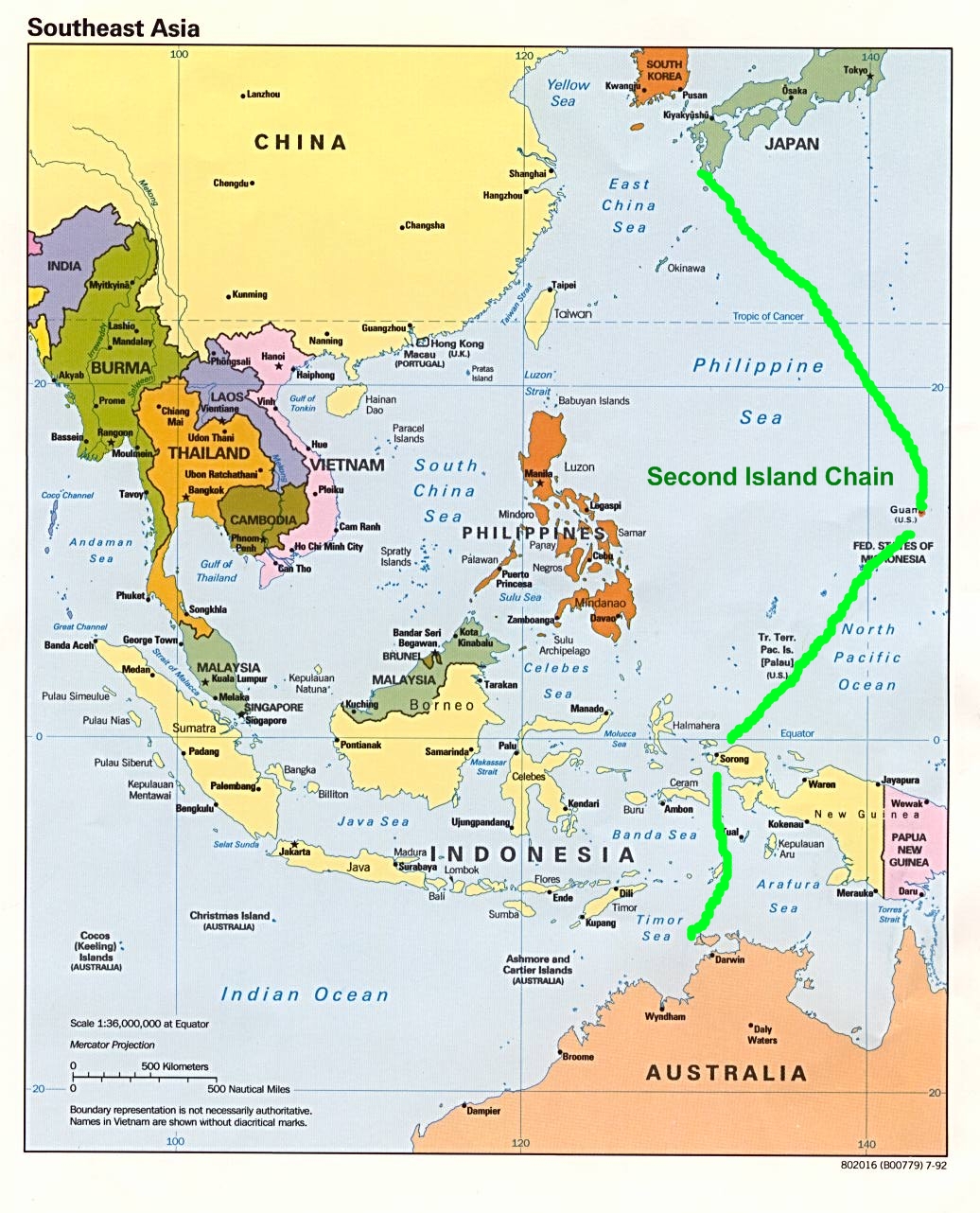
The 'second island chain' of Chinese maritime strategy.

By eliminating the ‘third island chain’ – global, blue-water power projection – China’s ambitions of regional hegemony seem much more restrained and reasonable in comparison. But keep in mind that even the ‘second island chain’ in the strategy is demarcated by a line running from southern Japan to Guam through the middle of Indonesia and terminating at Australia. It’s still quite a bit of space.

Am I just being paranoid?

Attack of the Caspian Sea Monster!

The ekranoplan rusting in its berth, 2010.

If you’ve never heard of the Russian ekranoplan, here’s what you need to know. A ground effect plane that flies only a few yards above water (right, it’s also a water-plane, I forgot to mention), the one-off ekranoplan was an ingenious attempt by the Russians to solve… some problem they’d come up with, presumably. It was retired in the early 90s.

Recently, some intrepid photographer found the ekranoplan in drydock, and has taken a number of pictures (along with a photoessay in Russian) so you can see the magnificent beast in all its glory.

.

Via War is Boring.

SMS Goeben, the Berlin-Baghdad Railway, and the Coming of the Great War

SMS Goeben

In November of 1914, the once-mighty “sick man of Europe,” the Ottoman Empire, entered the war to end all wars as a Central Power. Having concluded a secret alliance with Germany against her long-time rival Russia, the conditions for war were met, and on November11 Sultan Mehmed V declared jihad.

As with so many other empires, the jump into war would prove to be the downfall of Turkey as a Mediterranean power, and in fact as an empire at all. The terms of their alliance with Germany pulled the Ottomans into the war, but the real question remains: what led them to sign it? The answers can be found in two places: the Berlin-Baghdad Railway, and the arrival of the SMS Goeben.

Continue reading

The Coming Naval War with China?

There’s a new article making the usual rounds, from the Q1 2010 issue of Orbis. James Kraska’s “How the United States Lost the Naval War of 2015” [abstract only] is definitely an interesting read; it’s one of those future/alternate histories examining, essentially, how we might get there.

Kraska hypothesizes a Chinese missile attack on the USS George Washington while “conducting routine patrols” off of China’s coast. China immediately denies all responsibility and in fact aids in the rescue of several hundred sailors, out of the original complement of 4,000. In addition to the international perception of China as uninvolved (much less the aggressor), the United States is blamed for the ecological disaster caused by the George Washington‘s nuclear propulsion system.

China’s ability to conduct such an operation is chalked up to a combination of naval spending cuts, the reassignment of “an entire generation” of officers to COIN and conventional desert warfare in the Middle East and central Asia, and “the environmentalists in charge of strategic U.S. oceans policy.”

‘Ridiculous’ is certainly the first word that comes to mind, and commentators like Thomas Ricks certainly don’t disagree, but there’s a small point to extract from Kraska’s article. His assumption that the increasing budget and growing naval aviation programs of the PLAN will directly challenge the USN for control of East Asia is a little much. He’s right on the nose, however, with the specter of asymmetrical naval warfare.

Robert Kaplan wrote an article for the Atlantic Monthly a few years back, “How We Would Fight China.” It covers a lot of this in great detail. The psychological impact of asymmetry at sea is particularly telling – Kaplan notes that “the effect of a single Chinese cruise missile hitting a U.S. carrier…would be politically and psychologically catastrophic, akin to al-Qaeda’s attacks on the twin towers.” It’s hard to talk about China without getting melodramatic, apparently.

Perhaps the greatest lesson to take away from all this would be: do we still need carriers at all?