Resilience Through Incompetence


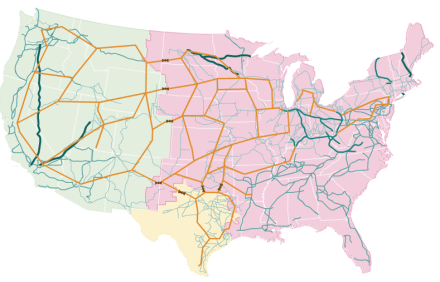
The electric grid of the United States.


Overall, it’s hard to tell whether this story comes as a relief or not. Short version: the illogicality and inconsistency with which the national power grid has built – that is to say, there isn’t a national grid – means that we are in fact more immune from a Robbian-style global guerrillas attack. The grid is too shitty to be vulnerable.

Which is good for our security short-term, but bad for long-term nationwide electricity. The real question is how do you duplicate the success of of an unplanned system? How do you engineer unpredictability? Answering that will be one of the major challenges of the 21st century.

Via io9.

The Output Gap

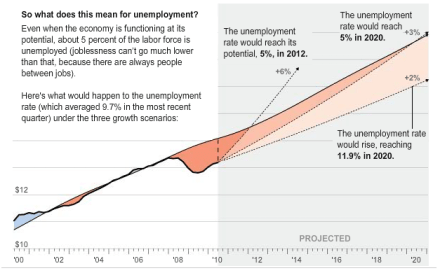
It seems like good news always comes out when the weather’s bad, and bad news when it’s nice out. But when it’s a grey day to begin with and you look at this series of charts

What the gap between potential and actual production means for employment.

Basically, a recovery could take 10 more years. Or never materialize at all. Given the devastating effects of long-term unemployment on recent graduates, young adults, and the very fabric of society, we have got to do better. And the stimulus was too much?!

At this point, it doesn’t even matter. Make-work, nothingness – anything is better than the worst-case outcome here.

Fear and Loathing in Lower Manhattan

Against my better judgment (there seems to be quite a bit of that going around these days), I’ve decided to engage with a post at the Urban Times that comes out against the Cordoba House Project in Lower Manhattan. Or, excuse me, the GROUND ZERO TERROR MOSQUE. Replies Nicolas Samson to my earlier objection:

My argument stems from a practical, pragmatic standpoint. I wish to avoid steaming [sic] ideology whether it is religious or secular, Christian, Muslim, republican, or liberal. My objections to building that mosque right now are just that, objections to building that mosque there, now. Freedom of religion has nothing to do with it. Bigotry has nothing to do with it. It’s all about the greater picture.

Freedom of religion has everything to do with it. That’s the entire point. Would you be just as opposed to a church, a synagogue, or a local chapter of the Richard Dawkins fan club opening up shop in the exact same spot? And what is the greater picture? Your objections to building a community center that includes a mosque seems awfully limited in its scope. The greater picture is who we are as a society and whether or not we can handle the consequences of our own rights and protections.

I sit down and ask myself, what is the coveted result? My answer is: An open-society America. Not a liberal America, not a kick-ass America, but an open-society America.

Well, you lost me when you decided that you didn’t want a kick-ass America.

Continue reading

Full Steam Ahead

Talk about setting your sights low. The current Amtrak plan for the Northeast Corridor calls for reducing travel times – over the next twenty years – by 4 minutes between Philadelphia and New York, and by 20 minutes between New York and Boston. As one professor says, “Amtrak’s new plan leaves you with a really good early-20th-century rail system.” It’s not speedy by any stretch of the imagination, and you save about 50 minutes over the regional trains for $80 more. Hell, this is how sorry the current state of high-speed rail funding in the Northeast is:

Rep. John Mica (R., Fla.), top Republican on the Transportation Committee, criticized the administration for giving little of $8 billion in high-speed money to the Northeast.

“They practically ignored the region of the country where high-speed makes the most sense – the Northeast Corridor,” he said. The corridor received $485 million, or 6 percent, of the stimulus funding. [Emphasis mine].

However, because we are the world and we are the future, some students at UPenn’s School of Design have proposed a radical alternative: a true, dedicated high-speed system that would make the journey from Boston to Washington, D.C. just 3.5 hours. From Philadelphia to New York in 37 minutes. This is the direction we want to go. This is more than just lip service.

One of the more interesting aspects to the proposal is a new route for the Boston-New York stretch. Instead of the current shadowing of I-95, trains would follow the same highways that I take when I drive to New York, I-90 to I-91 to I-84 (though presumably these trains won’t take the Merritt Parkway). But then the route diverges sharply to the south and crosses underneath Long Island Sound in a tunnel before turning west again and continuing on to the city.

I love this for so many reasons. This is something we’ll actually use, putting people to work, and producing a end-result we can all be happy with and proud of. Most importantly, it’s big-picture thinking. It’s ambitious. It’s grandiose. And it’s entirely in keeping with the American way.

“We started with a different framework than Amtrak,” said Bryan Rodda, 26, one of the student authors. “Amtrak said, ‘What’s the best we can do to make sure it doesn’t fall apart?’ and then, ‘What is the best we can do with what we have to improve travel time?’

“We asked, ‘What can we do if we rejected the way it is now and do actual, true high-speed rail and get travel time below two hours?’ ”

The students proposed a remade Market East station to accommodate the high-speed train stop in Philadelphia, with another stop at Philadelphia International Airport.

They suggested keeping 30th Street Station for other train traffic and visualized a revitalized Market Street corridor between University City and Old City.

The students proposed that federal and state governments pay for the new high-speed rail line for the Northeast, along with private investors. They suggested money could be raised from gas taxes, interstate tolls, user fees, value-added taxes, and station-area sales taxes.

The economic benefits, the students concluded, would outstrip the costs by $70 billion.

Yes we can, pretty please?

Via INFRASTRUCTURIST.

Rep. John Mica (R., Fla.), top Republican on the Transportation Committee, criticized the administration for giving little of $8 billion in high-speed money to the Northeast.

“They practically ignored the region of the country where high-speed makes the most sense – the Northeast Corridor,” he said. The corridor received $485 million, or 6 percent, of the stimulus funding.

Treason Doesn’t Pay

…or so Vladimir Putin reminds us. As the ten accused Russian spies returned home, Putin said that their outing was a “betrayal,” and vowed that there would be “tough times for the traitors,” whose names the Kremlin is apparently well aware of. And he had a word of caution for those who would do the same:

Traitors always end badly. As a rule, they end up in the gutter as drunks or drug addicts.

Take note, would-be Benedict Arnolds or Vidkun Quislings! If you commit treason, you might as well be heating up black tar heroin in a spoon.

Via Bostonist.

On Leadership

President Barack Obama in the Oval Office, January 2009.

I seem to have lost faith in the promise of the Obama administration, which has pursued a radically centrist agenda and left me sorely disappointed. There has been little real change. Kevin Drum summarizes the last eighteen months best in a much-circulated quote:

Here’s the good news: this record of progressive accomplishment officially makes Obama the most successful domestic Democratic president of the last 40 years. And here’s the bad news: this shoddy collection of centrist, watered down, corporatist sellout legislation was all it took to make Obama the most successful domestic Democratic president of the last 40 years. Take your pick.

While obviously Obama is not solely to blame for the BP oil spill in the Gulf of Mexico, the media lockdown that has been enabled by it is un-American on a fundamental level.

Nominees like Sonia Sotomayor or Elena Kagan, while a lock for confirmation, are exactly the kind of uninspiring mediocrities that have once again disillusioned us. If one of Kagan’s strongest credentials is that Lawrence Lessig endorsed her, why not reach for the stars and nominate Lessig himself? Or Harold Koh?

It’s difficult to come to terms with the fact that Barack Obama, who signaled an end to the Bush era abridgement of rights and liberties, may in fact be worse than his predecessor; a “third Bush term” that brings to their logical extreme many of the policies put in place that Obama had suggested might be curtailed. And even if all this does not accurately reflect Obama’s actual intentions, it points to something nearly as unforgiveable – half-assing it.

If you’re serious about a high-speed rail program, don’t just hand out the paltry sum of $8 billion and expect the states to pay for the rest. That would be worse than not spending anything at all. And at the same time, there are 1.8 million construction workers without anything to build. That’s an industry-wide unemployment rate of 20.1%. I mean, get serious about this. Put them to work. We need massive repairs to our roads, bridges, and vital infrastructure? Then sign a $1 trillion package. Or at least propose it. To quote The West Wing, “this is a time for American heroes – and we reach for the stars.”

Right now we’re just gazing at our shoes.

Crossposted at The Smolerian.

This Was Once a Country Where People Made Things

Aside from the usual terrible, terrible commentary both at YouTube and the site I found this at, it’s an excellent ad (at least for the first 40 seconds). It doesn’t matter if you’re from the East Coast, the Rust Belt, the Bible Belt, the New West, the “Left Coast,” or whatever. It’s America. And it restores a little bit of your faith in it.

We used to make things. And now we do once more? Well, we should be.

Via Isegoria.

Wait, What?

Every so often, I will have a mild revelation and ask myself, “Why are we still in Afghanistan?” It’s similar to the mental whiplash I developed in the run-up to the Iraq War, when all of a sudden the national conversation switched from one about Osama bin Laden, Afghanistan, and Tora Bora to yellowcake uranium and l’Affaire du Plame.

Despite his somewhat over-exaggerated blame (though sadly, his position grows a little more plausible each day), I found Howard Hart’s recent take on our efforts in Afghanistan a pretty convincing echo of my own thoughts. To wit:

Leaving Afghanistan would mean that the Taliban would officially take over the country – most of which they already control. So what? It has controlled Afghanistan before. America is under no moral or political obligation to re-make the country into some sort of “democratic” state. It would make it easier for Pakistan to deal with both its internal radical Islamic threat and with a Taliban-controlled Afghanistan (which Pakistan knows will be the end result of the war).

Difficult as it is for us freedom-and-democracy-loving Americans to admit, free elections will not be how the war in Afghanistan ends. Perhaps we are under some sort of moral obligation to attempt to stabilize the country, having brought war and destruction to it, but we’ve had nine years to work that out, and failed miserably. There are no positive outcomes. The only question is whether the Taliban returns sooner or later. And the longer we wait, the more it costs us.

Your depressing thought for the day.

Red Menace

One might be forgiven for thinking we’ve been trapped in some sort of time-warp-nexus lately. The Germans have bloodied the English yet again, Paul Krugman thinks we’re doomed to repeat the Long Depression, and now? Russian spies on our shores.

Yes, that’s right, 11 agents of the Kremlin were arrested in Yonkers, NY (where my alma mater is located), Boston (where I live), and northern Virginia (where thankfully I’ve never been to). But what exactly were they trying to do? Nothing less insidious than an “effort to plant Russian spies in the United States to gather information and recruit people able to infiltrate government policy-making circles.”

Great heavens! The Manchurian Candidate all over again. The Times is unclear on the specific motivations of the suspects, but does point out that while nine of the eleven were charged with money laundering, none were accused of stealing secrets (or presumably, influencing government policy). The real crime, though, was apparently “conspiring to act as agents of a foreign government without registering with the Justice Department.”

Ah, if only they’d bothered to let their local US Attorney they were attempting to influence the government! Then this could all have been resolved without such a fuss.

The Times has the original criminal complaints, which outline the high-tech tools of spycraft like LAPTOPS, AD HOC NETWORKS and MAC ADDRESSES. How dare the Russians outwit us again! Time for a crash program to develop a new, all-American SUPERLAPTOP and beat the Russkies at their game. It should be our goal to do this by the end of the decade.