War in the Pacific

I, like just about everyone, am looking forward to HBO’s new miniseries The Pacific. I mean like, really, really psyched; it’s been much too long in the making. But I’m really liking the Hanks-Spielberg team as of late.

Semperpapa at David Bellavia has taken Hanks to town, though, for the latter’s comments on the ‘true’ meaning of war in the Pacific. I responded at the source, but I also think the arguments deserve a full presentation, so here are his, followed by mine:

I was somewhat disappointed by Tom Hank’s simplistic look at what WWII represented for our Nation, when, during an interview, he stated that the reason America wanted to kill the Japanese was because they were different. They looked different, they believed different.
[…]
I could even understand that Tom, as a good Liberal, would hold America responsible for the Japanese attack on Pearl Harbor, because after all the American fleet was an “imperialistic” obstacle to the “legitimate” expansionist needs of Japan toward South Eat Asia.
[…]
In the interview, Hank points out his latest project wanted to honor the bravery of the American troops

“…but we also wanted to have people say, ‘we didn’t know our troops did that to Japanese people.’”…

I don’t know that Hanks’s opinions, overly simplistic as they are, can be blamed on his liberalism. There weren’t too many alternatives to what we did in either theater. Rather, his misinformation can be attributed to the general American ignorance about the Pacific theater.

Much of whatever vague impressions Americans get of the Pacific are from sources like Dr. Seuss’s wartime propaganda and the various posters attacking “yellow” “Japs.” Which if it’s all you’re getting, definitely paints a one-sided picture.

He’s also not entirely wrong. To a degree much more pronounced than in the ETO, the American war effort dehumanized the Japanese as both a race and a nationality. In Germany, we were fighting Hitler, but in the Pacific we were fighting the Japs. There was a distinct conflation of politics and racism there that was absent from Europe, or at least the western front in Europe. The Pacific shared a viciousness with that life-or-death struggle on the eastern front, where the choices were literally reduced to a binary: victory or death and enslavement.

But I don’t mean to condemn that brutality entirely. In most ways our response was a tit-for-tat regarding Japanese behavior. After enough incidents occurred when surrendering Japanese troops instead carried out the equivalent of a suicide bombing, we stopped taking prisoners. As a tactical solution it was entirely justified. We took no prisoners – but with good reason. See John Dower’s War without Mercy: Race and Power in the Pacific War for a fairly deep analysis of the course of the Pacific theater.

Basically, the dehumanization we carried out in the press and other media is being misattributed by Hanks to a cause of the war, rather than the fairly standard wartime practice and response to in-theater events that it was.

And of course, the Japanese behavior speaks for itself.

A Brief Study in Hyperbole

Margaret Thatcher and Ronald Reagan at Camp David, 1984.

Yesterday I took part in an in-class debate on which was the more ‘special’ relationship: Churchill and Roosevelt, Macmillan and Kennedy, or Thatcher and Reagan? I was assigned to the Thatcher-Reagan team.

I took it upon myself to write an opening statement, and it follows. Bear in mind I wrote this in approximately 30 minutes (including edits and rewrites). Then you can decide: did I actually say anything at all? Or did I just make it sound like I did? In other words, where’s the beef?

Since revolution tore the two asunder, and the White House burned in 1812, the United States and United Kingdom have enjoyed an extraordinary partnership unrivaled by anyone in the world – a “special” relationship.

The relationship has waxed and waned over the years, but never was it stronger or more dynamic than the Thatcher-Reagan era of the 1980s. Bound together by mutual respect and admiration, cultural affinity, and a shared commitment to western values, the special relationship between the Gipper and the Iron Lady was forged in history and sealed with blood. Through war and in peace, America and Britain held fast at home and abroad with Reagan and Thatcher at the helm.

From the windswept south Atlantic to the skies above Libya, Reagan and Thatcher were partners amidst a sea of troubles. Politically like-minded like to pair before them, they successfully navigated the shoals of the Cold War and brought the Soviet Union to its knees. Together they restored a sense of national pride to their respective countries and returned the special relationship to its lofty pedestal.

Personally, politically, diplomatically, and militarily, Reagan and Thatcher were exceptionally close. Maintaining a solid front publicly, they never hesitated to disagree in private, always constructively and without hint of animosity. Anglo-American relations, NATO, and indeed the west itself were and continue to be rejuvenated by their remarkable friendship; and nothing less than the whole of humanity has been the beneficiary of Thatcher and Reagan’s truly special relationship.

I like the lofty rhetoric I came up with, but methinks the substantive portion leaves something to be desired. And that’s ignoring what I actually think about the merits of the argument.

Another Canary

Smoke billowed from a seven-story building after a small private plane crashed into a building that houses an office of the federal tax agency in Austin, Tex.

The Metro Gunman – John Patrick Bedell –  who shot two policemen at the Pentagon metro station on Thursday, is the second anti-government terrorist to attack in as many weeks. Joe Stack was the first. While their respective manifestos differ in focus, they share a number of common elements that indicates there is more to come. Bedell is more of a conspiracy theorist (particularly harping on James Sadow, the marine killed in 1991) and wanted to establish “the truth of events such as the September 11 demolitions.”

We haven’t reached critical mass yet, but we’re getting there. Stack and now Bedell are each a “canary in the coal mine,” as John Robb puts it. He lays out three main drivers for this kind of terrorism: extreme frustration/hopelessness, few mitigating influences, and rage and a loss of government legitimacy. And while Stack and Bedell do have their differences, the crucial part is that they both came to the same conclusion.

Continue reading

Rethinking the U.S.

Chirol, long-time blogger at Coming Anarchy, has struck out on his own and started a new blog, Rethinking the United States.  He plans to cover a lot of ground, mostly serving to answer the question “does the United States serve its purpose?” His welcome post lists the topics to be covered as:

sustainability, autonomy, devolution, decentralization, political identity and loyalty,  political organization, self organization, superempowerment, technology, resilience in general and resilient communities.

Other related and more directly political topics and of great personal interest to the author will be Libertarianism, civil liberties, small government and firearms though they will almost always come back to the topic at hand.

Sounds like a perfect synthesis of stuff that I’m interested in. I cannot wait to see what he comes up with.

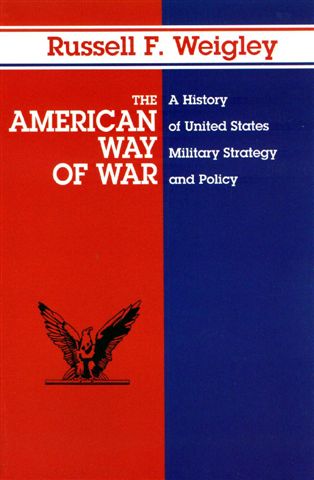
The American Way of War: A Review

After a long while of meaning to, I’ve finished Russell Weigley’s magisterial book The American Way of War. Took longer than it should have, but as a foundational text for understanding not only American strategy, but basic concepts of national strategy itself, this book is unsurpassed. It’s one of the few I can truly call “epic.”

Beginning with George Washington’s “strategy of attrition” during the Revolutionary War, Weigley traces the scope of American strategic thought up to the closing days of the Vietnam War. Structurally, American strategy falls into several phases. Washington eventually gives way to Halleck, who is then replaced by Ulysses Grant. Grant’s approach to war – “a strategy of annihilation” – then serves as the United States’ guiding principle until well into the twentieth century.

Continue reading

Transatlanticism

Daniel Korski’s new article in Foreign Policy, “Partners in Decline,” calls for a renewed US-European relationship, as a way of staving off marginalization at least for a while. It’s kind of hard to discern his point – clearly at this point, Europe needs the US far more than the US needs Europe. True, NATO is a force of legitimacy right now, but if the demographic trends Korski points to as signs of decline continue, won’t it begin to lose that legitimacy as it becomes less and less representative of any significant proportion of global population?

Korski also misinterprets history. He asks us to

Imagine if the United States had in the past chosen its allies exclusively on whether they were willing to fight alongside the 82nd Airborne. That would have meant abandoning an alliance with Britain in 1966 after then-Prime Minister Harold Wilson refused to send British troops to the Vietnam War.

Is there some sort of treaty or piece of paper we would have torn up? Aside from the (predominantly cultural) Special Relationship – which certainly was damaged for most of the 70s until the Reagan-Thatcher revival – Britain’s refusal to commit troops to Vietnam was no more than a disagreement between longtime global partners. There was no real ‘alliance’ to end as a response but even that informal alliance was seriously damaged.

I wouldn’t go so far as to advocate an American withdrawal from NATO (as Andrew Bacevich does), but at the same time it is perhaps on an even steeper path to irrelevancy than Europe and the United States themselves. Korski’s argument is in itself contradictory, as his prescription for waning influence just reemphasizes the extent of Western decline. And like all other nation-states, it is an inevitable collapse.

With Open Arms

Admiral Michael Mullen, Chairman of the Joint Chiefs of Staff.

I’ve meant to talk about it sooner, but it wasn’t until I saw some particularly egregious arguments that I was spurred to action. Don’t Ask, Don’t Tell absolutely needs to be repealed. First announced at the State of the Union address, Defense Secretary Bob Gates and JCS Chairman Admiral Mike Mullen continued to call for it at a press conference later that week. Admiral Mullen’s comments – declaring the current policy as detrimental to the military’s integrity – are particularly noteworthy:

No matter how I look at this issue, I cannot escape being troubled by the fact that we have in place a policy which forces young men and women to lie about who they are in order to defend their fellow citizens. For me, it comes down to integrity — theirs as individuals and ours as an institution. I also believe that the great young men and women of our military can and would accommodate such a change. I never underestimate their ability to adapt.

We would also do well to remember that this is not an issue for the military leadership to decide [emphasis mine].

Continue reading

The End of COIN?

Maj. General Rick Nash tries his hand at camel riding during a visit to the Sa’adoun tribe confederation land.

Last month, the zenpundit (Mark Safranski) came up with a startling idea: “The Post-COIN Era is Here.” The idea, while revelatory, is definitely worth consideration. The modern timescale for adopting and conceiving new doctrine has shrunk from the decades it used to take to only a few short years – both a blessing and a curse. On the plus side is the ability to shift rapidly from a failed strategy to one which stands a chance of succeeding, saving time and lives that would otherwise be wasted. At the same time, an untested new idea runs the risk of failing, in perhaps even more spectacular fashion.

It was fairly clear, then, that something would have to give way after the abyss into which Iraq plunged the first few years after invasion. Safranski lays down three main reasons for the initial adoption of COIN:

1) The  ”Big Army, fire the artillery, fly B-52’s and Search & Destroy=counterinsurgency” approach proved to be tactically and strategically bankrupt in Iraq. It failed in Mesopotamia as it failed in the Mekong Delta under Westmoreland – except worse and faster. Period.

2) The loudest other alternative to COIN at the time, the antiwar demand, mostly from Leftwing extremists, of immediately bugging-out of Iraq, damn the consequences, was not politically palatable even for moderately liberal Democrats, to say nothing of Republicans.

3) The 2006 election results were a political earthquake that forced the Bush administration to change policy in Iraq for its’ own sheer political survival. COIN was accepted only because it represented a life preserver for the Bush administration.

Continue reading

The 2010 QDR is Here

The  DoD’s Quadrennial Defense Review is out, and its prognosis for America’s military future is quite interesting indeed. Overall funding levels have remained virtually identical; all Gates requested was a 2% increase, about $159.3 billion. Specific increases are called for in the areas of rotary-wing assets, manned and unmanned aircraft, and special forces assets.

For the most part, the strategy remains the same: using a mix of diplomatic, intelligence, and military solutions, keep America safe. Be ready to operate abroad. And be flexible: the military needs the capability to adapt to conventional war, COIN, stabilization, and any other kind of mission that might come up. Below are some key points from the topsheet.

Continue reading