The Next Island Chain

All too often, a newspaper’s article about an aspect of the Chinese military uses an alarming headline, builds up the “threat,” and then contradicts itself within the first few paragraphs. This time, it’s the New York Times in an article titled “China Expands Naval Power to Waters U.S. Dominates.”

YALONG BAY, China — The Chinese military is seeking to project naval power well beyond the Chinese coast, from the oil ports of the Middle East to the shipping lanes of the Pacific, where the United States Navy has long reigned as the dominant force, military officials and analysts say.

Well, OK, so far so good. Nothing there that we didn’t know already.

The strategy is a sharp break from the traditional, narrower doctrine of preparing for war over the self-governing island of Taiwan or defending the Chinese coast. Now, Chinese admirals say they want warships to escort commercial vessels that are crucial to the country’s economy, from as far as the Persian Gulf to the Strait of Malacca, in Southeast Asia, and to help secure Chinese interests in the resource-rich South and East China Seas.

Yeah, that’s also nothing new. The ‘three island chain plan‘ has been around for decades; this was just the logical next step. They’re in the Gulf of Aden already conducting anti-piracy operations.

The overall plan reflects China’s growing sense of self-confidence and increasing willingness to assert its interests abroad. China’s naval ambitions are being felt, too, in recent muscle flexing with the United States: in March, Chinese officials told senior American officials privately that China would brook no foreign interference in its territorial issues in the South China Sea, said a senior American official involved in China policy.

Well, seeing as the South China Sea is a part of the first island chain – an arena China’s been capable of defending and projecting itself into for some time – this doesn’t change anything, really. Much like the United States will brook no interference in its own territorial issues. I’m not even sure what the problem is here that Wong sees…

The naval expansion will not make China a serious rival to American naval hegemony in the near future, and there are few indications that China has aggressive intentions toward the United States or other countries.

Oh, there it is. Thank you, Edward Wong, for leading us on with five paragraphs about the growing menace of the Chinese Navy and abruptly telling us “oh, you know what? Don’t worry about all that stuff I just said. It doesn’t matter.” Sea denial has been the constant refrain of the Chinese for a decade; the fact that we’re just catching on now is the alarming part. That’s why China’s focus is on asymmetrical naval warfare – not carriers to fight our carriers, but land-based missiles to sink our carriers.

Continue reading

An Afghan Primer

Hot on the heels of Binyavanga Wainaina’s “How to Write about Africa” comes a new guide, this time from Registan: “How to Write about Afghanistan.”

Always use the word ‘war-torn’ in your title. Subtitles may include the words ‘tribal,’ ‘Taliban,’ ‘corrupt,’ and ‘Sharia.’ Also useful are words such as ‘shuras,’ ‘fighters,’ ‘refugees’ and ‘insurgency.’ Do not distinguish between different ethnic groups with different languages, religions and histories, or regions with different landscapes and livelihoods. If people in Kandahar tell you something, assume people in Kabul feel the same way, and vice versa. Whenever possible, mention Pashtunwali. (Note: you do not need to understand what Pashtunwali is. You get points for mentioning it anyway.)

Never have a picture of a well-adjusted Afghan accompanying your article. (Make an exception for Afghans you want to be president.) A stoned cop, a woman in a burka begging, a scowling man holding a Kalashnikov: use these. If you must include an Afghan who is not miserable or threatening, make sure you get an elderly farmer with very few teeth, or a little girl holding a baby goat.

I’m reminded of why I chose ‘monolithic’ as my word of the month (possibly of the year).

Recommended Reading (2010-04-25) – SUNDAY Edition

Close up looking down onto Chrysler Building, New York.

– Today is ANZAC Day! A quote from Ataturk in its honor, courtesy of Abu Muqawama:

Heroes who shed their blood and lost their lives! You are now lying in the soil of a friendly country. Therefore rest in peace. There is no difference between the Johnnies and Mehmets to us where they lie side by side here in this country of ours. You, the mothers, who sent their sons from far away countries wipe away your tears; your sons are now lying in our bosom and are in peace. After having lost their lives on this land they have become our sons as well.

– In case you missed it, this past week the USAF launched the unmanned X37 ‘space plane‘. According to the Air Force’s Deputy Undersecretary for Space Programs, DoD has no idea “when it’s coming back for sure.”

Britain still owes Iran something like £400 million for 1,500 Chieftain tanks that it never delivered to the Shah thirty years ago. Because, of course, the Shah wasn’t around by the time the Ministry of Defence got around to it.

– It just sucks to be Mexico City. And often in this article when they say flooded with ‘water’, what they mean by water is ‘raw sewage’ (of course, it’s sucked to be Mexico City – or Mexico at all, for that matter – for quite some time now).

– ArmsControlWonk surveys the now-raised Cheonan and compares the effect of a modern North Korean torpedo (i.e. splitting the ship in half) with that of the Cole bombing and ‘classical’ torpedo effects.

Continue reading

The Anti-iPad

I’m not going to beat around the bush: I despise Apple in many ways, but the most damning has to be their insistence on making all new products a closed system, in which Apple has the ultimate control over what you buy, watch, read, listen to, and consume in general. If consumption is the lowest form of choice, then Apple has put further restrictions on that already crippled platform.

My words shouldn’t be the definitive take, though. Jack Shafer, Jim Stodgill, and Cory Doctorow basically say everything I’d like to. From Stodgill’s “The iPad Isn’t a Computer, It’s a Distribution Channel”:

In this context the iPad isn’t a computing device at all. Jobs is using his knack for design and user experience to build, not a better computer, but a better distribution channel. One that is controlled, constrained, and can re-take distribution as the point of monetization. You aren’t buying a computer when you buy an iPad, you are buying a 16GB Walmart store shelf that fits on your lap – complete with all the supplier beat downs, slotting fees, and exclusive deals that go with it – and Apple got you to pay for the building.

These are just some of the philosophical issues I have with the iPad – I won’t go into my more biased dislike of OSX (or its stripped-down variants).

I was pleased to come across this device, though:

Sporting XP Home and a full physical keyboard, the Asus EeeKeyboard is probably the most effective rebuttal to the iPad I’ve seen. And the best part is that it’s just as open a system as anything else running Windows is. Do with it what you want.

I’ve gotten into adopting the Doctorow mantra: close the back with screws not glue. Let us in.

Making and Doing

For anyone currently in London (and by currently, I mean in early May), Cory Doctorow is giving a free talk at Nettlefold Hall in West Norwood on May 8. RSVPs are required, though – send an email to readersandwriters@lambeth.gov.uk.

Along similar Doctorovian lines, I read a post in The Art of Manliness, of all places, bemoaning the “modern immaturity” of men, and encouraging us to “create more, consume less.” Consumerism is, after all, a passive activity that reduces all willpower to an illusory choice – “the weakening of man’s free agency.” It’s an indictment both of consumerism and of any kind of forward thinking:

The problem with consumerism is that it heavily emphasizes choice, to the complete exclusion of the idea of living with that choice. Choose, choose, choose. But what happens after your make that choice?

Definitely worth reading and considering in all contexts – be it manliness, resilience, or otherwise.

“A Small Thermal Exhaust Port…”

Its defenses are designed around a direct large-scale assault. A small one-man fighter should be able to penetrate the outer defense.
[…]
The Empire doesn’t consider a small one-man fighter to be any threat, or they’d have a tighter defense.

General Dodonna

Some good news for the US Navy:

Military experts say the Fifth Fleet has come a long way since Iranian gunboats crippled it within hours in a notorious war game five years ago.

In fact, says John Pike, president of the Alexandria, Va.-based Global Security Web site, the Navy was well on its way to solving the challenge of fending off the swarming swift boats before the war game began.

In that test, an enemy “red team” headed by retired Martine Corps Gen. Paul Van Riper deployed the gun boats and propeller-driven suicide planes to paralyze the Fifth Fleet, based in Bahrain in the Persian Gulf.

It took Riper less than two hours to knock it out of commission.

Key to the shocking result was Van Riper’s strategy of neutralizing the American advantage in big guns and cruise missiles by getting in close before hostilities began.

But the Navy now has the MK 182, “the mother of all shotgun shells,” fired by 5-inch guns deployed on every major ship in the fleet, says Pike.

Nice to see the USN thinking small, fast, and swarming. Even if it’s just a defensive strategy, the vulnerability of the navy as is to asymmetrical threats – be it dinghies or land-based anti-ship missiles – is pretty damning. Clearly a step in the right direction.

Of course, as Norman Polmar insists, “it always depends on how it starts.”

An Unpronounceable Volcano as Black Swan?

Taken 10 km east of Hvolsvollur Iceland on April 18th, 2010. Lightning flashes and glowing lava illuminate parts of Eyjafjallajokull's massive ash plume in this 30-second exposure.

Way back in 2004, John Robb wrote a piece on scale-free networks:

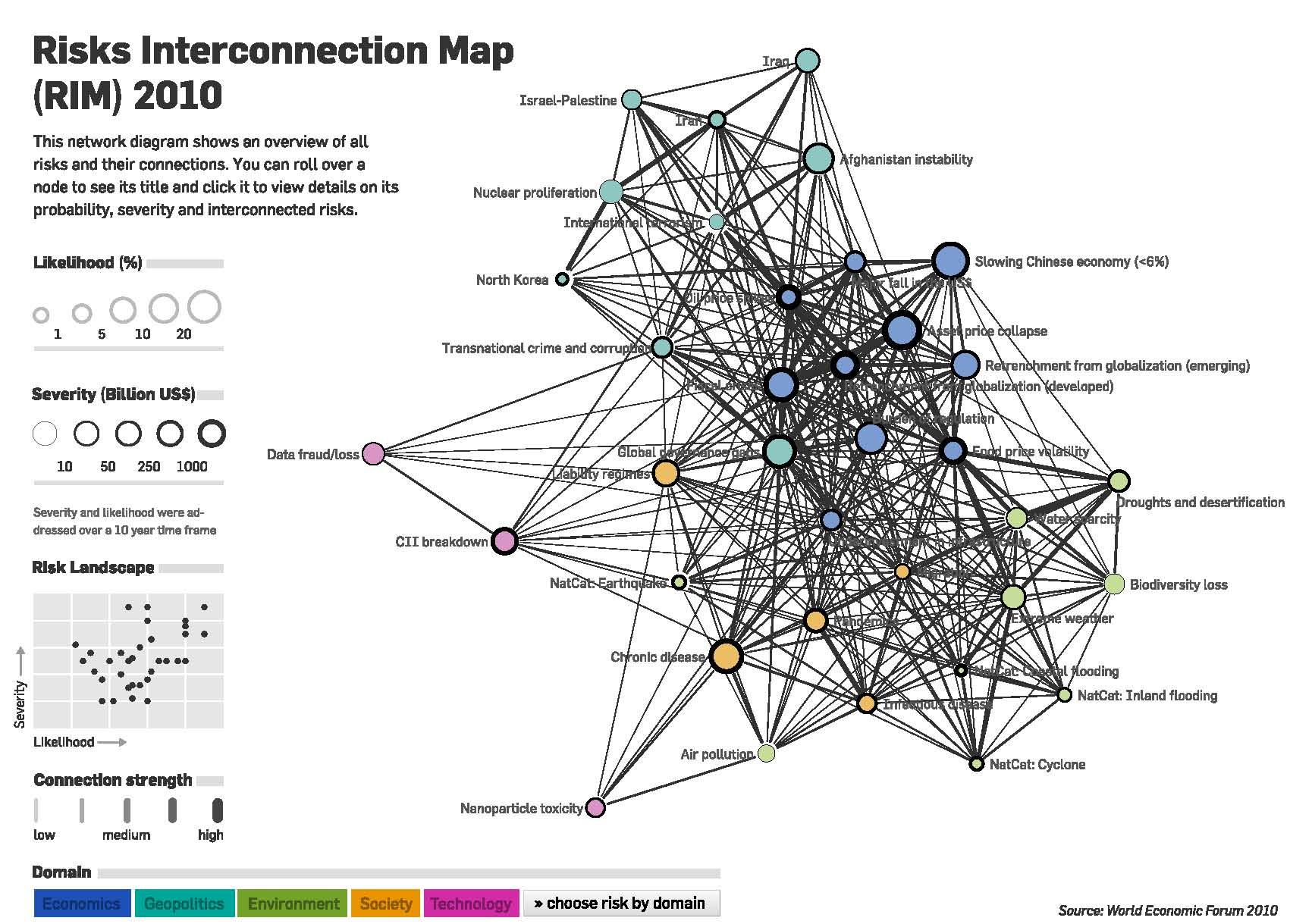
Scale-free networks are everywhere. The can be seen in airline traffic routes, connections between actors in Hollywood, weblog links, sexual relationships, and terrorist networks. So what exactly is a scale-free network? A scale-free network is one that obeys a power law distribution in the number of connections between nodes on the network [emphasis mine].

Obviously, considering the plight of the airlines right now in the midst of an apocalyptic (yet curiously invisible) ash cloud is particularly fascinating to do in the context of Robb’s networks. In characterizing the nature of scale-free ones, he comes up with a positive and a negative:

  • Scale-free networks are extremely tolerant of random failures. In a random network, a small number of random failures can collapse the network. A scale-free network can absorb random failures up to 80% of its nodes before it collapses. The reason for this is the inhomogeneity of the nodes on the network — failures are much more likely to occur on relatively small nodes.
  • Scale-free networks are extremely vulnerable to intentional attacks on their hubs. Attacks that simultaneously eliminate as few as 5-15% of a scale-free network’s hubs can collapse the network. Simultaneity of an attack on hubs is important. Scale-free networks can heal themselves rapidly if an insufficient number of hubs necessary for a systemic collapse are removed.

Examining the fallout from Eyjafjallajokullin in this light does present an interesting dichotomy. If we consider the entire globe as one big air traffic system, then it definitely is showing resilient capabilities. Flights are diverted around the affected nodes and redistributed to areas unaffected by the ash cloud. It’s as if Europe was a tumor that has been surgically removed from the rest of the airborne world.

Thus, of course most everyone can continue to fly whether or not Europe’s airports are open. The global network is continuing to function.

And in fact, it’s hard to conceptualize European airspace as an isolated network. At this point all air traffic to and from the continent is inextricably bound to the rest of world, and so it’s hard to imagine an inverse scenario in which the rest of the world ceases to fly while Europe muddles on.

However, this picture changes slightly if we consider the voluntary closure of most European airspace as an intentional attack. Robb gives the threshold as 5-15% of a system’s capability. Of the 30 busiest airports in the world in 2009, seven are in Europe, those seven with total passenger traffic of 268 million people a year. If 1.5 billion people travel by plane every year, that’s roughly 18% of world capacity (and that’s before taking into account all the other European airports that didn’t crack the top 30). For the rest of the world, it’s a relatively stable – if infuriating – situation. I suppose the real determining factor is that while the initial closures were shocks to the system, they didn’t begin on a Europe-wide scale, and by the time those in the east started closing, it was no longer a surprise.

Either way, the system is voluntarily taking at least a fifth of itself offline, which gives rise to an interesting third possibility that Robb doesn’t mention: how much of a system can turn itself off before collapse?

But I Repeat Myself

A reminder that history does not repeat itself; it merely rhymes:

Beneath azure blue skies on Sunday, an intrepid band of Englishmen tried to stage a scaled-down rerun of the “little ships,” hundreds of private craft that joined the Royal Navy in the improbable 1940 rescue [at Dunkirk], saving hundreds of thousands of British, French and Canadian soldiers to fight on against Nazi Germany.

This time, the effort centered on a group of men in a flotilla of inflatable speedboats who set out from Dover to ferry some of their stranded compatriots home from the rail and ferry chaos created by the cloud of volcanic ash that has shut down much of Europe’s air traffic.