Russian Resilience

Andrei Loshak has an article out on the endemic corruption in Russia. IKEA’s attempts to open new stores there are met with sheer absurdity, the currency of the realm. The absurd is everywhere in a nation of circular logic and Catch-22s, where power is shut off to a store on the verge of opening for no reason at all. “Reason has limited possibilities, whereas the absurd knows no limits.” According to Loshak, society may have reached a breaking point:

When the absurd transmogrified into the lunatic, the system activated the command to self-destruct. The Castle, impregnable from outside, starts collapsing from inside. Two eagle heads tear into each other, only feathers fly. But, strangely enough, the stronger the entropy in the state, the faster everything disintegrates and the easier it becomes to breathe. As if there’s more air. I think that society has lost its fear: the people perceive the government’s inability to keep control of itself as a sign of weakness. Such a state cannot have enough strength for repression. The animal nips of the enraged system have woken people from their hypnosis. Fear and apathy have been replaced by rage.

The Russian state is trying to do too much where it can, and can’t do enough where it matters (see the recent Metro bombings). Between corruption, incompetence,  and contempt, Moscow has managed to alienate vast swathes of its citizens. Overreach – and for no apparent reason other than the power to do so – could end up a catalyst for decentralizing the Russian state.

The further a person is away from power, the better he is. I have seen this for myself in far away Ural villages built by lumberjacks before the Revolution. These villages’ link with civilisation was the only one-track railway in the country. Five years ago the authorities decided to tear down the villages and pull up the one-track railway. People who had been born and grown up in the forests were offered a flat in a high-rise block on the outskirts of the regional centre.

The government’s attempts to ouster the good citizens of the small village went from gentle cajoling to scorched-earth, smoke-’em-out tactics. But people may be starting to fight back. The state’s attempt to overmanage in the Urals is met by a particularly resilient community.

First the trains stopped going there, so food and pensions were not able to get through. There were people in the villages who hadn’t seen money for several years. They baked their bread, fed their cattle, shot game in the hunting season and wanted only one thing: for the state to leave them in peace.  When their electricity was turned off, they used locally improvised materials to build their own hydroelectric station on the river…

As a rule the spectacle of total degradation is depressing, but the people who lived in these autonomous forest villages were completely different. The men were strong – their children had grown up and they were determined to die in the place where they were born. In spite of the hard living conditions, their wives had somehow managed to remain neat and womanly.  Doors were not locked here, as there had been no thieving in these forests for many years.  People moved from one village to another in railcars, a cross between Minsk motorcycles and wagons, on a narrow gauge railway, a construction that was as exotic as it was dangerous.  I was told confidentially that one of the men was on probation. Representatives of the regional administration had come to take up the railway and he had fired a warning shot and then one at their feet … These people were full of dignity. You don’t often see people like that in the cities.

Unfortunately, you don’t see a lot of people like that anywhere. I’m not trying to call for revolution or mass uprising, nor do I even want to approach the Teabagger argument that the guvmint is a’comin’ to take away our guns and liberties and force us all into abortions and gay marriages. But nevertheless, something’s on the horizon, and as my new mantra goes: the future is coming, for better or for worse.

Recommended Reading (2010-04-11) – SUNDAY Edition

Festung Hohensalzburg overlooking Salzburg, Austria.

Been catching up on lots and lots of stuff… So there will be even more to come soon.

– Toby Young responds to General John Sheehan’s remarks about the ‘gay Dutch’ at Srebenica: “Gay Dutch soldiers responsible for Srebrenica massacre? Balls. One of the finest British commanders of the Second World War was as bent as a nine-bob note.”

GRANTA offers a primer on writing about Africa (via Edge of the American West):

Always use the word ‘Africa’ or ‘Darkness’ or ‘Safari’ in your title. Subtitles may include the words ‘Zanzibar’, ‘Masai’, ‘Zulu’, ‘Zambezi’, ‘Congo’, ‘Nile’, ‘Big’, ‘Sky’, ‘Shadow’, ‘Drum’, ‘Sun’ or ‘Bygone’. Also useful are words such as ‘Guerrillas’, ‘Timeless’, ‘Primordial’ and ‘Tribal’. Note that ‘People’ means Africans who are not black, while ‘The People’ means black Africans.

– In further memory of the horrific Polish plane crash yesterday, here’s Adam Zamoyski on Chopin and his public diplomacy abroad on behalf of Poland.

Continue reading

More on Clausewitz

Patrick Porter takes on Admiral Mullen’s classification of Kandahar as the enemy “center of gravity” in anticipation of the upcoming offensive there:

Is Kandahar the centre?  Does the Taliban even have a centre that we can meaningfully disrupt within time? The critical condition for most violent insurgencies is external and usually international support. If that applies to this case, the Taliban’s centre may not be its sway in Kandahar, but its relationship with Pakistan, both the state and powerbrokers within it.

This isn’t the first time a major operation has been launched to strike at an enemy “center of gravity.” In fact, it happened fairly recently, and as I then pointed out, the military’s insistence on a) clinging to the term and b) if applicable, attacking that center of gravity is just irresponsible.

But more generally, this seems to be a movement lacking any important centers of gravity. That’s the whole problem with counterinsurgency; there’s no decisive point at which to apply pressure. It’s trying to tighten your grip on a handful of sand. Obviously I’m not saying give up the ghost, but I am suggesting that perhaps the whole concept of a large offensive whilst fighting an insurgency is an anachronism.

Kandahar probably is where we need to be, but if we’re doing so for these Clausewitzian theories… then we’re just missing the point.

A Return (Also on a Jet Plane)

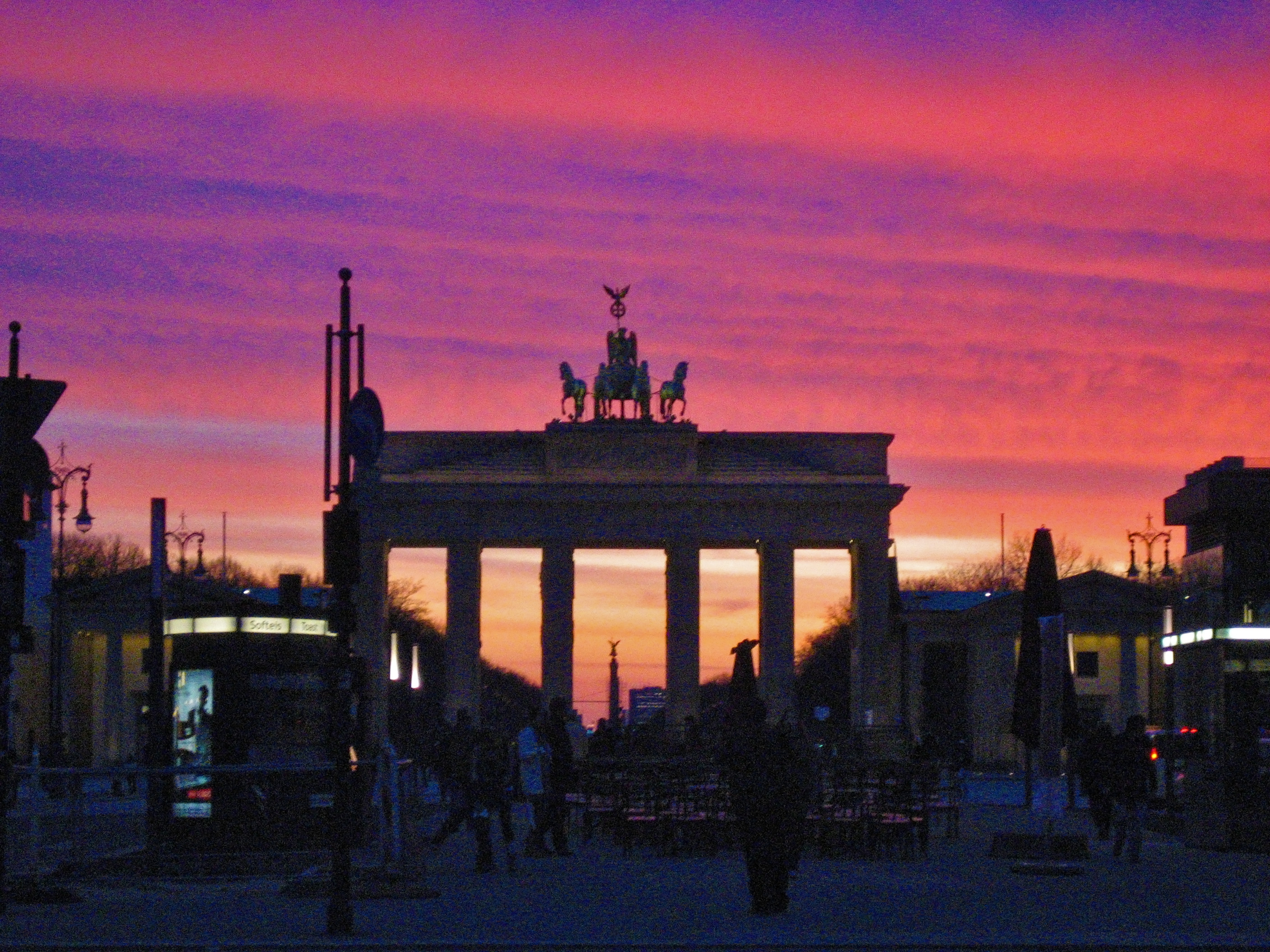
The Brandenburg Gate in Berlin, Germany at dusk; March 31, 2010.

I’ve been back in London for a couple days now, and while I wish I could say it’s good to be here, it’s at least nice to be catching up on the news (2,000+ items in Google Reader)!

Health care reform passed, a new nuclear limitation treaty signed in Prague – things are looking pretty swell right now.

I’ve got a lot of thoughts from the trip – which by the way, was AMAZING – but they’ll come slowly as I reintegrate into the real world. Side note: get to Eastern Europe now, before it gets all Euroed and Westernized. Particularly Hungary and Poland. In order, my favorite cities:

  1. Budapest
  2. Berlin
  3. Warsaw
  4. Vienna
  5. Salzburg
  6. Munich

I’ll explain them at some point. Oddly enough though, I think my favorite country is now Austria.

So much to do, so much to write, and you’ll have so much to read soon enough. Thanks for sticking around.

Operation Tannenbaum, Part IV

It is now November 9 1940. The bitterness of the Battle for Switzerland is something that will live with all Swiss and those German soldiers who participated. Out of the 800,000 Swiss under arms on September 24, 120,000 did not reach the redoubt. Only 15,486 of these soldiers were taken prisoner. In fact, there are more French and Polish prisoners in the German laagers then there are Swiss!

The Zytglogge in Bern, Switzerland.

Wilhelm Ritter von Leeb, commander of Heeresgruppe C.

Guisan and his staff are secure in the Redoubt, with the Germans unable to penetrate the massive defense works. However, the Germans are rather unwilling to commit so many forces to the strategically irrelevant alpine region. In the areas at higher altitude, the first snow has fallen, tabling any large offensives until the spring of 1941.

No less than 20 divisions are in occupied Switzerland, and tensions between occupier and occupied are running extremely high. Just as in Czechoslovakia, all popular gatherings have been banned. Weapons and wireless sets owned by private citizens have been ordered to be turned into authorities, including hunting rifles.[1] Heeresgruppe C has not been redeployed to the eastern front for a Russian offensive, and Wilhelm von Leeb has established his headquarters in occupied Bern for the winter.

Continue reading

Leaving on a Jet Plane

Buda Castle, Budapest, Hungary.

Today I’m en route to Hungary to kick off a grand central/eastern European trip, accompanied by an especially lovely lady. If you’re curious, the itinerary is Budapest-Vienna-Salzburg-Munich-Berlin-Warsaw.

I’ll be over there for two weeks, and while I’d like to pretend I’ll make occasional posts with pretty pictures I’ve taken, it would only take a couple of days for you all to see through the charade.

There’s a slight chance I’ll post every once in a while, but don’t hold your breath. Later today I’ll have Part IV of “Operation Tannenbaum” up, which will be the last for some time (and hopefully provide some needed closure). I’ll be back in April for sure.

And again, thanks so much for reading. If you haven’t already, this would be an excellent time to explore the links page and discover some interesting new blogs.

Operation Tannenbaum, Part III

While the odds were against any sort of meaningful Swiss victory in the event of invasion, such a German offensive was equally unlikely in the early years of the war. By 1943, the possibility of a successful German invasion had dwindled to virtually nothing, as the Swiss Army had expanded and modernized to a point that would make Tannenbaum a suicidal mission. This begs the question: why, then, would Hitler ever have chosen to invade Switzerland? Let us proceed with our counterfactual under the following premises.

It is now September 15. The unrestricted bombing campaign authorized by Churchill four months ago has been relatively unsuccessful. Fewer than 25 percent of the bombs dropped are landing within five miles of their intended targets, and only 30 percent have landed in any built-up areas.[1] However, this has had an unintended benefit. Having disguised the few industrial plants manufacturing jewel bearings, the Germans were fairly certain of their security. However, in a truly ironic case, this ended up being more costly, as the plants have been disproportionately hit by the British bombs. Jewel bearings are a main component of bombsights, and without them, Hitler is reluctant to press his luck in the Battle of Britain, much less Operation Sealion.

Continue reading

Operation Tannenbaum, Part II

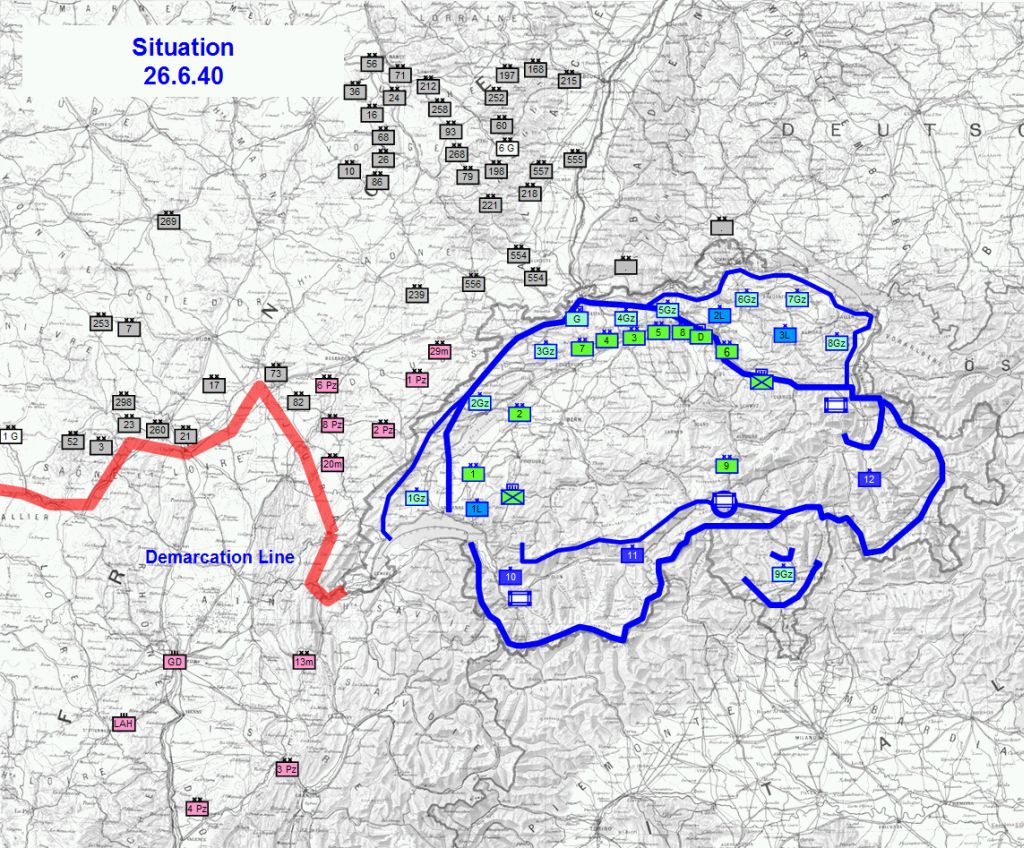
Hitler, flush with victory over France, now demanded to see plans for the invasion of Switzerland. His rage knew no bounds, as the head of OKH Franz Halder recalled: “I was constantly hearing of outbursts of Hitler’s fury against Switzerland, which, given his mentality, might have led at any minute to military activities for the army.”[1] Within hours of the French capitulation, Captain Otto Wilhelm von Menges in OKH submitted a draft plan for the invasion.

Menges' Fall Schweiz, first draft (June 26 1940).

Generaloberst Wilhelm Ritter von Leeb’s Heeresgruppe ‘C’ (HGr. C), led by Generalleutnant Wilhelm List and the 12th Army would conduct the attack. Leeb himself personally reconnoitered the terrain, studying the most promising invasion routes and paths of least resistance.[2] Menges’ plan called for a pincer movement from German troops in France and Germany focused on taking Bern quickly, with Italian divisions invading from the south. Speed was critical: the plan’s primary objective was to seize the industry in the Solothurn area and capture the railroads, bridges, and transportation infrastructure across the Alps intact.[3]

Continue reading

Operation Tannenbaum: Hitler’s Invasion of Switzerland

The military picture on the Franco-Swiss border, June 26, 1940.

France was defeated. So too were Poland, Norway, Denmark, Holland, and Belgium. Austria and Czechoslovakia had been incorporated into the Greater German Reich. Great Britain stood alone in her ‘splendid isolation,’ and the fascist regime of Francisco Franco held sway over the Iberian Peninsula. In June of 1940, all that remained, surrounded by enemies, was the Swiss Confederation.

Hitler called it a “pimple on the face of Europe.”[1] In the heady days of victory for the Third Reich, a move against the alpine republic seemed a great possibility – almost inevitable, even. Even before the Fall of France was made official, plans were being drawn up for ‘Operation Tannenbaum,’ the German invasion of Switzerland. Yet Hitler’s attention was soon drawn towards Britain, and eventually the plan fell by the wayside as he began focusing attention on his Bolshevik neighbor to the East.

But…what if? What if Hitler had decided that the conquest of that mountainous pimple was indeed worth the effort and manpower? What if Tannenbaum had been more than just idle words and an OKW plan? If Hitler had embarked on the ultimate folly, the results would have been disastrous for the Swiss – and the Nazis.

Continue reading