Operation Tannenbaum, Part IV

It is now November 9 1940. The bitterness of the Battle for Switzerland is something that will live with all Swiss and those German soldiers who participated. Out of the 800,000 Swiss under arms on September 24, 120,000 did not reach the redoubt. Only 15,486 of these soldiers were taken prisoner. In fact, there are more French and Polish prisoners in the German laagers then there are Swiss!

The Zytglogge in Bern, Switzerland.

Wilhelm Ritter von Leeb, commander of Heeresgruppe C.

Guisan and his staff are secure in the Redoubt, with the Germans unable to penetrate the massive defense works. However, the Germans are rather unwilling to commit so many forces to the strategically irrelevant alpine region. In the areas at higher altitude, the first snow has fallen, tabling any large offensives until the spring of 1941.

No less than 20 divisions are in occupied Switzerland, and tensions between occupier and occupied are running extremely high. Just as in Czechoslovakia, all popular gatherings have been banned. Weapons and wireless sets owned by private citizens have been ordered to be turned into authorities, including hunting rifles.[1] Heeresgruppe C has not been redeployed to the eastern front for a Russian offensive, and Wilhelm von Leeb has established his headquarters in occupied Bern for the winter.

Continue reading

Operation Tannenbaum, Part III

While the odds were against any sort of meaningful Swiss victory in the event of invasion, such a German offensive was equally unlikely in the early years of the war. By 1943, the possibility of a successful German invasion had dwindled to virtually nothing, as the Swiss Army had expanded and modernized to a point that would make Tannenbaum a suicidal mission. This begs the question: why, then, would Hitler ever have chosen to invade Switzerland? Let us proceed with our counterfactual under the following premises.

It is now September 15. The unrestricted bombing campaign authorized by Churchill four months ago has been relatively unsuccessful. Fewer than 25 percent of the bombs dropped are landing within five miles of their intended targets, and only 30 percent have landed in any built-up areas.[1] However, this has had an unintended benefit. Having disguised the few industrial plants manufacturing jewel bearings, the Germans were fairly certain of their security. However, in a truly ironic case, this ended up being more costly, as the plants have been disproportionately hit by the British bombs. Jewel bearings are a main component of bombsights, and without them, Hitler is reluctant to press his luck in the Battle of Britain, much less Operation Sealion.

Continue reading

Operation Tannenbaum, Part II

Hitler, flush with victory over France, now demanded to see plans for the invasion of Switzerland. His rage knew no bounds, as the head of OKH Franz Halder recalled: “I was constantly hearing of outbursts of Hitler’s fury against Switzerland, which, given his mentality, might have led at any minute to military activities for the army.”[1] Within hours of the French capitulation, Captain Otto Wilhelm von Menges in OKH submitted a draft plan for the invasion.

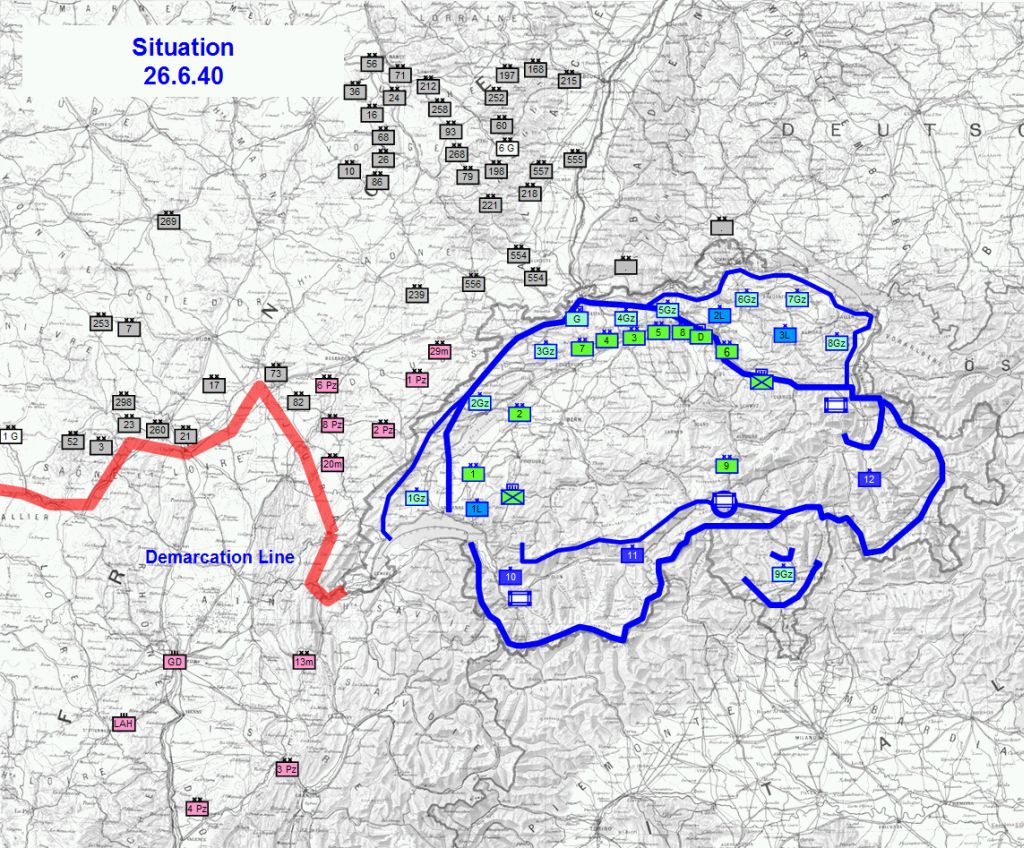
Menges' Fall Schweiz, first draft (June 26 1940).

Generaloberst Wilhelm Ritter von Leeb’s Heeresgruppe ‘C’ (HGr. C), led by Generalleutnant Wilhelm List and the 12th Army would conduct the attack. Leeb himself personally reconnoitered the terrain, studying the most promising invasion routes and paths of least resistance.[2] Menges’ plan called for a pincer movement from German troops in France and Germany focused on taking Bern quickly, with Italian divisions invading from the south. Speed was critical: the plan’s primary objective was to seize the industry in the Solothurn area and capture the railroads, bridges, and transportation infrastructure across the Alps intact.[3]

Continue reading

Operation Tannenbaum: Hitler’s Invasion of Switzerland

The military picture on the Franco-Swiss border, June 26, 1940.

France was defeated. So too were Poland, Norway, Denmark, Holland, and Belgium. Austria and Czechoslovakia had been incorporated into the Greater German Reich. Great Britain stood alone in her ‘splendid isolation,’ and the fascist regime of Francisco Franco held sway over the Iberian Peninsula. In June of 1940, all that remained, surrounded by enemies, was the Swiss Confederation.

Hitler called it a “pimple on the face of Europe.”[1] In the heady days of victory for the Third Reich, a move against the alpine republic seemed a great possibility – almost inevitable, even. Even before the Fall of France was made official, plans were being drawn up for ‘Operation Tannenbaum,’ the German invasion of Switzerland. Yet Hitler’s attention was soon drawn towards Britain, and eventually the plan fell by the wayside as he began focusing attention on his Bolshevik neighbor to the East.

But…what if? What if Hitler had decided that the conquest of that mountainous pimple was indeed worth the effort and manpower? What if Tannenbaum had been more than just idle words and an OKW plan? If Hitler had embarked on the ultimate folly, the results would have been disastrous for the Swiss – and the Nazis.

Continue reading

Dragon at Sea: A Brief History of Chinese Navies

The strategic arena of East Asia.

SINCE THE END OF THE COLD WAR, American naval supremacy has been unchallenged throughout the world. Even during that massive, global struggle, the Soviet Navy never came close to rivaling the power projection capabilities of the United States (of course, this was never their intent).

With the dawning of the twenty-first century, however, many commentators are declaring it to be “China’s Century,” during which the People’s Republic will finally assume its rightful place as a counterweight to the United States. Despite the financial crisis currently engulfing the world, the U.S.-China trade deficit reached record levels in 2008, with $266 billion against the United States. If the economic sphere were a battlefield, China would surely be winning.

Yet, the crucial trade arena formed by the South China Sea, East China Sea, Yellow Sea, and Western Pacific Rim has gone largely ignored in China as an area of vital strategic importance. Half of the largest container lines in the world are owned and based in Asia, and one-third of the world’s shipping is owned by Asian nations.[1]

It would make sense, then, for China to possess and deploy a strong navy. Since the Communist victory over the Kuomintang (KMT) in 1949, maritime power has been neglected, but the last decade has seen an ascendant navalist faction in the upper echelons of the Politburo. China has now embarked upon a major program of modernizing the People’s Liberation Army Navy (PLAN), and while American superiority in the region is likely to remain for the near future, the rise of the PLAN will pose significant challenges to the United States Navy in decades to come.

While recent history would indicate otherwise, China has a long and storied naval heritage.

Continue reading

Another Canary

Smoke billowed from a seven-story building after a small private plane crashed into a building that houses an office of the federal tax agency in Austin, Tex.

The Metro Gunman – John Patrick Bedell –  who shot two policemen at the Pentagon metro station on Thursday, is the second anti-government terrorist to attack in as many weeks. Joe Stack was the first. While their respective manifestos differ in focus, they share a number of common elements that indicates there is more to come. Bedell is more of a conspiracy theorist (particularly harping on James Sadow, the marine killed in 1991) and wanted to establish “the truth of events such as the September 11 demolitions.”

We haven’t reached critical mass yet, but we’re getting there. Stack and now Bedell are each a “canary in the coal mine,” as John Robb puts it. He lays out three main drivers for this kind of terrorism: extreme frustration/hopelessness, few mitigating influences, and rage and a loss of government legitimacy. And while Stack and Bedell do have their differences, the crucial part is that they both came to the same conclusion.

Continue reading

SMS Goeben, the Berlin-Baghdad Railway, and the Coming of the Great War

SMS Goeben

In November of 1914, the once-mighty “sick man of Europe,” the Ottoman Empire, entered the war to end all wars as a Central Power. Having concluded a secret alliance with Germany against her long-time rival Russia, the conditions for war were met, and on November11 Sultan Mehmed V declared jihad.

As with so many other empires, the jump into war would prove to be the downfall of Turkey as a Mediterranean power, and in fact as an empire at all. The terms of their alliance with Germany pulled the Ottomans into the war, but the real question remains: what led them to sign it? The answers can be found in two places: the Berlin-Baghdad Railway, and the arrival of the SMS Goeben.

Continue reading

The End of COIN?

Maj. General Rick Nash tries his hand at camel riding during a visit to the Sa’adoun tribe confederation land.

Last month, the zenpundit (Mark Safranski) came up with a startling idea: “The Post-COIN Era is Here.” The idea, while revelatory, is definitely worth consideration. The modern timescale for adopting and conceiving new doctrine has shrunk from the decades it used to take to only a few short years – both a blessing and a curse. On the plus side is the ability to shift rapidly from a failed strategy to one which stands a chance of succeeding, saving time and lives that would otherwise be wasted. At the same time, an untested new idea runs the risk of failing, in perhaps even more spectacular fashion.

It was fairly clear, then, that something would have to give way after the abyss into which Iraq plunged the first few years after invasion. Safranski lays down three main reasons for the initial adoption of COIN:

1) The  ”Big Army, fire the artillery, fly B-52’s and Search & Destroy=counterinsurgency” approach proved to be tactically and strategically bankrupt in Iraq. It failed in Mesopotamia as it failed in the Mekong Delta under Westmoreland – except worse and faster. Period.

2) The loudest other alternative to COIN at the time, the antiwar demand, mostly from Leftwing extremists, of immediately bugging-out of Iraq, damn the consequences, was not politically palatable even for moderately liberal Democrats, to say nothing of Republicans.

3) The 2006 election results were a political earthquake that forced the Bush administration to change policy in Iraq for its’ own sheer political survival. COIN was accepted only because it represented a life preserver for the Bush administration.

Continue reading

For Love of Country, Part V

Part 5 of a 5-part series.

On behalf of France, La Coloniale and the Armée d’Afrique performed admirably in both combat and occupation duties during World War I.

The French Africans who served in Europe came from all across the empire—Tirailleurs from Senegal, spahis from Tunisia and Algeria, and goums from Morocco, 175,000 in all. Other local regiments of Tirailleurs from equatorial French Africa were in turn deployed to the French colonial possessions in North Africa, and many others (about 160,000 in total) joined the Armée Métropolitaine in France on an ad hoc basis.

Moroccan goums, 1914.

In combat, the colonial troops proved themselves beyond a shadow of a doubt. Many succumbed to the illnesses brought on by the radical change of climate, and for the most part, the harsh European winters meant that the African units would winter in the south of France. To some, this was reason enough to doubt the effectiveness of Africans in combat, but it was always ignored that these ‘deficiencies’ had nothing to do with the fighting skill of men from the tropics.

Continue reading

For Love of Country, Part IV

Part 4 of a 5-part series.

World War I was more global in scope than is often realized.

World War I belligerents; Allies are green, Central Powers orange, and non-aligned are gray.

The colonial forces of both Britain and France were tried and tested in theaters throughout the globe, perhaps most surprisingly in India itself. Thanks to the Anglo-Japanese Pact of 1902 there was no direct threat across the frontier – as the Japanese would pose in World War II – but the fighting in the  Middle Eastern theater often spilled over in the Punjab, and nationalist revolts there and in Bengal threatened to destabilize the Raj. In Mesopotamia, there were three mutinies by Muslim soldiers unwilling to fight their fellow believers, but for the most part native troops remained unwaveringly loyal. Even the horrific casualties in the various African campaigns did not dissuade colonial troops from fighting alongside their occupiers and preserving their own subjugation.

Continue reading