R.U.S.E.

American Stuart and Lee tanks advance on a German position.

I gave the real-time strategy game R.U.S.E. a quick whirl last night. Expect a formal review at some point, but here are some initial impressions:

– From what I’ve played, it already seems somewhat more historically accurate than others in the this genre, at least with regards to the campaign. So far I’ve been operating in a support role in the Battle of Kasserine Pass (the North Africa campaign itself is woefully underused in games), and it seems to have a fairly accurate order of battle, down to the Italian bersaglieri regiments and Free French units you’re operating with.

– The actual “RUSE” system has so far been limited to “spies” and “decryption,” the former of which reveals the identities of units in a given sector, and the latter which reveals movements only. Used in tandem, it is a neat trick to predict enemy attacks and move to ambush. Presumably as the game progresses, more elaborate ruses will become available.

– Selecting and issuing orders to units is less easy than one would expect, and the imprecision with which you move a given unit compares pretty unfavorably with something like Company of Heroes. It’s hard to get, say, an infantry squad exactly where you want it, and the AI does not at all compensate for that.

– The zoom-in/out system is pretty neat. Zoom all the way in and you’re practically at the level of a first-person shooter, with individual units all moving separately. As you zoom out from there, your units gradually change to a stacked-counter view, and at the farthest zoom levels, you see you’re actually moving counters on a map table in some sort of command post. The micro/macro views do help.

Today’s* Unsurprising News

This should come as a shock…to just about no one:

A top Chinese military official has confirmed that Beijing is building an aircraft carrier, marking the first acknowledgement of the ship’s existence from China’s secretive armed forces.

[…]

Qi Jianguo, assistant to the chief of the PLA’s general staff, told the newspaper that the carrier would not enter other nations’ territories, in accordance with Beijing’s defensive military strategy.

“All of the great nations in the world own aircraft carriers – they are symbols of a great nation,” he was quoted as saying.

Of course, the Chinese carrier will primarily be used for “training and as a model for a future indigenously-built ship.” If the sister ship Admiral Kuznetsov is any indication, the former Varyag will not be a particularly reliable platform for power projection abroad – Kuznetsov has been at sea for approximately 12 months in total since the year 2000. Along a similar tack as the Chinese, Kuznetsov has remained operational primarily “to preserve its school of deck aircraft pilots.”

Still, any kind of operational Chinese naval aviation platform is an interesting development, even if it has been a long time coming. But for real blue-water capabilities, the world will almost certainly have to wait for China to produce its first domestic carrier.

*It has come to my attention that the Defense News article is actually dated June 8, so not exactly today, per se. Blame Google Reader, I suppose.

A “Historic Moment of Choice”

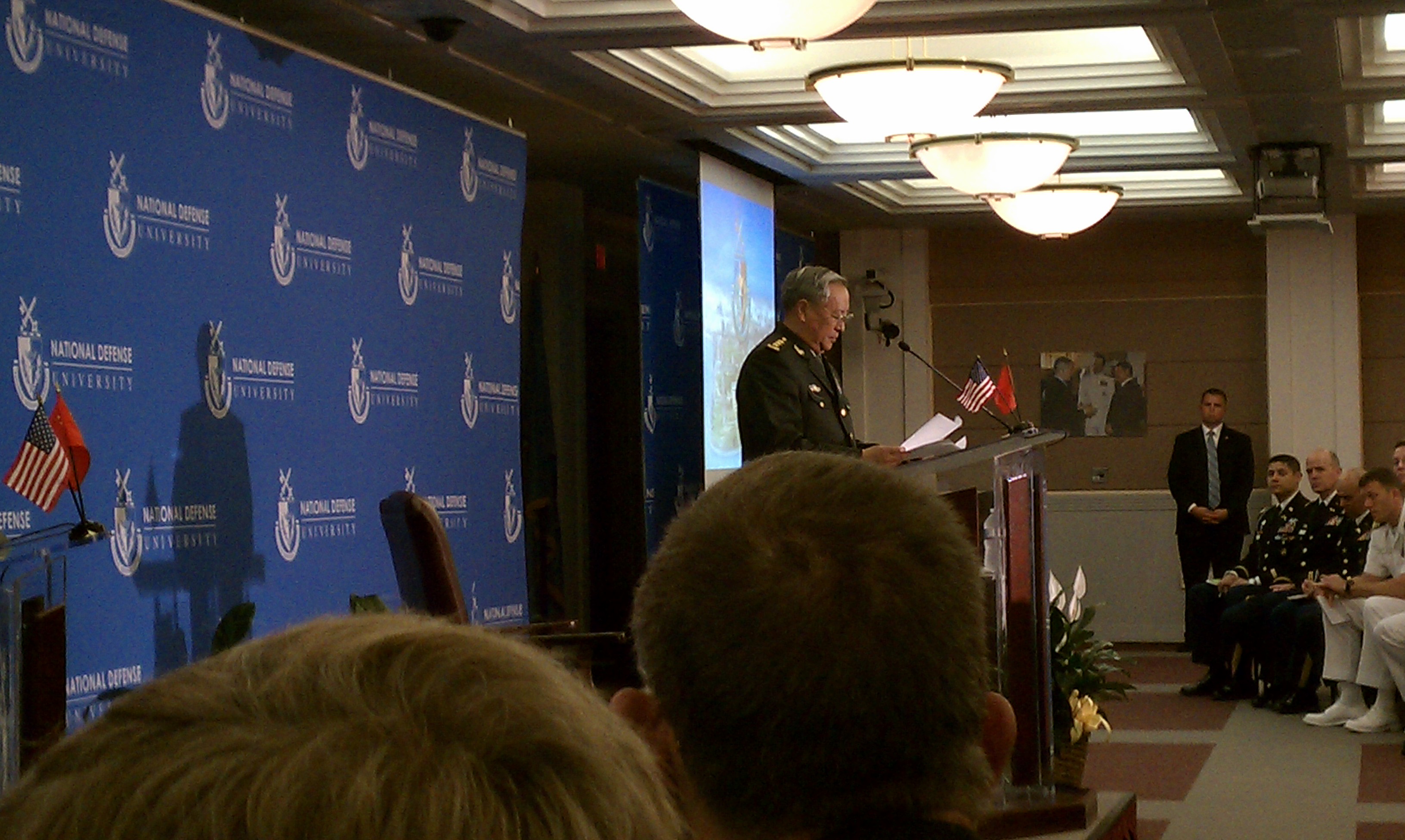
Chinese Minster of Defense General Chen Bingde delivers remarks at the National Defense University, May 18, 2011.

The most difficult part about watching an official speech – be it on policy or otherwise – is to separate the platitudes from the substance, assuming there is any of the latter. The meat of public remarks can often be found in soundbite form, or on a single slide of a powerpoint presentation. It is also equally possible to sit through an entire thirty minute speech and to hear absolutely nothing that hasn’t been said before.

Fortunately, that was not the case when Chen Bingde spoke at the National Defense University last week. While granted, much of the talk consisted of appeals to American sensibilities and national interests, there were some moments of real substance in it.

General Chen opened by declaring this to be an “official goodwill visit,” and that the Chinese sought mutual respect and benefits for both parties in Sino-American relations. He reminded us that the Chinese name for the United States translated to ‘beautiful country’. Continue reading

La Guerre de Longue Durée

So I wrote most of this over the weekend. In light of recent events, it may be more or less relevant. But presumably no less true.

Interesting read from the War Nerd (who is back with a vengeance) comparing Al Qaeda with the IRA. He comes to a somewhat surprising conclusion: the IRA was far more professional, they truly took the long view, and they essentially won.

Al Qaeda played all out, spent all its assets in a few years. In my dumb-ass 2005 article, I called the Al Qaeda method “real war” and the IRA’s slow-perc campaign “nerf war.” That was ignorance talking, boyish war-loving ignorance. I wanted more action, that was all. I saw what an easy target the London transport system made for a few amateur Al Qaeda recruits and just thought that since the IRA had several long-term sleeper teams in place in London, they could have wreaked a million times more havoc. Which was true, they could’ve. But could’ve and should’ve are different things, and a guerrilla group that goes all-out, does everything it can, is doomed.

The first job of a guerrilla force is to continue to exist…

That’s how every modern guerrilla army except Al Qaeda has played, and that’s why every one of those groups has lasted longer than Al Qaeda did.

This seems to ring true. Looking at the pattern of terrorist attacks in the United States and Europe since 9/11, here’s what came next (and seemed at least vaguely Islamic extremism-related, so not necessarily Al Qaeda even):

  • December 2001 – Richard Reid’s attempted shoe-bombing.
  • October 2004 – Indonesian Embassy in Paris is bombed by the “French Armed Islamic Front,” though presumably Algeria-related.
  • July 2005 – the 7/7 Tube Bombings in London.
  • July 2005 – attempted duplication of 7/7; minor damage.
  • March 2006 – Mohammed Reza Taheri-azar drives an SUV onto the UNC Chapel Hill campus to “avenge Muslims,” injuring nine.
  • July 2006 – attempted suitcase bombings in Dortmund and Koblenz, in retaliation for the Muhammad cartoon publication. Failed to detonate.
  • August 2006 – foiled transatlantic plot between Heathrow and the United States.
  • August 2006 – Afghan Muslim Omeed Aziz Popal hits 19 pedestrians with an SUV in San Francisco, killing one.
  • December 2009 – the attempted “underwear bombing.”

There is very little in that list that was an objectively “successful” terror attack, in the sense that with the exception of the 7/7 Bombings, few people were killed in total. Yet somehow, every single one of these – including if not especially the failed attempts – has provoked a stronger and more intrusive security backlash.

There are a few possibilities with Al Qaeda today. The first is that they’ve been so disrupted and shattered that there’s no organizational capacity left to stage large terror attacks. The second is that they’re biding their time, rebuilding capabilities in order to strike. And the third is that we’ve reduced Al Qaeda to a shadow of its former self, yet preserved enough of the command structure that we can keep tabs on all of its associates and prevent any strikes by them.

But even if that leaves them unable to mount much more than a failed pants bombing around Christmas, that might just be all they need (see: failure as a strategy). Look at what that ‘attack’ – which killed and injured none – has wrought: the whole Yemen affair, a bigger bureaucratic push for the “rape scanners,” and a whole revamp of the no-fly lists to include Nigerian nationals and other useless security theater. They don’t need to succeed to have catastrophic effects on American politics and the ever-so-delicate American psyche. Even non-Al Qaeda actions, such as walking through airport security the wrong way, can paralyze an entire transportation corridor for hours and hours.

So where does the IRA come in? While Al Qaeda is still active and deadly in the immediate theater (Iraq, Afghanistan, etc.), it has little reach beyond its borders. Especially not as an organization its trying to kill people. Instead, the IRA strategy of as few casualties as possible – in many cases zero – aided by numerous telephoned warnings and carefully-chosen targets has enabled the organization to not be the target it might have been.

The IRA had this “Nerf” strategy of…not killing civilians, which seemed weak to me. But it worked way, way better than I could have imagined. First of all, by not reacting to LVF hit teams, the IRA kept the focus on the Brits, who they considered the real enemy. The Loyalist hit teams, I realize now, were a classic SAS attempt to turn the whole Ulster fight into a tribal war, so the British could come off as the impartial referees trying to keep the savages from tearing each other apart. If the IRA had settled for taking all these Loyalists down into nice soundproofed basements and giving them some hands-on experience of their favorite games, it would’ve been satisfying short-term but would have fed right into the enemy propaganda model.

Not only was the IRA never systematically wiped out, it was incorporated into peace efforts and brought into the government itself after the Good Friday accords.

The point is that in the long run, killing civilians – if you’re fighting an insurgent, guerrilla, terrorist-style war – is counterproductive. That’s not to say that for these groups ‘terrorism’ in and of itself might be ineffective. Rather, it’s all about targeting. If instead of the World Trade Center, the Pentagon, and (presumably) the White House, bin Laden had selected a virtually empty Statue of Liberty, an early-morning deserted Lincoln Memorial, or the Washington Monument, wouldn’t the blow to our psyche have been nearly as great? But even if we were just as horrified, would we have pursued him for ten years with the same fervor?

Either way, whatever command hierarchy Al Qaeda once had will now certainly cease to be. The rigid discipline required to avoid killing civilians at all costs will be impossible to impose on disparate, franchised mini-Qaedas – and that might, in the long run, lead to shooting themselves in the foot. One can only hope.

Patriot’s Day

The British route to Concord and the route of the Patriot riders.

I meant to post this yesterday, but dropped the ball on it. Today (yesterday) was Patriot’s Day, and for those of you not living in the Boston area (or Wisconsin, for some reason), that means a celebration (and Monday off in honor) of the Battles of Lexington and Concord. Lexington was the first battle that saw colonial blood spilled. At Concord, we finally shot back.

It’s one of my favorite holidays, complete with reenactors all across the state, the Boston Marathon, and a Red Sox game played at 11 AM. So I figure this is as good a time as any to announce that my paper on the Battle of Concord, “Privates and Patriots,” has been accepted for presentation at the NEASA conference this November. It’s a comparison of British and American (or if you like, loyalist and rebel) perceptions of that day’s battle, and an attempt to discern fact from exaggeration. Here’s a little excerpt:

With Pole’s companies still at the South Bridge and Laurie’s detachment at the North Bridge, Colonel Smith’s troops still in the town square had set the courthouse aflame. Since 0900, Colonel Barrett’s forces had grown in size with companies from Acton, Bedford, Lincoln, and Carlisle joining those already mustered in Concord. Upon seeing plumes of smoke from the center of town (and mistaking those at the South Bridge for a larger conflagration), the young Lieutenant Joseph Hosmer turned to Barrett and asked, “Will you let them burn the town down?” The captain of the Acton company, Isaac Davis, declared to those who might question their willingness to fight for a town not their own that “I haven’t a man who isn’t afraid to go.” Barrett and the various company captains at Punkatasset held an impromptu war council. The verdict was simple and clear: “To march into the middle of the town for its defense, or die in the attempt.”

So on this day (yesterday), remember Lexington Green and the Old North Bridge. Remember the running battle fought all the way back to Boston, around the “Bloody Angle” and Parker’s Revenge; Fiske’s Hill and The Bluff. And remember that every side has its own story.

By the rude bridge that arched the flood
Their flag to April’s breeze unfurl’d
Here once the embattled farmers stood
And fired the shot heard ‘round the world

Ralph Waldo Emerson, “Concord Hymn”


They came three thousand miles and died
To keep the past upon its throne
Unheard beyond the ocean tide
Their English Mother made her moan

– James Russell Lowell, inscribed on the grave of the British soldiers


On Things Happening

Seriously, when was the last time we had a news cycle like this? Or a year that started off as interestingly?

  • Tunisia
  • Egypt
  • Bahrain
  • Saudi Arabia
  • Libya
  • Earthquake/Tsunami
  • Partial meltdowns
  • Volcano
  • Libyan intervention

And March isn’t even over yet. What’s next? Is this all just one big lead-in to the end of the world in 2012?

Also, see The Awl‘ s chart of topics going back to 2010.

Lines Drawn, Sides Chosen

One of the more interesting results of last night’s UNSC vote to authorize a no-fly zone over Libya was the voting pattern of the Council. More specifically, the abstentions.

Look at the countries that decided not to vote:

  • Brazil
  • China
  • Germany
  • India
  • Russia

Two things jump out: all four of the BRIC countries abstained from a vote, and of these five countries, the three which are not already members of the P5 are heavily discussed candidates for membership should the council expand. Do they too see themselves as a bloc? Or was it just coincidence?

So it’s interesting to try and ascertain where this reluctance comes from. One can just throw out some crude snapshots: Germany is wary of overseas military operations. China and Russia see any intervention as an ominous precedent and a threat to their own national sovereignty. India and Brazil don’t want the responsibility, perhaps, and see a vote on Resolution 1973 as a distinct voting record that could come back to haunt them (much like the conventional wisdom explaining why a United States senator would never be electable as president).

Also interesting are the military capabilities of these five countries. All, with the possible exception of Brazil, have formidable land armies, but lack a great deal of expeditionary capacity or any meaningful power projection. China has been making the greatest strides in this area with their naval armament program, but is still a long ways off from being able to physically support operations like a Libyan intervention. Much the same goes for Russia, even if the recent Mistral purchases were an attempt to provide new command-and-control capabilities that would make such a deployment easier.

Despite NATO’s series of capability commitments, developing a true airlift capacity remains stuck. Germany is the European leader of strategic lift, and yet still only operates the woefully outdated C-160. Its replacement, the A400M, has nearly three times the weight capacity – but has been delayed yet again and will not enter service until 2014 at the earliest. So even discounting moral reservations, Germany might have some legitimate tactical concerns about intervention in Libya.

Of course, to have to write something like this implies a great deal of cynicism on the part of the international community. The ‘clean voting record hypothesis’, in particular, is a rather damning indictment of why nothing gets done politically either in the international or domestic realm. No matter the reason, though, it appears as if the BRIC countries are their own power bloc, and they’re not going to help if they don’t want to. Which perhaps then begs the question of why the West has to intervene whenever a dictator starts murdering his own people.

(Of course, as I’m writing this, this article pops up in my Twitter feed.)

Earning It

Prolonged American deployments in both Iraq and Afghanistan have crippled the country’s ability to quickly respond to emerging threats and situations elsewhere in the world. Sheer logistics aside, the same stubborn logic that has maintained an American presence in Afghanistan would also preclude its redeployment on the grounds that American troops are vital to winning the hearts and minds of the Afghan War.

But what happens when that might mean missing a genuine opportunity? The regime of Muammar Gaddafi, longtime sworn enemy of the United States, is in the midst of a particularly brutal crackdown against what appears to be a genuine democracy movement in that country. He has vowed to die a martyr, and what were peaceful protests have spread into legitimate civil war throughout the country.

The arguments against intervention in Libya are many, and are valid concerns. American officials – Robert Gates most prominent among them – have been offering constant reminders that establishing a no-fly zone in Libyan airspace would be more complex and dangerous than is casually thought, and the next steps – the exit strategy – have yet to be fleshed out. (The question of international law seems somewhat less damning as Patrick Porter suggests – the Arab League and Libyans themselves have called for such a step to be taken.) But unlike the Bush-era misadventures in Central Asia, commentators are actually thinking about those issues now. Such a commitment as the United States might undertake in Libya requires careful thought. But it requires more than just talk, too.

Who would such an intervention be supporting, exactly? What if the rebels lose the civil war? Will the presence of ground troops be established? These are all questions that need answering. But here’s the other crucial difference between the catastrophic error in Iraq, the open-ended disaster in Afghanistan, and this situation – Libyans are asking for it. Libyan officials who have dissolved ties with the Gaddafi government – including Justice Minister Mustafa Mohamed Abud Al Jeleil, Interior Minister Abdul Fatah Younis, and the Ambassadors to France, India, Poland, Sweden, the EU, the UN, the Arab League, and the United States – are echoing calls for a no-fly zone. The governments of Britain, France, Portugal, and the Arab League have all recognized the National Transitional Council as the legitimate governing body of Libya.

Who’s more deserving of American military backing: an Afghan government that enjoys the support of neither its people nor the United States, in a country filled with people just waiting for American troops to leave, or those revolutionaries trying to overthrow Gaddafi in their quest for democracy? Even if the United States were to adhere to the coldest realpolitik calculation, in this case the devil we know is diabolical indeed. Gaddafi is responsible for the Lockerbie bombings, for attempting an enrichment program, and is guilty of the most horrific crimes imaginable against his people. It would be difficult to find an even worse devil. And even in that case, isn’t it time to pick the one that actually matters: democratic or US-friendly? By not articulating – or proving through its own actions – just which one is the driving force behind American foreign policy, the United States continues to look weak, ineffectual, indecisive, and hypocritical to the rest of the world. And it’s that kind of ‘soft power’ that it can ill-afford to lose.

Then again, the most justified intervention would probably be in Cote d’Ivoire to remove Laurent Gbagbo. That country, after all, has already held free and fair elections that ousted Gbagbo from the presidency. But Gbagbo has refused to step down, precipitating a civil war. It’s apparent that things have gotten out-of-control bad when refugees are fleeing into Liberia.

Limited resources require prioritization. And it would appear as if America is focusing all its time and energy, its  blood and treasure, on precisely the wrong theaters. Even when Afghans aren’t actively hostile to the American presence in their country, they’re not enthusiastic about it either. The waiting game is on. Whether the United States pulls out of Afghanistan in six months or six years, the situation there won’t change. Only the cost will.

Those who aren’t asking for help don’t need or want it. Those crying out for it surely do.

Hyphenated-Americans

And so all too soon, my tenure at Fortnight comes to a close.

I like to think that my last article, “Hyphenated-Americans,” ends on an optimistic note. What we are is as much what we make it as what we’re born with; we are the architects of our own dreams.* The baggage that identity carries with it is forever changing, from liability to asset, cornerstone to curiosity, cast away to embraced. And all of that goes for collective identity and culture as well.

In the grand scheme of existential questions, “Who am I?” is a close second behind “Why am I here?” Identity remains the catalyst for countless struggles within families, communities, states and nations. The heyday of 1960s-era identity politics may have passed, but we live in an age of unreconciled, increasingly fluid social boundaries.

The idea of a single American identity is a relatively recent construct. During the American Revolution, it was hard to find a single unifying idea beyond that of throwing off the yoke of British rule. But after the war was won, the fledgling Republic suffered its own trials. The failed Articles of Confederation presaged Shay’s Rebellion, and the final Constitution used today. We struggled through a bloody five-year civil war before reuniting, even if at gunpoint. There has always been tension and impetus in different directions here; the United States has always been a restless melting pot.

Today, we’re anything but united. Politically, ethnically and regionally, we’re split even more than perhaps we realize. The number of overlapping identities and allegiances that exist lead to an incredible number of constructed personas. Are Americans a collection of adjectives –Jewish, gay, Christian, Muslim, white, black, Arab, female, young, old–or, are we something more than the sum of these parts? And in an age of ever-increasing fracture, what do we still have in common?

Read the rest at Fortnight. And also, stay tuned for Fortnight, Volume II. My editors, Adam and Samantha, already have some amazing names lined up: James Ransone of Generation Kill and The Wire fame, author Benjamin Hale (whose debut novel The Evolution of Bruno Littlemore is really quite excellent), Army Lieutenant Rajiv Srinivasan, and Digital Democracy founder Mark Belinsky, just to name a few. And those are just the contributors. I can’t even imagine what kind of luminaries they’ll find. As always, thanks for humoring these digressions.

*Apologies for the reference, I only just saw Inception for the first time the other night.

The Talking Pictures

So, a little while back, I managed to sit down and interview Noah Shachtman of Danger Room and Brookings fame for that wonderful venue known as Fortnight. Part of the structure of the journal includes “luminary responses,” in which an established figure in the author’s field engages with the author in some sort of dialogue or response piece. I was one of the lucky ones to receive such a response, and my luminary was Noah Shachtman.

My interview has finally gone live. You may have already gotten the official email; if not, my apologies for the omission. In the end, it’s even better than I hoped it would be. Shachtman is awesome. We covered a wide range of topics, from writing while trying to break into the field to America’s need for/lack of an overarching grand strategy to the future of navies. Please, check it out for yourself.

Also, “underemployed” seems to be one of those words that will now be permanently affixed in front of my name, like “Doe-eyed Athena.” I am a much bigger fan of “millennial combat scholar.” One for the business cards, perhaps?