Today is November 2nd. So vote!
But also more importantly, my first Fortnight article goes live today: “The Stormy Present.”
Read it, weep, then get back to me. Preferably with a job offer.

Today is November 2nd. So vote!
But also more importantly, my first Fortnight article goes live today: “The Stormy Present.”
Read it, weep, then get back to me. Preferably with a job offer.
Peter Beinart wrote a pretty decent appraisal of Ronald Reagan’s more moderate and dovish tendencies for Foreign Affairs recently. For anyone at all to approach the Gipper with a modicum of even-handedness is impressive these days, and for some of those facts to damn near inspire me; well, I guess that just speaks to Reagan’s better qualities.
Anyways, moral of the story is that of all people, Foreign Affairs somehow ended up with Richard Perle writing a rebuttal. Yes, that Richard Perle, the ‘Prince of Darkness’, who argued for invading Iraq with 40,000 troops. The same Perle who got tired of being credited with planning the Iraq War and passed the buck up to President Bush . The same Perle who called Seymour Hersh a terrorist , proposed a national biometric ID card program, and demanded an invasion of Syria (at this point it should of course be noted that Perle attended the London School of Economics for a time). Perle’s latest gem is called “Against Evil,” with a tagline of “Only liberals like Peter Beinart think that Ronald Reagan was a dove.”
Yes, and only Richard Perles like Richard Perle think that Richard Perle is in any way still relevant or qualified to comment on anything.

President Barack Obama in the Oval Office, January 2009.
I seem to have lost faith in the promise of the Obama administration, which has pursued a radically centrist agenda and left me sorely disappointed. There has been little real change. Kevin Drum summarizes the last eighteen months best in a much-circulated quote:
Here’s the good news: this record of progressive accomplishment officially makes Obama the most successful domestic Democratic president of the last 40 years. And here’s the bad news: this shoddy collection of centrist, watered down, corporatist sellout legislation was all it took to make Obama the most successful domestic Democratic president of the last 40 years. Take your pick.
While obviously Obama is not solely to blame for the BP oil spill in the Gulf of Mexico, the media lockdown that has been enabled by it is un-American on a fundamental level.
Nominees like Sonia Sotomayor or Elena Kagan, while a lock for confirmation, are exactly the kind of uninspiring mediocrities that have once again disillusioned us. If one of Kagan’s strongest credentials is that Lawrence Lessig endorsed her, why not reach for the stars and nominate Lessig himself? Or Harold Koh?
It’s difficult to come to terms with the fact that Barack Obama, who signaled an end to the Bush era abridgement of rights and liberties, may in fact be worse than his predecessor; a “third Bush term” that brings to their logical extreme many of the policies put in place that Obama had suggested might be curtailed. And even if all this does not accurately reflect Obama’s actual intentions, it points to something nearly as unforgiveable – half-assing it.
If you’re serious about a high-speed rail program, don’t just hand out the paltry sum of $8 billion and expect the states to pay for the rest. That would be worse than not spending anything at all. And at the same time, there are 1.8 million construction workers without anything to build. That’s an industry-wide unemployment rate of 20.1%. I mean, get serious about this. Put them to work. We need massive repairs to our roads, bridges, and vital infrastructure? Then sign a $1 trillion package. Or at least propose it. To quote The West Wing, “this is a time for American heroes – and we reach for the stars.”
Right now we’re just gazing at our shoes.
Crossposted at The Smolerian.
Every so often, I will have a mild revelation and ask myself, “Why are we still in Afghanistan?” It’s similar to the mental whiplash I developed in the run-up to the Iraq War, when all of a sudden the national conversation switched from one about Osama bin Laden, Afghanistan, and Tora Bora to yellowcake uranium and l’Affaire du Plame.
Despite his somewhat over-exaggerated blame (though sadly, his position grows a little more plausible each day), I found Howard Hart’s recent take on our efforts in Afghanistan a pretty convincing echo of my own thoughts. To wit:
Leaving Afghanistan would mean that the Taliban would officially take over the country – most of which they already control. So what? It has controlled Afghanistan before. America is under no moral or political obligation to re-make the country into some sort of “democratic” state. It would make it easier for Pakistan to deal with both its internal radical Islamic threat and with a Taliban-controlled Afghanistan (which Pakistan knows will be the end result of the war).
Difficult as it is for us freedom-and-democracy-loving Americans to admit, free elections will not be how the war in Afghanistan ends. Perhaps we are under some sort of moral obligation to attempt to stabilize the country, having brought war and destruction to it, but we’ve had nine years to work that out, and failed miserably. There are no positive outcomes. The only question is whether the Taliban returns sooner or later. And the longer we wait, the more it costs us.
Your depressing thought for the day.

The Deepwater Horizon oil platform burns in the Gulf of Mexico.
As per my standard operating procedure, I should be studying for my final final exam on Russia/Eurasia tomorrow morning but will procrastinate a little more (productive procrastination, that’s my motto). Instead, I have a number of thoughts to offer on the ‘British Petroleum’ spill in the Gulf of Mexico. And it’s worse than we can imagine.
The Oil Drum has had some of the best recent coverage of the disaster from a technical and policy perspective. It also has some of the better commenters I’ve seen anywhere on the internet. Via BLDGBLOG comes a particularly chilling one:
The well bore structure is compromised “Down hole”.
That is something which is a “Worst nightmare” conclusion to reach.
[…]
All the actions and few tid bits of information all lead to one inescapable conclusion. The well pipes below the sea floor are broken and leaking.
[…]
What does this mean?It means they will never cap the gusher after the wellhead. They cannot…the more they try and restrict the oil gushing out the bop?…the more it will transfer to the leaks below.
It also means that the entire reservoir area is growing weaker and weaker underwater, and that (here comes the absolutely terrifying part) “fracturing and a complete bleed-out are already underway. Rumors also suggest a massive collapse of the Gulf floor itself is in the making” [emphasis mine].
That means 2 billion barrels of oil just dumped into the Gulf of Mexico. It means an ecological disaster of biblical proportions as the oil is carried around Florida and up the eastern seaboard. It will end entire industries, ways of life, and…it’s pretty much unfathomable how bad this will probably be. We don’t even have the technology to stop the leak at this point; the best we can do is siphon off as much as possible and pray it doesn’t get worse. Continue reading

A LibCon unity government poster from the National Coalition Government of 1940-45.
Much as I despise the term ‘statism’, which like ‘socialism’ has been overused into a meaningless oblivion, you’d be hard-pressed to find a more suitable term for the Labour Party’s approach to governing Britain. For better or worse, Labour’s solution to just about every problem that popped up between 1997 and 2010 involved some kind of state intervention.
Most troubling (to my mind) has been the encroachment on civil liberties as evidenced by the dramatic rise in CCTV and the extrajudicial legal system created by various anti-terrorism acts since 9/11. The absence of handgun-bearing police officers has merely softened the gradual, insidious reach of the government. Thankfully, that era may be coming to an end.
The fledgling Liberal Democrat-Conservative coalition government has a number of fundamental disagreements, but one of their shared values is that of civil liberties, and gradually they aim to begin rolling back the state (Guido Fawkes would also like to see the Labour Party crushed for all eternity, but that’s not a preordained outcome). None of the Labour policies have been making us any safer, and it seems like this country is coming around to that conclusion.
Nick Clegg, the Deputy Prime Minister, will shepherd a “Great Repeal” bill through the House of Commons. Under the bill, the National ID Card program will be scrapped. A whole host of other Labour programs are due to be severely curtailed if not outright canceled, including DNA retention, anti-terror laws, databases, and the omnipresent CCTV. Details include:
:: New legislation to restrict the scope of the DNA database, probably reducing the length of time innocent people’s details are held to three years as is the case in Scotland.
:: Changes to ensure members of the public can protest peacefully without fear of being branded a criminal.
:: Overhaul draconian and unpopular counter-terrorism laws to strike a fresh balance between protecting the public and civil liberties.
:: New laws to better regulate the use of CCTV, particularly by local authorities and to ensure internet and email records are only stored when necessary.
It’s a good start.
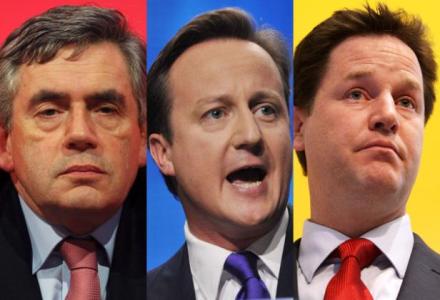
There’s an interesting debate going on over at Harry’s Place as to which British political party has been and would be most conducive (or accommodationist, if you like) to the ‘Special Relationship’. “Norflondon’s” article, in particular, claims that Labour is the “true Atlanticist party.” I would have to disagree.
If you take the three major personal relationships throughout the twentieth century, you have FDR and Churchill, Jack and Mac, and Reagan-Thatcher. All three Prime Ministers were Tories and two of three Presidents Democrats.
This is not meant to imply that the most fruitful partnership would necessarily be Obama-Cameron (i.e. a Democrat and a Tory), but rather that Labour has until recently never been a particularly stalwart half of the Special Relationship. Indeed, America was rather fearful when Clement Attlee and Labour came into power – they were seen as ‘red’ socialists, and socialism was naturally a bad thing (a contemporary cartoon by David Horn in the Evening Standard showed Attlee surrounded by a circle of U.S. Congressmen all asking themselves “no hooves? No tail”)?
The article mentions the Major Government and divides over the Balkans , but considering that was a highly contentious debate within the Clinton Administration itself – not to mention a low-risk bombing campaign – the absence of British support wasn’t seen as a low blow in the same way that say, the Wilson Government’s silence was in Vietnam. Then, of course, there’s Major’s wholehearted British contribution to the first Gulf War.
The change could be pinned on Blair and New Labour, but also keep in mind the nature Blair-Clinton relationship: new center-left incarnations of their old selves.
However, when it comes down to it, does the United States really want a Blairite United Kingdom as part of the special relationship? Patrick Porter has made this point much more eloquently than me; he reminds us of Britain’s pretensions to Great Power status, but then points out the absurdity of Britain trying to do so much:
Geography comes up in the Strategy, but only in a perfunctory and generalised way. It asserts that Africa matters wherever there is extremism or violence, not a very discriminating test; Eastern Europe matters because Britain is engaged there; the Middle East matters because it is central to security and ‘totemic’ to extremists, and Afghanistan-Pakistan for its links to domestic terrorism. Central Asia, Eastern Europe, large chunks of Africa and the Middle East: these four spheres would strain a superpower, let alone Britain.
If at least a portion of an alliance is for figuring out what’s best for an individual country, isn’t the New Labour approach of ‘America first, British national interest second’ pretty bankrupt at this point? Prime Ministers in the past have easily subordinated their Atlanticism to the national interest of the United Kingdom – Thatcher being a notable example – but the times the call for spartan budgets and austerity measures, and those will have to translate into defense cuts as well.
Sadly, I don’t know which prime minister would be the most healthy combination for the Special Relationship and the United States. Perhaps Britain itself must reduce it to no more than a ‘special partnership.’

I meant to talk about this a while ago. Fakeisthenewreal has had a map up for some time of what the 50 states might look like if they were all divided into sections of equal population. All have between 5.4 and 5.635 million residents (and Hawaii and Alaska are part of Coronado and Olympia, respectively).
Missouri gets to stay the same.
T. Greer at The Scholar’s Stage tell us World War II provides a convenient metaphorical framework for understanding the world today, but goes on to explain that today’s political situation is more akin to the 30 Years’ War than World War II.
You can summarize the history of the Second World War in two paragraphs. Squeezing the causes, campaigns, and countries of the war into these paragraphs would be a gross simplification, but it is possible. This does not hold true for the Thirty Years War. It is one conflict that simply cannot be related in a paragraph. The number of actors involved, the myriad of motivations and goals of each, and the shifting alliances and intrigues between them all are simply too complex to be stripped down to a single page. Piecing together the events of the Thirty Years War inevitably takes up much more time and effort than single page summaries allow.
Single page summaries or 5-minute interviews allow no room for nuance, deliberation, or even explanation. The goal of televised news seems to be for one side to “win” at the other’s expense, and victory means hammering home as simple an argument as possible. Sure, the Maginot Line is long-gone, we have airborne robots and laser weapons, and even Communism has been defeated, yet somehow the analogies of ‘the last good war’ resonate in our collective memories.
The great majority of policy makers are familiar with the Second World War. If asked to, I am sure that most folks in Washington concerned with foreign affairs and security policy could provide an accurate sketch of the countries and campaigns involved. Indeed, we conceptualize current challenges from the standpoint of World War II; allusions to it are the lifeblood of both popular and academic discourse on foreign affairs. Pearl Harbor, Munich, Stalingrad, Normandy, Yalta, and Hiroshima are gifts that keep on giving – they serve as an able metaphorical foundation for any point a pundit or analyst wishes to make.
Compounding the problem is that old familiar anti-intellectual strain in American public discourse. Just the thought of applying something other than a 20th-century analogy to a contemporary situation seems like high-falutin’ blasphemy, further evidence that the pansy college boys have no place deciding what’s what. But we need to start comparing other human conflicts (thought not so all-over-the-place as Edward Luttwak) to our own, and figuring out what really matters – and what really doesn’t.
Via zenpundit.
Christopher Albon takes on John Arquilla and addresses “The Limits of Netwar” in Current Intelligence:
Arquilla is correct: a netwar-enabled military would be powerful. Swarms of small American units could be perfectly suited for dismantling irregular terrorist networks in Afghanistan and elsewhere. However, America will never have a netwar military. Why? One reason: the political cost of casualties.
While a network of small swarming units represents substantial capacity, it also increases the risks to individual units on the battlefield. Operating quasi-independently and at speed, netwar’s small units are vulnerable to being flanked, isolated, and overrun. The network is resilient, but individual nodes are exposed.
Albon also cites the Battle of Wanat – with an American contingent of the same ‘small unit’ size advocated by Arquilla – as an example of how this particular conception of ‘netwar’ is in fact precisely wrong for waging war in a democracy.
That is what truly determines the US military’s ability to conduct prolonged operations in a given theater: public support. And the easiest way to undermine it is to kill lots of American soldiers, preferably all at one time. This strategy is particularly effective within the node-centric system Arquilla calls for:
The attack left nine U.S. soldiers dead and the outpost was quickly abandoned. If the Taliban’s attack had been successful, the loss of this one node would have had little detrimental effect on an Arquillan network of small units.
Still, the military already seems to be considering the idea, with exercises scheduled for this summer to determine the feasibility of a company-sized Marine landing team. Of course, then logistics become the primary problem (plus the lack of battalion C3I, etc), which in turn leads to more deaths, which of course is the whole point for the enemy.
Leaving aside the issues of media control and information handling (because I still keep the faith), how then could a node-centric strategy utilizing smaller units actually function? Obviously, one key component to coming wars is UAVs and other unmanned weapons platforms. Most of these systems are currently more mobile than needed to be effective in a node-centric system. Automated sentry guns and the like, coupled with appropriate surveillance equipment and on-call air support – manned or unmanned – would be enough to maintain a network of observation posts without risk to American lives.
Then again, perhaps it’s the concept of nodes as they currently stand that needs to be addressed. Obviously not all OPs could be replaced by drones and remote-controlled camera, but presumably some could be. The further goal of the OP; that is, contact and interaction with the native population, could just as easily be accomplished through means other than an isolated post. Albon might overstate the case for maintaining centers of gravity (“There is power in small, networked units, but there is security in massed forces and large fortress bases, both for servicemen and politicians”), but he certainly grasps the risks of not doing so.
Presenting an American war effort to the public, then, is a two-part project. One is to convince them that both the overall and the specific causes are just (why are we in Afghanistan? And why do we maintain a network of isolated observation posts)? Two is to make sure that American casualties are in line with the perceived goal of it. Perhaps nothing more than a good PR strategy is what’s needed, but I think the issues with netwar run a bit deeper.
 Automatic Ballpoint