A Vicious Cycle

Wired has officially proclaimed the web to be dead. Not the internet, mind you, but the HTML, browser-driven world of dotcoms this and firefox that. Both us and ‘them’ are to blame, according to Chris Anderson and Michael Wolff, but somehow, we’ve come back to the idea of a “curated” internet experience after roundly rejecting AOL and Earthlink less than a decade ago.

But perhaps even more than our willingness to sacrifice control for convenience is the business approach to the web. No longer do we have the frontier mentality, the lawless Wild West where anything went. The top 10 websites accounted for 75% of all web traffic in 2010. But as Anderson reminds us:

This was all inevitable. It is the cycle of capitalism. The story of industrial revolutions, after all, is a story of battles over control. A technology is invented, it spreads, a thousand flowers bloom, and then someone finds a way to own it, locking out others. It happens every time. [Emphasis in original].

Possibly the one upside to the increasing corporate control of our internet experience – and our complicity in that takeover – is that once the internet is locked down, we can finally start asking “what’s next?” Because that, too, is the story of industrial revolutions.

Wedding Crashers

What I at first thought was just a single issue as a gift turned out to be a full subscription to The Counter Terrorist. I’ve had one issue sitting around staring at me for months, and finally got around to cracking it. The first article offers some interesting lessons beyond those the author seems to have taken away. While the actual operation is pretty unequivocally badass, there seem to be a couple unnecessary elements towards the end.

Aaron Cohen on the cover of his book.

In “Undercover in Nablus” (an excerpt from his recent book Brotherhood of Warriors: Behind Enemy Lines with a Commando in One of the World’s Most Elite Counterterrorism Units), Aaron Cohen, an operative in an Israeli Duvdevan unit, describes an attempt to capture ‘Abu Jihad’, the “Hamas mastermind behind the Dizengoff Mall bombing.” The plan is simple yet intricate. Two operators posing as friends of the groom will snatch Abu Jihad from a wedding reception in Mishraim once the entire unit has eyes-on the target. But everyone prepares for the worst-case scenario, of course:

Rooftop snipers would surround the target location. We would have a dozen undercover cars with heavy weaponry on the perimeter, circling the streets of Nablus.

Cohen was posing as a sweet-corn vendor, with a heavily modified cart:

The cart also had a live-action camera feed… If a firefight were to break out, I had my SIG tucked at the small of my back and the bottom of the cart was custom lined with Kevlar. Flipped on its side, the cart would provide cover as a bulletproof barricade.

The actual snatch goes pretty well. Cohen gets eyes-on the target, followed by confirmation from the rest of the unit. Within six seconds the two operators inside the wedding reception grab Abu Jihad without drawing their weapons and hustle him into a waiting fake taxi.

Cohen and the others begin to just drift away, but it’s what happens right after the snatch that troubles me.

Continue reading

Full Steam Ahead

Talk about setting your sights low. The current Amtrak plan for the Northeast Corridor calls for reducing travel times – over the next twenty years – by 4 minutes between Philadelphia and New York, and by 20 minutes between New York and Boston. As one professor says, “Amtrak’s new plan leaves you with a really good early-20th-century rail system.” It’s not speedy by any stretch of the imagination, and you save about 50 minutes over the regional trains for $80 more. Hell, this is how sorry the current state of high-speed rail funding in the Northeast is:

Rep. John Mica (R., Fla.), top Republican on the Transportation Committee, criticized the administration for giving little of $8 billion in high-speed money to the Northeast.

“They practically ignored the region of the country where high-speed makes the most sense – the Northeast Corridor,” he said. The corridor received $485 million, or 6 percent, of the stimulus funding. [Emphasis mine].

However, because we are the world and we are the future, some students at UPenn’s School of Design have proposed a radical alternative: a true, dedicated high-speed system that would make the journey from Boston to Washington, D.C. just 3.5 hours. From Philadelphia to New York in 37 minutes. This is the direction we want to go. This is more than just lip service.

One of the more interesting aspects to the proposal is a new route for the Boston-New York stretch. Instead of the current shadowing of I-95, trains would follow the same highways that I take when I drive to New York, I-90 to I-91 to I-84 (though presumably these trains won’t take the Merritt Parkway). But then the route diverges sharply to the south and crosses underneath Long Island Sound in a tunnel before turning west again and continuing on to the city.

I love this for so many reasons. This is something we’ll actually use, putting people to work, and producing a end-result we can all be happy with and proud of. Most importantly, it’s big-picture thinking. It’s ambitious. It’s grandiose. And it’s entirely in keeping with the American way.

“We started with a different framework than Amtrak,” said Bryan Rodda, 26, one of the student authors. “Amtrak said, ‘What’s the best we can do to make sure it doesn’t fall apart?’ and then, ‘What is the best we can do with what we have to improve travel time?’

“We asked, ‘What can we do if we rejected the way it is now and do actual, true high-speed rail and get travel time below two hours?’ ”

The students proposed a remade Market East station to accommodate the high-speed train stop in Philadelphia, with another stop at Philadelphia International Airport.

They suggested keeping 30th Street Station for other train traffic and visualized a revitalized Market Street corridor between University City and Old City.

The students proposed that federal and state governments pay for the new high-speed rail line for the Northeast, along with private investors. They suggested money could be raised from gas taxes, interstate tolls, user fees, value-added taxes, and station-area sales taxes.

The economic benefits, the students concluded, would outstrip the costs by $70 billion.

Yes we can, pretty please?

Via INFRASTRUCTURIST.

Rep. John Mica (R., Fla.), top Republican on the Transportation Committee, criticized the administration for giving little of $8 billion in high-speed money to the Northeast.

“They practically ignored the region of the country where high-speed makes the most sense – the Northeast Corridor,” he said. The corridor received $485 million, or 6 percent, of the stimulus funding.

Notes from the Archive II

It merely rhymes:

Mk VII mine buried in a detour around an unfinished culvert on the new road being constructed…

Warning of concerted sabotage attempts at prestige targets and the introduction of timing and anti-handling devices…

Well-timed and expertly executed act of sabotage. The nuisance value was extremely effective considering the small effort and explosives involved…

National opinion is perhaps hardening against us.

45 Commando Royal Marine Newsletters, April 1966-June 1967

Recommended Reading (2010-08-01)

The tomb of Sultan Mohammed Telai, which was destroyed during the Afghan civil war in 1990's is lit by setting sun on Friday, July 23, 2010 in Kabul, Afghanistan.

– Nate Silver gives us a ground-eye view of the area where the Cordoba House Islamic center is to be built in Lower Manhattan, and convinces me pretty thoroughly that it should be built there.

– Putting people to work (and providing some education for the kids) through historically accurate castle-building techniques? Sounds like a winner to me.

– A couple of civil liberties and human rights groups have teamed up to bring you a free point-and-click adventure game – The Curfew – set in a dystopian Britain circa 2027 (via io9).

– An old gem unearthed: a Harper’s Magazine article from 1941 simply titled “Who Goes Nazi?” And it really does make for a delightful game at parties (H/T to the Hybrid Diplomat).

It is an interesting and somewhat macabre parlor game to play at a large gathering of one’s acquaintances: to speculate who in a showdown would go Nazi. By now, I think I know. I have gone through the experience many times–in Germany, in Austria, and in France. I have come to know the types: the born Nazis, the Nazis whom democracy itself has created, the certain-to-be fellow-travelers. And I also know those who never, under any conceivable circumstances, would become Nazis.

– If you missed it last month, the New York Times took a look at the innate ability to wage war – in chimpanzees.

– Illicit virtual underground economies in “Dark Gold: Statistical Properties of Clandestine Networks in Massively Multiplayer Online Games” (PDF).

And from the past week at Automatic Ballpoint:

Putin issued a warning to all would-be spies and traitors. I finally get around to reviewing Freedom™. And Richard Perle continues to maintain the self-delusion that he is still relevant.

A general note: this blog will essentially go dark for the month of August so that I might really, really get around to writing that whole dissertation thing. I’ve been told it’s awfully important.

Perles Before Swine

Peter Beinart wrote a pretty decent appraisal of Ronald Reagan’s more moderate and dovish tendencies for Foreign Affairs recently. For anyone at all to approach the Gipper with a modicum of even-handedness is impressive these days, and for some of those facts to damn near inspire me; well, I guess that just speaks to Reagan’s better qualities.

Anyways, moral of the story is that of all people, Foreign Affairs somehow ended up with Richard Perle writing a rebuttal. Yes, that Richard Perle, the ‘Prince of Darkness’, who argued for invading Iraq with 40,000 troops. The same Perle who got tired of being credited with planning the Iraq War and passed the buck up to President Bush . The same Perle who called Seymour Hersh a terrorist , proposed a national biometric ID card program, and demanded an invasion of Syria (at this point it should of course be noted that Perle attended the London School of Economics for a time). Perle’s latest gem is called “Against Evil,” with a tagline of “Only liberals like Peter Beinart think that Ronald Reagan was a dove.”

Yes, and only Richard Perles like Richard Perle think that Richard Perle is in any way still relevant or qualified to comment on anything.

Freedom™: A Review

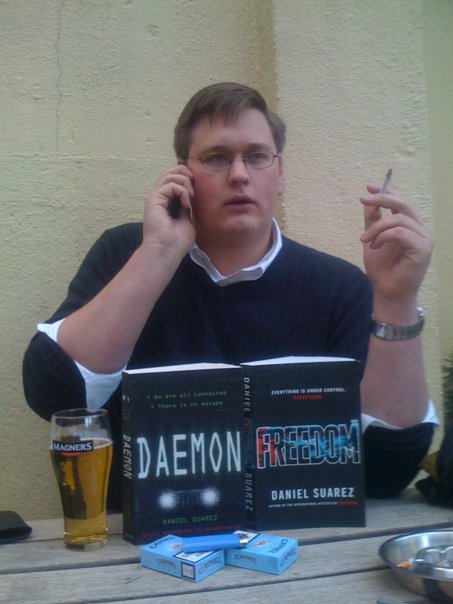
This author, with Suarez' duology at a London pub, May 2010.

After cruising through Daemon in about 2 days, Freedom™ was even quicker: I blew through it in about 24 hours (back in May). That’s no knock against it, though; rather, I just couldn’t put it down at all.

This review will be brief, even though it’s taken me almost three months to get around to finishing it. Basically, if Daemon was the end of the beginning, Freedom™ is the beginning of the end. Or at least of the next step. It lays out the climactic struggle much more succinctly, a titanic clash between people and business, corporate and individual. I found this particular passage most instructive:

You, sir, are walking on a privately owned Main Street—permission to trespass revocable at will. Read the plaque on the ground at the entrance if you don’t believe me. These people aren’t citizens of anything, Sergeant. America is just another brand purchased for its goodwill value. For that excellent fucking logo … No conspiracy necessary. It’s a process that’s been happening for thousands of years. Wealth aggregates and becomes political power. Simple as that. ‘Corporation’ is just the most recent name for it. In the Middle Ages it was the Catholic Church. They had a great logo, too. You might have seen it, and they had more branches than Starbucks. Go back before that, and it was Imperial Rome. It’s a natural process as old as humanity.

Of course, overreach leads to retreat and retrenchment, et cetera, et cetera. Even if the message seems a little obvious (and by no means subtly presented), it’s an important one, and it’s framed in an interesting new way. It’s that presentation that makes this not only legible, but well worth your time, if not just to see what the traditional cries of anticonsumerism and Adbusters-type activism look like in the digital age.

John Robb’s ‘holons‘ take some big strides here too; Suarez has done an excellent job of envisioning the resilient community concept, and doing so in a way that makes them seem not only possible, but inevitable. A blueprint for the future? Not necessarily. But at the least, a realistic portrayal of the kind of decentralized communities that we’ll hopefully be migrating to in the future. Thanks to Daniel Suarez, they’re more than just a concept.

So read Daemon and then read Freedom. Seriously, you won’t be disappointed. And even if you are, ignore the prose and focus on the message – it’s one we sorely need to listen to right now.

Buy Freedom™ at Amazon.com.

Treason Doesn’t Pay

…or so Vladimir Putin reminds us. As the ten accused Russian spies returned home, Putin said that their outing was a “betrayal,” and vowed that there would be “tough times for the traitors,” whose names the Kremlin is apparently well aware of. And he had a word of caution for those who would do the same:

Traitors always end badly. As a rule, they end up in the gutter as drunks or drug addicts.

Take note, would-be Benedict Arnolds or Vidkun Quislings! If you commit treason, you might as well be heating up black tar heroin in a spoon.

Via Bostonist.