Airwaves? What Airwaves?

Just ahead of Oscar night, word comes that Disney is pulling the ABC channel from Cablevision – affecting about 3 million subscribers in the New York-New Jersey area. ABC is, of course, scheduled to broadcast the Academy Awards tonight.

I’m in no way affected by this, be it living in New York, a Cablevision subscriber, or a religious Oscar aficionado, but this is still pretty outrageous. If you subscribe to cable, you’re now denied access to a theoretically public access channel. ABC may no longer broadcast in analog, but it still does in digital – across frequencies in the public spectrum, which have been leased from the public (and which existing analog broadcasters were able to obtain licenses for without an auction).

Of course, the former obligations that stations using public airwaves were held – such as the “fairness doctrine” – have been allowed to lapse. No one is required to do much of anything anymore, save not broadcasting ‘filth’ and ‘obscenities’. But worse is that millions of people are denied access to a station in the public spectrum over a billion-dollar dispute. I know, I know, theoretically everyone could go out and buy an over-the-air broadcast converter, but how many of those do you think are in stock in the New York metro area?

Nobody at all wins here.

Recommended Reading (2010-03-07) – SUNDAY Edition

Bank of England, Liverpool Street, showing all of the City of london with Tower Bridge at upper right.

– Medvedev is displeased with the apparent lack of progress. Russian military to double their efforts. Putin will not be as forgiving as Medvedev is.

– Newsflash: water runs downhill. Why America supports Israel.

– Greece continues to head towards imminent collapse. Some German MPs are calling for Greece to sell off a few lesser islands, the Acropolis, and the Parthenon. Meanwhile, the Greek citizenry cannot cope with a sacrifice – higher taxes or spending cuts (or both) are the only way to recovery. Do they even know what they’re protesting in favor of? (via Shloky). The U.S. is soon to face the same problem.

– An unbelievable tale about the attempt to save one soldier’s life, courtesy of Michael Yon. Complete with fancy infographic.

– Regardless of what party wins the British elections, Gordon Brown will almost certainly not be prime minister.

– The ultimate case for prison as rehabilitation.

– I like having comments here (even if they’re underutilized). Not everyone is quite so lucky, as Theodore Dalrymple explains in “Thank You for Not Expressing Yourself.”

Attack of the Caspian Sea Monster!

The ekranoplan rusting in its berth, 2010.

If you’ve never heard of the Russian ekranoplan, here’s what you need to know. A ground effect plane that flies only a few yards above water (right, it’s also a water-plane, I forgot to mention), the one-off ekranoplan was an ingenious attempt by the Russians to solve… some problem they’d come up with, presumably. It was retired in the early 90s.

Recently, some intrepid photographer found the ekranoplan in drydock, and has taken a number of pictures (along with a photoessay in Russian) so you can see the magnificent beast in all its glory.

.

Via War is Boring.

Recommended Reading (2010-03-05)

(via Shloky).

– It’s Strategic Decision Making Exercise time yet again at the Army War College. Mark Grimsley wanders the halls and reports.

– Boeing’s new KC-X will officially be a competitor for the Air Force’s tanker replacement program. Built on a 767, it can’t look like anything but a civilian plane, try as they might with the grey drab paint job.

– Has anyone else noticed an increasing disconnect between the mainstream media and the reality-based community? Even parts of the MSM itself are starting to pick up on this (but it won’t be far-reaching or fast enough a discovery to really change anything).

– I would really like to commit a crime in Norway. Though it’s equally possible that by the time I get to Halden my life turns into an O. Henry story.

– More on the decline of Germany and the rise of the uber-left.

Rethinking the U.S.

Chirol, long-time blogger at Coming Anarchy, has struck out on his own and started a new blog, Rethinking the United States.  He plans to cover a lot of ground, mostly serving to answer the question “does the United States serve its purpose?” His welcome post lists the topics to be covered as:

sustainability, autonomy, devolution, decentralization, political identity and loyalty,  political organization, self organization, superempowerment, technology, resilience in general and resilient communities.

Other related and more directly political topics and of great personal interest to the author will be Libertarianism, civil liberties, small government and firearms though they will almost always come back to the topic at hand.

Sounds like a perfect synthesis of stuff that I’m interested in. I cannot wait to see what he comes up with.

Recommended Reading (2010-03-04)

– The US Postal Service may have to make some severe service cuts, including ending Saturday delivery. As long as they don’t go on strike, I’ll be fine with it (via GOOD).

– The U.S. is facing a “surge” of rightwing extremist and milita groups to the tune of 250%. It makes one long for the Clinton years, when the fringe movements weren’t legitimized by Glenn Beck, CPAC, and the Teabaggers.

Armored trains are back on track in Russia. But based on where most IEDs are in Russia (the railroad system), are the trains really MRAP?

– Galrahn at Information Dissemination gives a brief overview of ‘AirSea Battle’. As he points out though, it may be nothing more than “a new wine in old barrels,” and in most ways it sounds like, well, Air Force-Navy cooperation. Just with a catchy name.

– Even the upstart kid-gangs in Mexico are getting ballsy. But unfortunately for them, the existing cartels probably won’t take too kindly to this.

Tsarist Russia, in Color

"A. P. Kalganov poses with his son and granddaughter for a portrait in the industrial town of Zlatoust in the Ural Mountain region of Russia. The son and granddaughter are employed at the Zlatoust Arms Plant--a major supplier of armaments to the Russian military since the early 1800s. Kalganov displays traditional Russian dress and beard styles, while the two younger generations have more Westernized, modern dress and hair styles." 1910.

Sergei Mikhailovich Prokudin-Gorskii was a photographer in Russia born in 1863 and who lived until 1944. He invented his own camera, which in and of itself is impressive, but not only that – it was a color camera. The Library of Congress has used modern computing technology to recreate Produkin-Gorskii’s colorization technique, and the collection is available to view as “The Empire That Was Russia.”

These pictures provide a record of tsarist Russia in color, and the results are stunning. Transportation, ethnic diversity, and people at work are the themes of the exhibition. Make sure to check out the Austro-Hungarian prisoners-of-war in 1915. A land time might now remember.

.

Via Eternal Remont.

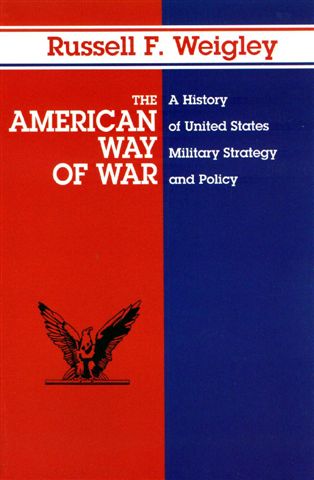
The American Way of War: A Review

After a long while of meaning to, I’ve finished Russell Weigley’s magisterial book The American Way of War. Took longer than it should have, but as a foundational text for understanding not only American strategy, but basic concepts of national strategy itself, this book is unsurpassed. It’s one of the few I can truly call “epic.”

Beginning with George Washington’s “strategy of attrition” during the Revolutionary War, Weigley traces the scope of American strategic thought up to the closing days of the Vietnam War. Structurally, American strategy falls into several phases. Washington eventually gives way to Halleck, who is then replaced by Ulysses Grant. Grant’s approach to war – “a strategy of annihilation” – then serves as the United States’ guiding principle until well into the twentieth century.

Continue reading

But They Knew Where the Keys Were

Even if they misplaced the tanks themselves. From the Telegraph:

‘There are tanks all over the forest, abandoned,’ an unnamed reporter on the video says. ‘If you need one, come and get it.’

Locals in a nearby village said the tanks had been sitting there for almost four months covered in snow. The armoured vehicles were identified as a mixture of T-80 and T-72 battle tanks, the workhorses of the Russian army.

Who has time to worry about where they left an entire armored regiment’s worth of tanks? What with the nation-state collapsing anyways and all manner of intrigue on every conceivable frontier… Or are the Russians early adopters of the “tanks do not equal power projection” school?

Transatlanticism

Daniel Korski’s new article in Foreign Policy, “Partners in Decline,” calls for a renewed US-European relationship, as a way of staving off marginalization at least for a while. It’s kind of hard to discern his point – clearly at this point, Europe needs the US far more than the US needs Europe. True, NATO is a force of legitimacy right now, but if the demographic trends Korski points to as signs of decline continue, won’t it begin to lose that legitimacy as it becomes less and less representative of any significant proportion of global population?

Korski also misinterprets history. He asks us to

Imagine if the United States had in the past chosen its allies exclusively on whether they were willing to fight alongside the 82nd Airborne. That would have meant abandoning an alliance with Britain in 1966 after then-Prime Minister Harold Wilson refused to send British troops to the Vietnam War.

Is there some sort of treaty or piece of paper we would have torn up? Aside from the (predominantly cultural) Special Relationship – which certainly was damaged for most of the 70s until the Reagan-Thatcher revival – Britain’s refusal to commit troops to Vietnam was no more than a disagreement between longtime global partners. There was no real ‘alliance’ to end as a response but even that informal alliance was seriously damaged.

I wouldn’t go so far as to advocate an American withdrawal from NATO (as Andrew Bacevich does), but at the same time it is perhaps on an even steeper path to irrelevancy than Europe and the United States themselves. Korski’s argument is in itself contradictory, as his prescription for waning influence just reemphasizes the extent of Western decline. And like all other nation-states, it is an inevitable collapse.